
[Paper Review] Few-shot Diagnosis of Chest x-rays Using an Ensemble of Random Discriminative Subspaces
This paper proposes a fast, efficient few-shot learning method for chest X-ray diagnosis using an ensemble of random discriminative subspaces, which outperforms existing approaches in accuracy and is nearly 1.8× faster than t-SVD-based methods. The approach uses a novel loss function to create well-separated, discriminative subspaces, improving classification on small annotated datasets.
Due to the scarcity of annotated data in the medical domain, few-shot learning may be useful for medical image analysis tasks. We design a few-shot learning method using an ensemble of random subspaces for the diagnosis of chest x-rays (CXRs). Our design is computationally efficient and almost 1.8 times faster than method that uses the popular truncated singular value decomposition (t-SVD) for subspace decomposition. The proposed method is trained by minimizing a novel loss function that helps create well-separated clusters of training data in discriminative subspaces. As a result, minimizing the loss maximizes the distance between the subspaces, making them discriminative and assisting in better classification. Experiments on large-scale publicly available CXR datasets yield promising results. Code for the project will be available at https://github.com/Few-shot-Learning-on-chest-x-ray/fsl_subspace.
Motivation & Objective
- Address the challenge of limited annotated medical imaging data in few-shot learning for chest X-ray diagnosis.
- Develop a computationally efficient alternative to existing subspace decomposition methods like t-SVD.
- Improve classification accuracy by generating discriminative, low-correlation subspaces through a novel loss function.
- Enable effective few-shot learning using only a few labeled examples per class in medical imaging.
Proposed method
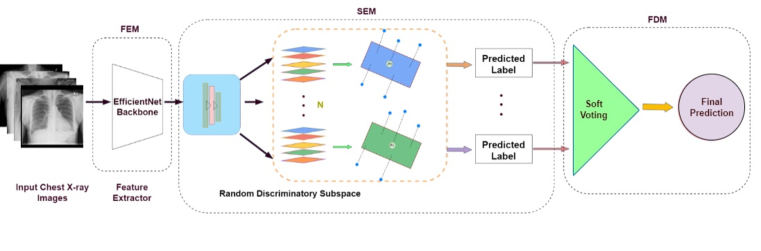
- Uses a three-module pipeline: Feature Extraction Module (FEM) with fine-tuned EfficientNet-B7 for feature extraction.
- Employs a Subspace Embedding Module (SEM) that projects features into multiple random, discriminative subspaces using learnable fully connected layers.
- Applies a novel discriminative loss to minimize similarity between subspaces and maximize inter-subspace separation.
- Calculates class probabilities via L2 distance to mean embeddings in each subspace, followed by softmax for classification.
- Uses a Final Decision Module (FDM) to aggregate predictions across subspaces for final label assignment.
- Optimizes the model end-to-end by minimizing a composite loss that enhances discriminative power of subspaces.
Experimental results
Research questions
- RQ1Can an ensemble of random subspaces achieve competitive few-shot classification performance on chest X-ray diagnosis with minimal labeled data?
- RQ2How does the proposed method compare in accuracy and speed to t-SVD-based subspace decomposition techniques?
- RQ3Does the novel discriminative loss function effectively enhance inter-subspace separation and improve classification performance?
- RQ4What is the optimal number of subspaces for achieving best performance in few-shot CXR diagnosis?
Key findings
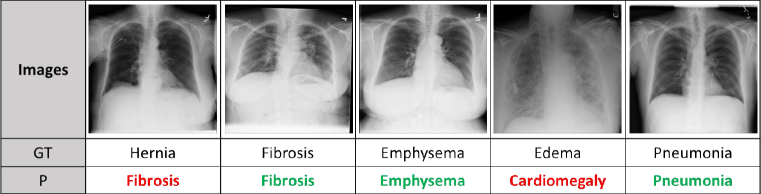
- The proposed method achieves state-of-the-art or competitive accuracy across multiple test classes on the NIH CXR dataset in 3-way 5-shot classification.
- With 30 subspaces, the method achieves the highest mean accuracy of 42.82% on Group1 (Fibrosis, Hernia, Pneumonia), outperforming ProtoNet and MatchingNet.
- The method is approximately 1.8× faster per epoch than DSN, which uses t-SVD, with a training time of 18 min 35 sec vs. 33 min 48 sec on a GTX 1080 Ti.
- On Group3 (Edema, Emphysema, Consolidation), the method achieves 65.16% accuracy, significantly outperforming DSN (68.00% for Edema but lower on others).
- The ablation study confirms that 30 subspaces yield optimal performance, indicating a strong impact of subspace count on model efficacy.
- The novel loss function effectively reduces subspace similarity, leading to better inter-class separation and improved classification robustness.
Read this paper
Open the full text in the Nubint reader and ask about any passage as you read.
Read this paper on NubintThis review was generated by AI from the original paper. Please check the paper before citing it.