
[Paper Review] Few-Shot Object Detection via Variational Feature Aggregation
This paper proposes a meta-learning framework for few-shot object detection using Class-Agnostic Aggregation (CAA) and Variational Feature Aggregation (VFA) to reduce bias toward base classes and improve robustness to few-shot example variance. By modeling class distributions via variational autoencoders trained on base data and decoupling classification from regression, VFA enables more accurate and stable feature aggregation, achieving state-of-the-art performance with up to 16% relative improvement over strong baselines on PASCAL VOC and COCO.
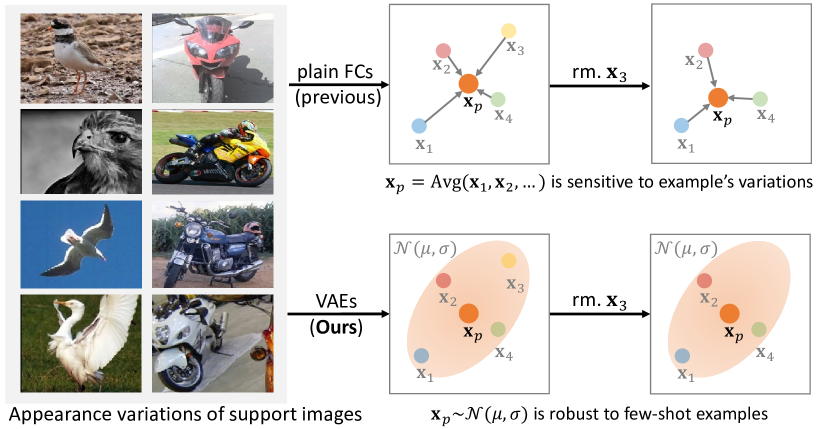
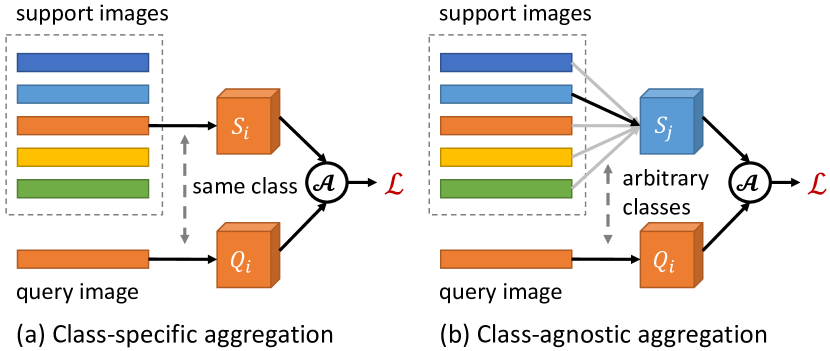
As few-shot object detectors are often trained with abundant base samples and fine-tuned on few-shot novel examples,the learned models are usually biased to base classes and sensitive to the variance of novel examples. To address this issue, we propose a meta-learning framework with two novel feature aggregation schemes. More precisely, we first present a Class-Agnostic Aggregation (CAA) method, where the query and support features can be aggregated regardless of their categories. The interactions between different classes encourage class-agnostic representations and reduce confusion between base and novel classes. Based on the CAA, we then propose a Variational Feature Aggregation (VFA) method, which encodes support examples into class-level support features for robust feature aggregation. We use a variational autoencoder to estimate class distributions and sample variational features from distributions that are more robust to the variance of support examples. Besides, we decouple classification and regression tasks so that VFA is performed on the classification branch without affecting object localization. Extensive experiments on PASCAL VOC and COCO demonstrate that our method significantly outperforms a strong baseline (up to 16\%) and previous state-of-the-art methods (4\% in average). Code will be available at: \url{https://github.com/csuhan/VFA}
Motivation & Objective
- Address the bias of few-shot object detectors toward base classes due to class imbalance in training data.
- Reduce confusion between novel and base classes by encouraging class-agnostic representations through cross-class feature interactions.
- Improve robustness to intra-class variance in few-shot examples by modeling class distributions using variational autoencoders.
- Decouple classification and regression to allow feature aggregation to focus on translation-invariant representations without affecting localization.
- Achieve state-of-the-art performance on few-shot object detection benchmarks despite limited support examples.
Proposed method
- Propose Class-Agnostic Aggregation (CAA), which enables feature interaction between query and support features regardless of class identity, reducing class bias and improving generalization.
- Introduce Variational Feature Aggregation (VFA), which uses a shared variational autoencoder (VAE) pre-trained on base classes to model class-level distributions from few-shot support examples.
- Encode support features into latent distributions (mean μ and variance σ) using a VAE, then sample robust prototypes z = μ + ε·σ for aggregation with query features.
- Apply a consistency loss ℒcons to preserve class-specific information during VAE fine-tuning on novel classes, ensuring meaningful distribution estimation.
- Decouple the classification and regression heads so that VFA operates only on the classification branch, maintaining localization accuracy.
- Use a meta-learning training paradigm where the model is first pre-trained on base classes and fine-tuned on few-shot novel classes with K-shot support sets.
Experimental results
Research questions
- RQ1Can cross-class feature interactions reduce bias toward base classes in few-shot object detection?
- RQ2Can modeling class distributions via variational autoencoders improve robustness to intra-class variance in few-shot examples?
- RQ3Does decoupling classification and regression allow for more effective feature aggregation without degrading localization performance?
- RQ4Can distributions learned from abundant base classes be effectively transferred to generalize to novel classes with only K shots?
- RQ5How does the choice of feature representation (e.g., original, reconstructed, latent) impact the robustness and accuracy of class prototypes?
Key findings
- The proposed VFA method improves the strong Meta R-CNN++ baseline by up to 16% in average precision on 1-shot detection, demonstrating significant gains in low-shot regimes.
- On PASCAL VOC, VFA achieves 57.7% nAP in 1-shot detection when ℒcons is applied to reconstructed features S′, outperforming the 51.3% baseline without VFA.
- The method reduces confusion between novel and base classes: for example, the similarity between novel 'cow' and base classes like 'horse' and 'sheep' drops significantly under CAA and VFA.
- Class prototypes estimated via VFA are more robust to shot reduction; their distance to real class centers increases less as the number of support examples decreases.
- The latent representation μ and σ from the VAE outperform original features S and reconstructed features S′ in terms of prototype accuracy and robustness.
- The consistency loss ℒcons is critical: applying it to reconstructed features S′ yields the best performance (57.7% nAP in 1-shot), showing its role in preserving class-specific information during distribution learning.
Read this paper
Open the full text in the Nubint reader and ask about any passage as you read.
Read this paper on NubintThis review was generated by AI from the original paper. Please check the paper before citing it.