
[Paper Review] Few-shot Semantic Segmentation with Support-induced Graph Convolutional Network
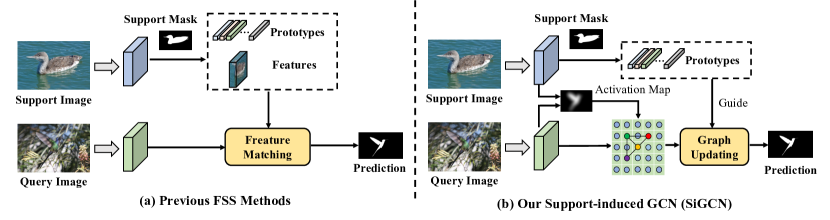
This paper proposes a Support-induced Graph Convolutional Network (SiGCN) for few-shot semantic segmentation that enhances query feature representation by explicitly mining contextual structures from query images using support-guided graph reasoning. By integrating a Support-induced Graph Reasoning (SiGR) module and an Instance Association (IA) module, SiGCN achieves state-of-the-art performance on PASCAL-5i and COCO-20i benchmarks, especially under high appearance variation.
Few-shot semantic segmentation (FSS) aims to achieve novel objects segmentation with only a few annotated samples and has made great progress recently. Most of the existing FSS models focus on the feature matching between support and query to tackle FSS. However, the appearance variations between objects from the same category could be extremely large, leading to unreliable feature matching and query mask prediction. To this end, we propose a Support-induced Graph Convolutional Network (SiGCN) to explicitly excavate latent context structure in query images. Specifically, we propose a Support-induced Graph Reasoning (SiGR) module to capture salient query object parts at different semantic levels with a Support-induced GCN. Furthermore, an instance association (IA) module is designed to capture high-order instance context from both support and query instances. By integrating the proposed two modules, SiGCN can learn rich query context representation, and thus being more robust to appearance variations. Extensive experiments on PASCAL-5i and COCO-20i demonstrate that our SiGCN achieves state-of-the-art performance.
Motivation & Objective
- Address the challenge of large appearance variations between support and query images in few-shot semantic segmentation (FSS), which undermines traditional feature matching-based methods.
- Improve robustness of query mask prediction by explicitly modeling contextual relationships among salient parts of the query object.
- Introduce a novel mechanism to guide graph-based context learning in the query image using support prototypes, rather than relying solely on feature matching.
- Capture high-order instance-level context from both support and query instances to improve segmentation generalization to novel categories.
- Achieve state-of-the-art performance under 1-shot and 5-shot settings despite significant appearance variance between support and query samples.
Proposed method
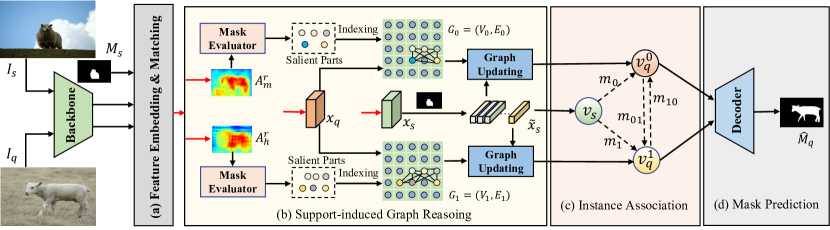
- Propose a Support-induced Graph Reasoning (SiGR) module that constructs a query graph based on activation maps from support-query feature matching, focusing on discriminative object parts.
- Introduce support prototypes as guidance to iteratively update the query graph, enabling more accurate and contextually informed feature aggregation.
- Design an Instance Association (IA) module that captures high-order contextual features by modeling relationships across support and query instances.
- Utilize graph convolutional networks (GCNs) to propagate and refine features across nodes in the query graph, with support prototypes influencing the message-passing process.
- Apply a mask thresholding mechanism (t=0.7) to select high-confidence, discriminative parts for graph construction, improving localization accuracy.
- Integrate SiGR and IA modules into a unified SiGCN framework that jointly optimizes query context representation and support-guided reasoning.
Experimental results
Research questions
- RQ1Can explicit modeling of query object context improve segmentation robustness under large appearance variations in few-shot semantic segmentation?
- RQ2How does support-guided graph reasoning enhance feature representation compared to conventional feature matching in FSS?
- RQ3What is the impact of integrating high-order instance context from both support and query images on segmentation performance?
- RQ4How do hyperparameters such as the number of support prototypes (k), instance size (s), and mask threshold (t) affect model performance?
- RQ5Does the proposed SiGCN framework generalize effectively across diverse benchmarks like PASCAL-5i and COCO-20i under 1-shot and 5-shot settings?
Key findings
- SiGCN achieves state-of-the-art performance on PASCAL-5i with a 1-shot mIoU of 65.3 and a 5-shot mIoU of 77.5, outperforming prior methods.
- The SiGR module contributes most significantly to performance gain, with ablation studies showing that its inclusion leads to substantial mIoU improvements over baseline models.
- The IA module is indispensable, as removing it degrades performance, indicating its role in capturing complementary high-order context.
- Using 5 support prototypes (k=5) yields the best performance, suggesting optimal balance between prototype diversity and guidance quality.
- The model achieves superior results with ResNet-101 as backbone (65.7 mIoU on 1-shot), outperforming VGG16 and ResNet-50.
- Ablation shows that t=0.7 provides the optimal mask threshold for selecting discriminative parts, and s=10 yields the best instance size for context modeling.
Read this paper
Open the full text in the Nubint reader and ask about any passage as you read.
Read this paper on NubintThis review was generated by AI from the original paper. Please check the paper before citing it.