
[Paper Review] FinRL-Podracer: High Performance and Scalable Deep Reinforcement Learning for Quantitative Finance
FinRL-Podracer is a high-performance, scalable deep reinforcement learning (DRL) framework for quantitative finance that accelerates DRL-driven trading strategy development via RLOps (continuous training, integration, and delivery) on GPU clouds. It employs a generational evolution mechanism with ensemble learning and multi-level GPU mapping to achieve 3×–7× faster training and 12%–35% higher annual returns than RLlib, Stable Baseline 3, and FinRL on NASDAQ-100 minute-level data.
Machine learning techniques are playing more and more important roles in finance market investment. However, finance quantitative modeling with conventional supervised learning approaches has a number of limitations. The development of deep reinforcement learning techniques is partially addressing these issues. Unfortunately, the steep learning curve and the difficulty in quick modeling and agile development are impeding finance researchers from using deep reinforcement learning in quantitative trading. In this paper, we propose an RLOps in finance paradigm and present a FinRL-Podracer framework to accelerate the development pipeline of deep reinforcement learning (DRL)-driven trading strategy and to improve both trading performance and training efficiency. FinRL-Podracer is a cloud solution that features high performance and high scalability and promises continuous training, continuous integration, and continuous delivery of DRL-driven trading strategies, facilitating a rapid transformation from algorithmic innovations into a profitable trading strategy. First, we propose a generational evolution mechanism with an ensemble strategy to improve the trading performance of a DRL agent, and schedule the training of a DRL algorithm onto a GPU cloud via multi-level mapping. Then, we carry out the training of DRL components with high-performance optimizations on GPUs. Finally, we evaluate the FinRL-Podracer framework for a stock trend prediction task on an NVIDIA DGX SuperPOD cloud. FinRL-Podracer outperforms three popular DRL libraries Ray RLlib, Stable Baseline 3 and FinRL, i.e., 12% \sim 35% improvements in annual return, 0.1 \sim 0.6 improvements in Sharpe ratio and 3 times \sim 7 times speed-up in training time. We show the high scalability by training a trading agent in 10 minutes with $80$ A100 GPUs, on NASDAQ-100 constituent stocks with minute-level data over 10 years.
Motivation & Objective
- To address the steep learning curve and low training efficiency hindering DRL adoption in quantitative finance.
- To enable continuous training, integration, and delivery (RLOps) for DRL-driven trading strategies in a scalable cloud environment.
- To improve trading performance and training speed using generational evolution and GPU-optimized distributed training.
- To demonstrate high scalability and performance on large-scale financial data using a GPU cloud infrastructure.
Proposed method
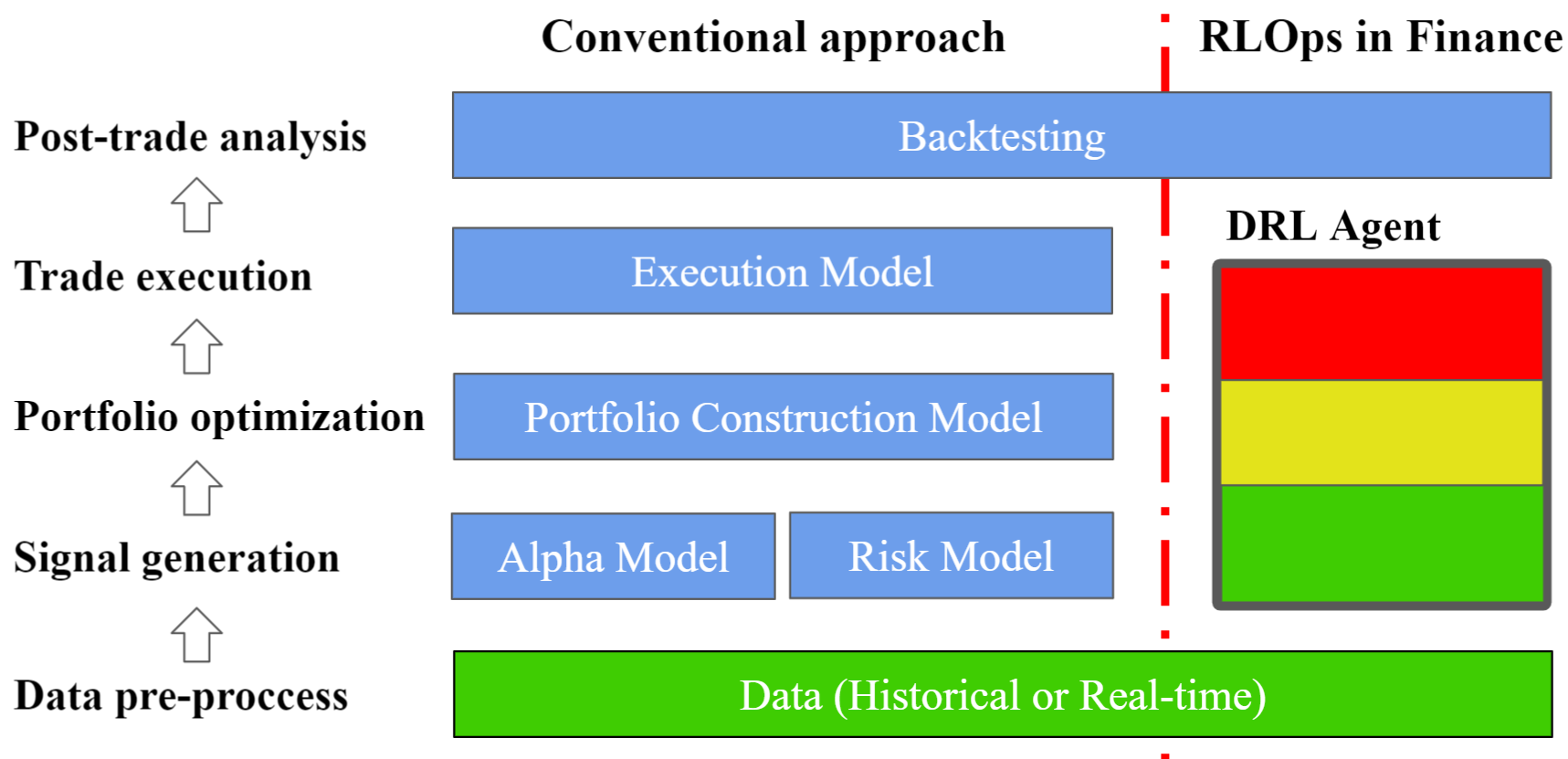
- Proposes an RLOps-in-finance paradigm integrating modeling, signal generation, portfolio optimization, and execution into a single DRL agent.
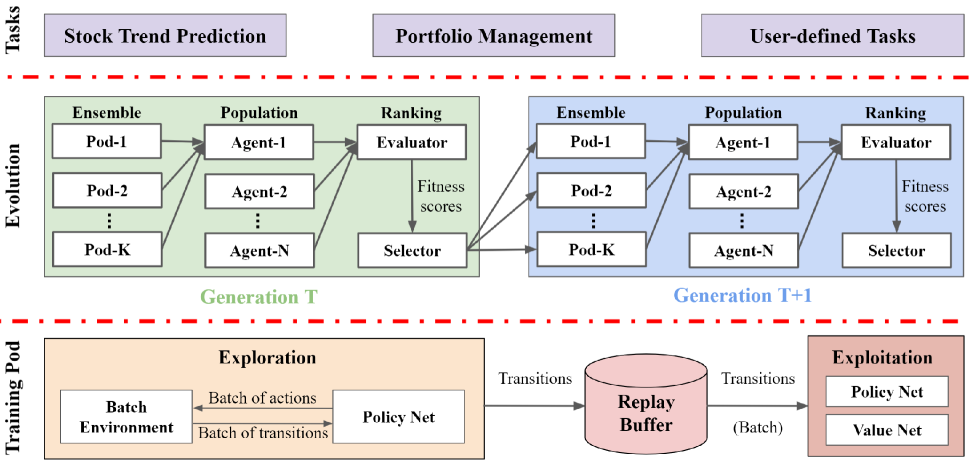
- Employs a generational evolution mechanism with ensemble strategy to iteratively improve agent performance by selecting top-performing models across generations.
- Uses multi-level GPU mapping to schedule DRL training across a GPU cloud, enabling efficient parallelization and hardware-aware optimization.
- Applies low-level GPU optimizations including parallelism encapsulation, GPU acceleration, and storage optimization for high-performance training.
- Implements a tournament-based ensemble training method with asynchronous parallelism to reduce communication overhead and enhance scalability.
- Deploys the framework on an NVIDIA DGX SuperPOD cloud for large-scale training on 10 years of NASDAQ-100 minute-level data.
Experimental results
Research questions
- RQ1Can a scalable, high-performance DRL framework significantly reduce training time while improving trading performance in quantitative finance?
- RQ2How does a generational evolution mechanism with ensemble learning enhance DRL agent performance compared to single-agent training?
- RQ3To what extent can GPU cloud infrastructure accelerate DRL training for high-frequency financial data?
- RQ4How does FinRL-Podracer compare in performance and efficiency to established DRL libraries like RLlib, Stable Baseline 3, and FinRL?
- RQ5Can massively parallel simulation and distributed training unlock new levels of exploration and market dynamics understanding in DRL-based trading?
Key findings
- FinRL-Podracer achieved 12%–35% higher annual returns compared to RLlib, Stable Baseline 3, and FinRL on NASDAQ-100 minute-level data.
- The framework improved the Sharpe ratio by 0.1–0.6 units over baseline DRL libraries.
- Training time was reduced by 3× to 7× compared to RLlib, with FinRL-Podracer reaching a cumulative return of 4.0 in 800 seconds using 80 A100 GPUs.
- With 80 A100 GPUs, FinRL-Podracer trained a trading agent in just 10 minutes on 10 years of NASDAQ-100 minute-level data, demonstrating high scalability.
- The generational evolution mechanism significantly outperformed individual training runs, with the evolution curve (thick green line) substantially exceeding the performance of 10 independent agents in the first generation.
- The framework showed strong scalability, with performance improving consistently as GPU count increased, unlike RLlib, which showed minimal speed-up with more GPUs.
Read this paper
Open the full text in the Nubint reader and ask about any passage as you read.
Read this paper on NubintThis review was generated by AI from the original paper. Please check the paper before citing it.