
[Paper Review] Fitting the light curves of Sagittarius A* with a hot-spot model
This study fits polarized millimeter light curves of Sagittarius A* using a semi-analytical hot-spot model within a Bayesian framework, incorporating synchrotron emission from a magnetized plasma blob orbiting the black hole. The best-fitting models reveal a preferred orbital period of ~90 minutes, an inclination of 150–160°, a radius of 10.7–13.0 gravitational radii, and non-Keplerian motion at 0.8–0.9 times the Keplerian speed, with low spin (a* < 0.6).
Sagittarius A* exhibits frequent flaring activity across the electromagnetic spectrum. Signatures of an orbiting hot spot have been identified in the polarized millimeter wavelength light curves observed with ALMA in 2017 immediately after an X-ray flare. The nature of these hot spots remains uncertain. We expanded existing theoretical hot-spot models created to describe the Sgr A* polarized emission at millimeter wavelengths. We sampled the posterior space, identifying best-fitting parameters and characterizing uncertainties. Using the numerical radiative transfer code ipole, we defined a semi-analytical model describing a ball of plasma orbiting Sgr A*, threaded with a magnetic field and emitting synchrotron radiation. We then explored the posterior space in the Bayesian framework of dynesty. We fit the static background emission separately, using a radiatively inefficient accretion flow model. We considered eight models with a varying level of complexity, distinguished by choices regarding dynamically important cooling, non-Keplerian motion, and magnetic field polarity. All models converge to realizations that fit the data, but one model without cooling, non-Keplerian motion, and magnetic field pointing toward us improved the fit significantly and also matched the observed circular polarization. Our models represent observational data well and allow testing various effects in a systematic manner. From our analysis, we have inferred an inclination of $155-160$ deg, which corroborates previous estimates, a preferred period of 90 minutes, and an orbital radius of $9-12$ gravitational radii. Our non-Keplerian models indicate a preference for an orbital velocity of $0.6-0.9$ times the Keplerian value. Last, all our models agree on a high dimensionless spin value ($a_{*}>0.8$), but the impact of spin on the corresponding light curves is subdominant with respect to other parameters.
Motivation & Objective
- To model the polarized millimeter emission of Sgr A* using a semi-analytical hot-spot model that includes synchrotron radiation from a magnetized plasma blob.
- To constrain the physical parameters of the hot spot—such as size, magnetic field strength, and orbital velocity—through Bayesian inference.
- To test the impact of dynamical effects like non-Keplerian motion and synchrotron cooling on the fit quality and consistency with observations.
- To separate the hot-spot signal from the underlying accretion flow background using a radiatively inefficient accretion flow (RIAF) model.
- To assess the role of black hole spin and magnetic field topology in shaping the observed light curves and polarization signatures.
Proposed method
- Uses the numerical radiative transfer code ipole to simulate synchrotron emission from a localized plasma blob orbiting Sgr A* with a magnetic field.
- Applies a Bayesian inference framework with dynesty to explore the posterior distribution of model parameters, including spot location, magnetic field, and orbital motion.
- Fits the background emission separately using a RIAF model to isolate the hot-spot contribution to the observed Stokes parameters (I, Q, U, V).
- Considers eight model variants differing in assumptions about cooling, non-Keplerian motion, and magnetic field polarity to assess model robustness.
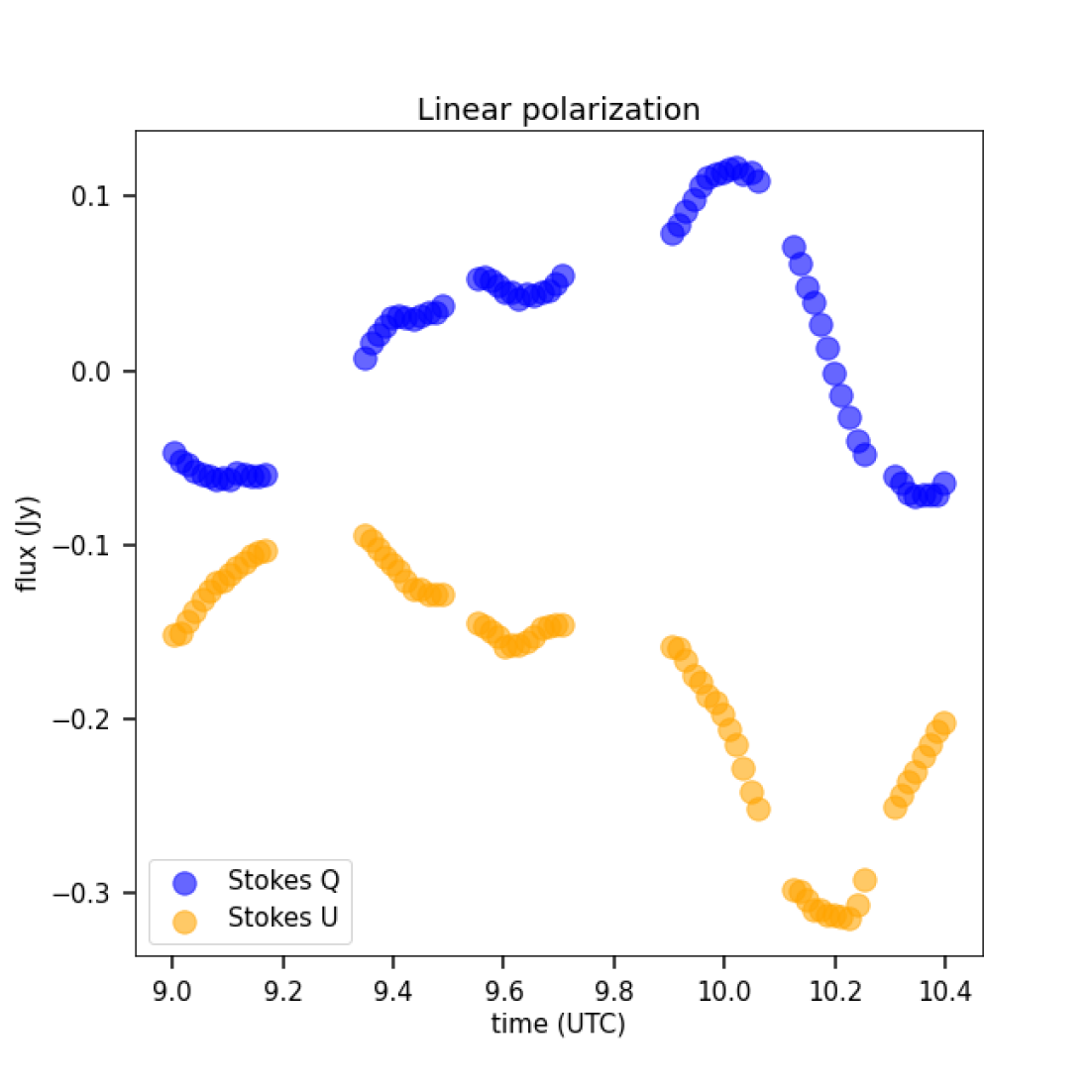
- Compares model predictions to ALMA 2017 observations of Sgr A* in the 1.3 mm band, focusing on Q–U loops and circular polarization.
- Validates model consistency by checking whether the background model reproduces the shadow-like Stokes parameters inferred from the spot-fitting process.
Experimental results
Research questions
- RQ1What are the best-fitting orbital and magnetic parameters for a hot spot producing the observed Q–U loops in Sgr A*?
- RQ2How does including synchrotron cooling or non-Keplerian orbital motion improve the fit to the ALMA light curves compared to standard models?
- RQ3What constraints do the observations place on the black hole’s spin and inclination?
- RQ4How do different magnetic field configurations (e.g., inward vs. outward pointing) affect the polarization signature and model likelihood?
- RQ5To what extent does the background RIAF emission influence the inferred hot-spot parameters, and can a combined disk-spot model better reproduce all Stokes parameters?
Key findings
- The best-fitting models converge to an orbital period of approximately 90 minutes, consistent with the observed Q–U loop timescale.
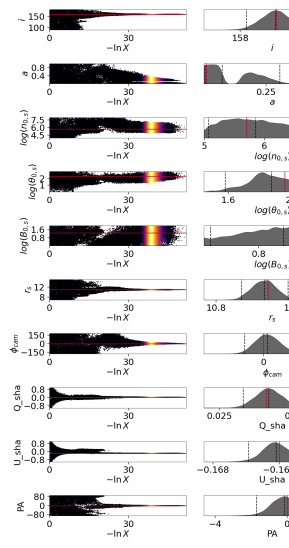
- The inclination is constrained to 150–160 degrees, in agreement with previous estimates from EHT and other studies.
- The orbital radius of the hot spot is estimated at 10.7–13.0 gravitational radii, placing it near the innermost stable circular orbit.
- Models with non-Keplerian motion (velocity 0.8–0.9 times Keplerian) significantly improve the fit and match the expected synchrotron cooling timescale.
- The inclusion of synchrotron cooling also improves the fit and reproduces the observed circular polarization, particularly when the magnetic field points toward the observer.
- The black hole spin is constrained to a low value (a* < 0.6), though its influence on light curves is subdominant compared to other parameters like inclination and orbital radius.
Read this paper
Open the full text in the Nubint reader and ask about any passage as you read.
Read this paper on NubintThis review was generated by AI from the original paper. Please check the paper before citing it.