
[Paper Review] Flares from stars crossing active galactic nuclei disks on low-inclination orbits
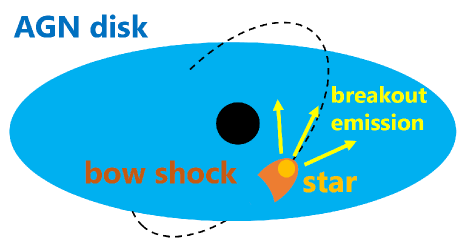
This paper proposes that X-ray quasi-periodic eruptions (QPEs) are caused by massive stars on retrograde, low-inclination orbits crossing active galactic nucleus (AGN) disks, generating luminous bow shock emission upon breakout. The model explains QPE durations (~hour), luminosities (~10⁴² erg s⁻¹), complex light curves, and low SMBH masses via shock breakout from dense, extended bow shocks formed under specific orbital and stellar conditions.
The origin of the recently discovered new class of transients, X-ray quasi-periodic eruptions (QPEs), remains a puzzle. Due to their periodicity and association with active galactic nuclei (AGN), it is natural to relate these eruptions to stars or compact objects in tight orbits around supermassive black holes (SMBHs). In this paper, we predict the properties of emission from bow shocks produced by stars crossing AGN disks, and compare them to the observed properties of QPEs. We find that when a star's orbit is retrograde and has a low inclination ($\lesssim 40^\circ$) with respect to the AGN disk and the star is massive ($\gtrsim 10$ $M_{\odot}$), the breakout emission from the bow shock can explain the observed duration ($\sim$ hours) and X-ray luminosity ($\sim$few$ imes10^{42}~{ m erg~s^{-1}}$) of QPEs. This model can further explain various observed features of QPEs, such as their complex luminosity evolution, the gradual decline of luminosity of the flares over several years, the evolution of the hardness ratio, the modulation of the luminosity during quiescent phases, and the preference of the central SMBHs to have low masses.
Motivation & Objective
- To explain the origin of X-ray quasi-periodic eruptions (QPEs), a newly discovered class of transients with periodic, luminous flares.
- To address why QPEs are preferentially associated with low-mass supermassive black holes (SMBHs) and exhibit complex light curves.
- To investigate whether emission from bow shocks formed during stellar encounters with AGN disks can reproduce observed QPE properties.
- To determine the orbital and stellar parameters required for such shocks to produce the observed X-ray luminosity and timescales.
- To compare the breakout emission model with alternative models involving disk instabilities or cooling envelopes.
Proposed method
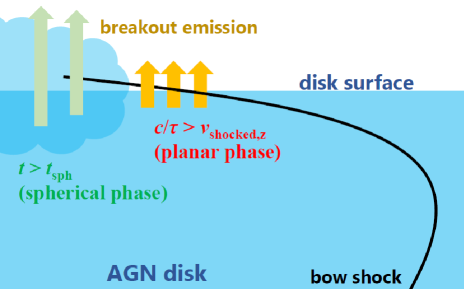
- Model the formation and evolution of bow shocks when a star crosses an AGN disk, focusing on the breakout phase where the shock emerges from the disk surface.
- Use hydrodynamic simulations to calculate the shock structure, density, temperature, and emission properties of the shocked gas.
- Compute X-ray luminosity using radiative transfer and cooling prescriptions, including both optically thick and thin limits.
- Incorporate the effects of stellar mass, orbital inclination, and retrograde motion to determine conditions for high luminosity and short duration.
- Compare synthetic light curves and spectral evolution with observed QPEs, including eRO-QPE1’s multiple peaks and gradual decline.
- Assess the role of photon diffusion timescales and thermalization efficiency (η) in determining observable luminosity.
Experimental results
Research questions
- RQ1Can bow shock emission from stars crossing AGN disks reproduce the observed X-ray luminosity and duration of QPEs?
- RQ2What orbital and stellar parameters (mass, inclination, sense of motion) are required for the shock emission to match QPE properties?
- RQ3How does the evolution of the X-ray hardness ratio and quiescent-phase modulation arise in this model?
- RQ4Why are QPEs preferentially observed in low-mass SMBH systems?
- RQ5Can the complex, multi-peak light curve of eRO-QPE1 be explained by a combination of shock breakout and subsequent cooling emission?
Key findings
- The breakout emission from bow shocks can produce X-ray flares with luminosity ∼10⁴² erg s⁻¹ and duration ∼1 hour, matching the observed QPE properties.
- Massive stars (≳10 M☉) on retrograde, low-inclination orbits (≲40°) with respect to the AGN disk produce the longest, most luminous shocks, enabling high emission.
- The model naturally explains the gradual decline in flare luminosity over several years due to decreasing shock surface area and cooling.
- The evolution of the X-ray hardness ratio and quiescent-phase modulations arise from changing shock geometry and optical depth during breakout and expansion.
- The model accounts for the preference of QPEs in low-mass SMBHs (10⁵–10⁶ M☉) due to the required disk scaleheight and shock dynamics.
- Shock breakout emission dominates the initial flare peak, while cooling emission from the expanding envelope contributes to later, broader features, explaining multi-peak light curves like in eRO-QPE1.
Read this paper
Open the full text in the Nubint reader and ask about any passage as you read.
Read this paper on NubintThis review was generated by AI from the original paper. Please check the paper before citing it.