
[Paper Review] Formation of primordial black hole binaries and their merger rates
This paper develops a comprehensive theoretical framework for primordial black hole (PBH) binary formation and merger rates, focusing on early-Universe two- and three-body processes. It shows that for $ f_{\text{PBH}} \lesssim 0.1 $, early two-body binaries dominate merger rates, but their suppression by dynamical encounters becomes significant at higher $ f_{\text{PBH}} $, where the three-body channel may dominate due to enhanced clustering and harder binaries.
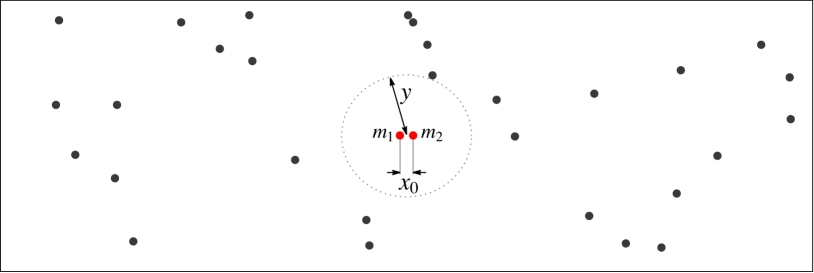
We review the theory behind the formation of primordial black hole binaries and their merger rates. We consider the binary formation in the early and late Universe, emphasising the former as it gives the dominant contribution of the present primordial black hole merger rate. The binaries formed in the early Universe are highly eccentric so their interactions with other primordial black holes can significantly increase their coalescence times and thereby suppress the merger rate. We discuss in detail how the suppression of the merger rate arising from such interactions can be estimated and how such interactions lead to the formation of another, much harder, binary population that contributes to the present merger rate if more than 10% of dark matter consists of primordial black holes with a relatively narrow mass distribution. When the primordial abundance is below 1%, encounters between primordial black holes are unlikely and their effect on the merger rate becomes negligible.
Motivation & Objective
- To understand the formation mechanisms of primordial black hole (PBH) binaries in the early Universe and their contribution to current merger rates.
- To quantify how dynamical encounters with other PBHs suppress merger rates of early two-body binaries, especially at high PBH fractions.
- To assess the relative importance of early versus late-time binary formation channels under varying PBH mass functions and clustering conditions.
- To derive analytical expressions for merger rate densities across different formation channels, including corrections for three-body dynamics and mass function extensions.
- To evaluate the impact of initial PBH clustering on binary formation and disruption, particularly for the early three-body channel.
Proposed method
- Uses geometric units ($ c = G = 1 $) and defines a PBH mass function $ \psi(m) $ normalized to unity over $ \ln m $, enabling statistical treatment of PBH populations.
- Derives merger rate densities $ \mathrm{d}R/\mathrm{d}\ln m_1\mathrm{d}\ln m_2 $ for four channels: early two-body, early three-body, late two-body, and late three-body.
- Applies analytical models for gravitational wave energy loss and three-body dynamics, incorporating parameters like $ \mathcal{K} \approx 4.0 $ and $ \gamma $, which govern angular momentum distribution and hardening.
- Incorporates effects of PBH clustering via rescaling of $ f_{\text{PBH}} $, modeling local density enhancements as $ \delta $, and evaluates their impact on disruption and formation rates.
- Uses numerical simulations to inform key constants (e.g., $ \mathcal{K} \approx 4.0 $) and validates scaling behaviors across different $ f_{\text{PBH}} $, $ \gamma $, and velocity dispersion regimes.
- Derives explicit rate formulas (e.g., Eqs. 97–100), including dependencies on $ f_{\text{PBH}} $, $ \langle m \rangle $, $ \eta $, $ \sigma_v $, and $ \delta_{\text{eff}} $, to quantify channel dominance.
Experimental results
Research questions
- RQ1How do early-Universe two-body and three-body processes contribute to the present-day merger rate of primordial black hole binaries?
- RQ2What is the impact of dynamical encounters with other PBHs on the merger rate of early two-body binaries, especially at high PBH fractions?
- RQ3Under what conditions does the early three-body channel dominate over the two-body channel, and how does this depend on $ f_{\text{PBH}} $ and initial clustering?
- RQ4How do late-time binary formation channels (two- and three-body) compare in contribution to the total merger rate, and what environmental factors enhance them?
- RQ5How does initial PBH clustering affect the relative suppression or enhancement of different binary formation channels?
Key findings
- For $ f_{\text{PBH}} \lesssim 0.1 $, the early two-body channel dominates the PBH merger rate, with a merger rate density of $ \sim 7.9 \times 10^4 \, \text{Gpc}^{-3}\text{yr}^{-1} $ for monochromatic $ m = 30\,M_\odot $, assuming $ \gamma = 1 $ and $ \mathcal{K} = 4.0 $.
- The early three-body channel becomes dominant at $ f_{\text{PBH}} \gtrsim 0.1 $, with a merger rate scaling as $ f_{\text{PBH}}^{144\gamma/259 + 47/37} $, which exceeds the two-body rate due to stronger $ f_{\text{PBH}} $ dependence.
- The merger rate from the early three-body channel is significantly less susceptible to disruption by encounters due to its lower eccentricity and higher binding energy, making it more robust than the two-body channel.
- Late-time channels (two- and three-body) are subdominant, with merger rates of $ \sim 3.4 \times 10^{-6} \, \text{Gpc}^{-3}\text{yr}^{-1} $ and $ \sim 1.3 \times 10^{-16} \, \text{Gpc}^{-3}\text{yr}^{-1} $, respectively, even under optimistic assumptions of high $ \delta_{\text{eff}} $ and low $ \sigma_v $.
- Initial clustering enhances the early three-body channel more than the two-body channel due to its higher $ f_{\text{PBH}} $ power, but also increases disruption of two-body binaries, leading to a net suppression of $ R_{E2} $.
Read this paper
Open the full text in the Nubint reader and ask about any passage as you read.
Read this paper on NubintThis review was generated by AI from the original paper. Please check the paper before citing it.