
[Paper Review] Foundational Models Defining a New Era in Vision: A Survey and Outlook
A comprehensive survey of vision-language foundational models, detailing architectures, training objectives, data, fine-tuning, prompting, and challenges, with an outlook on future directions.
Vision systems to see and reason about the compositional nature of visual scenes are fundamental to understanding our world. The complex relations between objects and their locations, ambiguities, and variations in the real-world environment can be better described in human language, naturally governed by grammatical rules and other modalities such as audio and depth. The models learned to bridge the gap between such modalities coupled with large-scale training data facilitate contextual reasoning, generalization, and prompt capabilities at test time. These models are referred to as foundational models. The output of such models can be modified through human-provided prompts without retraining, e.g., segmenting a particular object by providing a bounding box, having interactive dialogues by asking questions about an image or video scene or manipulating the robot's behavior through language instructions. In this survey, we provide a comprehensive review of such emerging foundational models, including typical architecture designs to combine different modalities (vision, text, audio, etc), training objectives (contrastive, generative), pre-training datasets, fine-tuning mechanisms, and the common prompting patterns; textual, visual, and heterogeneous. We discuss the open challenges and research directions for foundational models in computer vision, including difficulties in their evaluations and benchmarking, gaps in their real-world understanding, limitations of their contextual understanding, biases, vulnerability to adversarial attacks, and interpretability issues. We review recent developments in this field, covering a wide range of applications of foundation models systematically and comprehensively. A comprehensive list of foundational models studied in this work is available at \url{https://github.com/awaisrauf/Awesome-CV-Foundational-Models}.
Motivation & Objective
- Define foundational models in vision and their significance for multimodal understanding.
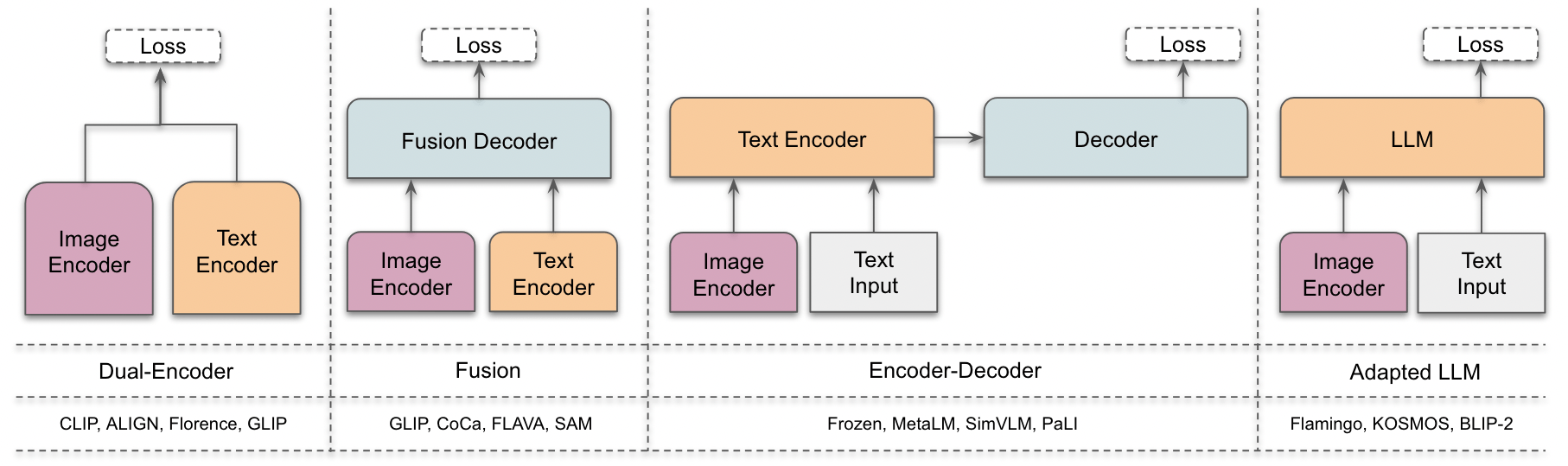
- Survey architecture families (dual-encoder, fusion, encoder-decoder, adapted-LLM) and training objectives (contrastive, generative, hybrid).
- Analyze pre-training data types, fine-tuning strategies, and prompt engineering for vision-language models.
- Discuss open challenges such as evaluation, biases, robustness, and interpretability, and outline future research directions.
Proposed method
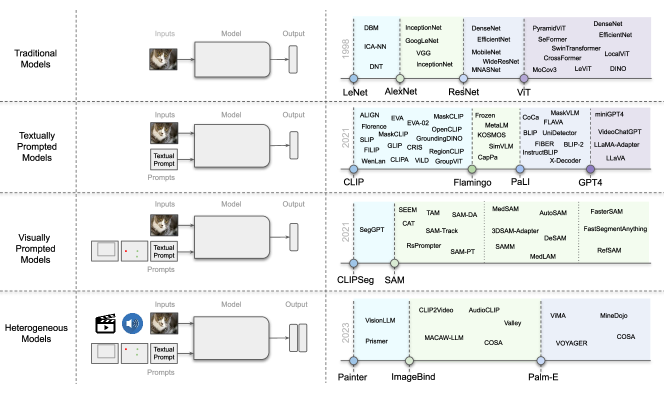
- Systematic review of foundational vision models across textually prompted, visually prompted, heterogeneous modality, and embodied categories.
- Classification of architectures into dual-encoder, fusion, encoder-decoder, and adapted-LLM designs with example models.
- Synthesis of training objectives including contrastive, generative, and hybrid losses with representative formulations (e.g., ITC, MLM, LM).
- Overview of large-scale pre-training data sources (image-text datasets, partially synthetic data, and combinations) and prompting/fine-tuning paradigms.
- Discussion of evaluation challenges, biases, adversarial vulnerabilities, and interpretability issues.
- Compilation of an up-to-date list of foundational models in a community resource (GitHub).
Experimental results
Research questions
- RQ1What are the architectural patterns used by vision-language foundational models and how do they differ across prompts and modalities?
- RQ2How do training objectives and data types influence generalization and downstream task performance in vision-language models?
- RQ3What are the common fine-tuning and prompting strategies for adapting foundational models to downstream vision tasks?
- RQ4What are the key evaluation challenges and open research directions for foundational models in computer vision?
- RQ5How do current foundational models address biases, robustness, and interpretability in multimodal settings?
Key findings
- Foundational models enable zero-shot and few-shot transfer to a wide range of vision tasks via prompts without retraining.
- Textually prompted models are categorized into contrastive, generative, and hybrid approaches, with CLIP-like architectures being foundational.
- Large-scale image-text data and diversified pre-training objectives significantly impact model generalization and downstream performance.
- Prompt engineering and fine-tuning strategies (instruction-following, grounding, and task-specific adaptations) are essential for leveraging these models.
- Open challenges include evaluation difficulties, real-world understanding gaps, biases, adversarial vulnerabilities, and interpretability concerns.
Read this paper
Open the full text in the Nubint reader and ask about any passage as you read.
Read this paper on NubintThis review was generated by AI from the original paper. Please check the paper before citing it.