
[Paper Review] Fourier PINNs: From Strong Boundary Conditions to Adaptive Fourier Bases
This paper introduces Fourier PINNs, a novel physics-informed neural network framework that enhances high-frequency and multi-scale solution learning by integrating adaptive Fourier basis functions into the network architecture. By combining neural network optimization with dynamic basis selection and coefficient truncation, Fourier PINNs achieve superior accuracy—reducing relative $L_2$ errors to $10^{-3}$–$10^{-4}$—compared to standard PINNs, W-PINNs, A-PINNs, and RFF-PINNs, which often fail on high-frequency problems due to sensitivity to hyperparameters.
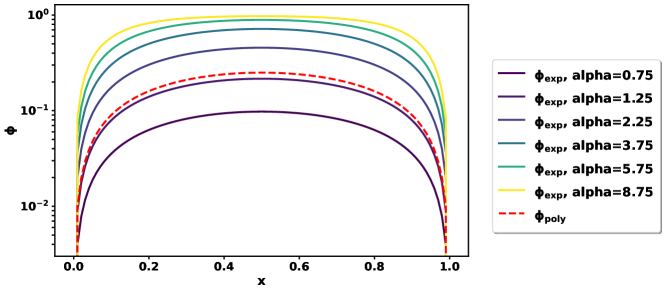
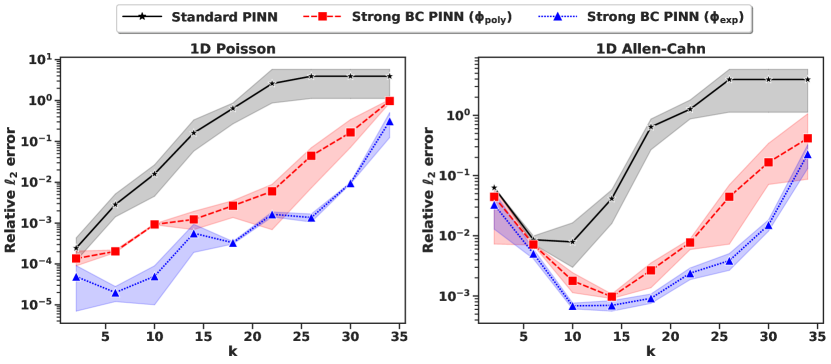
Interest is rising in Physics-Informed Neural Networks (PINNs) as a mesh-free alternative to traditional numerical solvers for partial differential equations (PDEs). However, PINNs often struggle to learn high-frequency and multi-scale target solutions. To tackle this problem, we first study a strong Boundary Condition (BC) version of PINNs for Dirichlet BCs and observe a consistent decline in relative error compared to the standard PINNs. We then perform a theoretical analysis based on the Fourier transform and convolution theorem. We find that strong BC PINNs can better learn the amplitudes of high-frequency components of the target solutions. However, constructing the architecture for strong BC PINNs is difficult for many BCs and domain geometries. Enlightened by our theoretical analysis, we propose Fourier PINNs -- a simple, general, yet powerful method that augments PINNs with pre-specified, dense Fourier bases. Our proposed architecture likewise learns high-frequency components better but places no restrictions on the particular BCs or problem domains. We develop an adaptive learning and basis selection algorithm via alternating neural net basis optimization, Fourier and neural net basis coefficient estimation, and coefficient truncation. This scheme can flexibly identify the significant frequencies while weakening the nominal frequencies to better capture the target solution's power spectrum. We show the advantage of our approach through a set of systematic experiments.
Motivation & Objective
- To address the persistent challenge of poor performance in standard PINNs when solving PDEs with high-frequency or multi-scale solutions.
- To overcome the limitations of existing methods like RFF-PINNs, which require careful tuning of frequency scales and often fail due to sensitivity.
- To develop a general, flexible, and robust framework that enhances learning of high-frequency components without architectural constraints on boundary conditions or domain geometry.
- To design an adaptive basis selection algorithm that identifies significant frequencies and suppresses irrelevant ones automatically.
- To demonstrate that Fourier PINNs outperform existing PINN variants in accuracy and robustness across diverse 1D and 2D PDE problems.
Proposed method
- Augment the PINN architecture with a fixed, dense set of pre-specified Fourier basis functions to improve representation of high-frequency solution components.
- Introduce an alternating optimization scheme that jointly updates neural network weights, Fourier basis coefficients, and performs coefficient truncation to retain only significant frequencies.
- Apply a theoretical analysis based on the Fourier transform and convolution theorem to justify why strong boundary condition enforcement improves high-frequency amplitude learning.
- Use a coarse-to-fine frequency search strategy with a sufficiently large candidate frequency range $K$, ensuring that target frequencies are included in the basis set.
- Implement a truncation mechanism that removes low-magnitude Fourier coefficients, reducing noise and improving model generalization.
- Maintain compatibility with existing PINN training by integrating the Fourier basis as an inductive bias without modifying the loss function or requiring boundary condition-specific architectures.
Experimental results
Research questions
- RQ1Can enforcing strong boundary conditions in PINNs improve the learning of high-frequency components in PDE solutions?
- RQ2Does the use of pre-specified Fourier bases in PINNs lead to more robust and accurate solutions for high-frequency and multi-scale problems compared to standard PINNs?
- RQ3Can an adaptive basis selection algorithm automatically identify the most relevant frequencies without requiring manual tuning of the number or scale of basis functions?
- RQ4How does the performance of Fourier PINNs compare to RFF-PINNs, especially in terms of sensitivity to hyperparameter choices and solution accuracy?
- RQ5To what extent can Fourier PINNs generalize across different PDEs and boundary conditions without architectural modifications?
Key findings
- Fourier PINNs achieve relative $L_2$ errors between $10^{-3}$ and $10^{-4}$ across all tested 1D and 2D problems, significantly outperforming standard PINNs, W-PINNs, A-PINNs, and RFF-PINNs.
- Standard PINN variants consistently fail on high-frequency problems, with relative $L_2$ errors around 1.0, indicating an inability to capture high-frequency content.
- RFF-PINNs exhibit high sensitivity to frequency scale and number settings, failing in 60–70% of tested configurations despite achieving low errors in a few cases.
- The spectral method, while effective, produces larger relative $L_2$ errors (two orders of magnitude higher than Fourier PINNs) and shows noticeable point-wise error bias near boundaries.
- Fourier PINNs demonstrate robustness to the choice of frequency range $K$, achieving consistent accuracy as long as $K$ is sufficiently large to include the target frequencies.
- The proposed adaptive basis selection algorithm successfully identifies dominant frequencies and suppresses irrelevant ones, enabling accurate solution recovery without manual tuning of basis parameters.
Read this paper
Open the full text in the Nubint reader and ask about any passage as you read.
Read this paper on NubintThis review was generated by AI from the original paper. Please check the paper before citing it.