
[Paper Review] Fractal scaling and the aesthetics of trees
This paper proposes a fractal scaling theory of tree aesthetics based on da Vinci's Rule of Trees and modern vascular biology, using power-law fitting of branch diameters in artworks to quantify scaling exponents (α). It finds that 16th-century Islamic, Edo-period Japanese, and 20th-century European art exhibit α values between 1.5 and 2.5, with Piet Mondrian’s abstract tree anticipating the modern scaling exponent α=3, demonstrating a deep alignment between artistic representation and biological scaling principles.
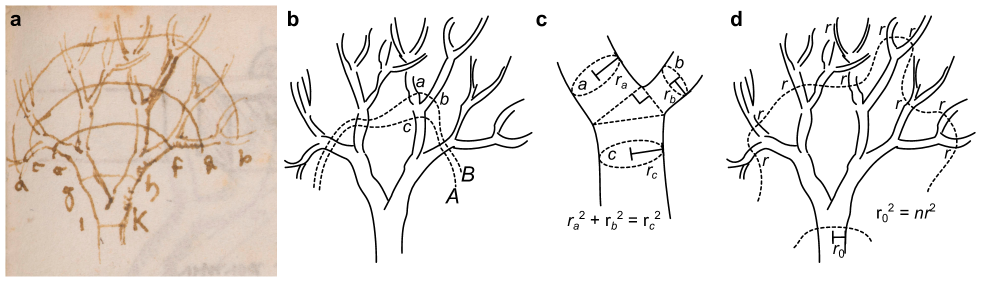
Trees in works of art have stirred emotions in viewers for millennia. Leonardo da Vinci described geometric proportions in trees to provide both guidelines for painting and insights into tree form and function. Da Vinci's Rule of trees further implies fractal branching with a particular scaling exponent $α= 2$ governing both proportions between the diameters of adjoining boughs and the number of boughs of a given diameter. Contemporary biology increasingly supports an analogous rule with $α= 3$ known as Murray's Law. Here we relate trees in art to a theory of proportion inspired by both da Vinci and modern tree physiology. We measure $α$ in 16th century Islamic architecture, Edo period Japanese painting and 20th century European art, finding $α$ in the range 1.5 to 2.5. We find that both conformity and deviations from ideal branching create stylistic effect and accommodate constraints on design and implementation. Finally, we analyze an abstract tree by Piet Mondrian which forgoes explicit branching but accurately captures the modern scaling exponent $α= 3$, anticipating Murray's Law by 15 years. This perspective extends classical mathematical, biological and artistic ways to understand, recreate and appreciate the beauty of trees.
Motivation & Objective
- To investigate whether artistic representations of trees reflect underlying fractal scaling principles found in real tree physiology.
- To test the hypothesis that artists across cultures and periods implicitly follow or anticipate the scaling laws of tree morphology, such as da Vinci’s Rule (α=2) or Murray’s Law (α=3).
- To develop a quantifiable method for measuring fractal scaling in artworks using branch diameter distributions and power-law fitting.
- To assess the role of deviation from ideal scaling in artistic expression and design constraints.
- To explore how abstract art, such as Mondrian’s tree, may still encode biologically accurate scaling despite lacking explicit branching.
Proposed method
- Manual annotation of branch diameters in 16th-century Islamic, Edo-period Japanese, and 20th-century European artworks using SVG vector graphics in Inkscape.
- Measurement of branch diameters via perpendicular lines drawn downstream of branch points to avoid distortions from curvature or leaves.
- Extraction of branch length and diameter data using JavaScript in the Firefox Web Developer Console from SVG path elements.
- Application of a maximum-likelihood power-law fitting method with λ=2 to estimate scaling exponent α, using a threshold (xm) to exclude noisy or unreliable small-scale measurements.
- Use of visual and statistical checks to validate threshold selection, ensuring the power-law model fits the largest, most reliably measurable branches.
- Independent replication of scoring by three viewers, including a blinded third rater for Mondrian’s painting, to assess inter-rater reliability and subjectivity.
Experimental results
Research questions
- RQ1Do artistic representations of trees across different cultures and historical periods exhibit fractal scaling consistent with biological principles?
- RQ2To what extent do deviations from ideal scaling (e.g., α=2 or α=3) reflect artistic constraints or stylistic choices?
- RQ3Can abstract or stylized tree representations, such as in Mondrian’s work, still encode biologically accurate scaling exponents?
- RQ4How does the choice of threshold (xm) affect the estimation of the scaling exponent in artistic branch diameter data?
- RQ5To what extent do visual and measurement subjectivity influence the estimation of fractal scaling in artworks?
Key findings
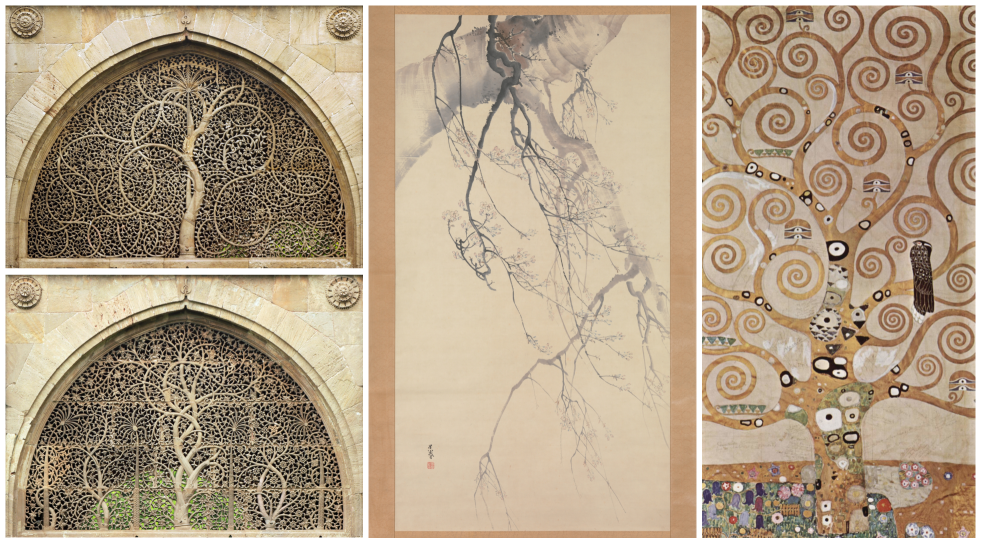
- The scaling exponent α in 16th-century Islamic architecture (Sidi Saiyyed Mosque) ranges from 1.5 to 2.5, indicating fractal scaling consistent with biological principles.
- Edo-period Japanese paintings (e.g., Matsumura Goshun’s cherry blossoms) exhibit α values within the same range, suggesting artistic adherence to fractal scaling.
- Gustav Klimt’s 'L’Arbre de Vie' shows α values consistent with fractal branching, reflecting both aesthetic and physiological scaling.
- Piet Mondrian’s abstract tree, despite lacking explicit branching, accurately captures the modern biological scaling exponent α=3, anticipating Murray’s Law by 15 years.
- The study’s power-law fitting method with λ=2 and empirically chosen thresholds (xm) successfully models branch diameter distributions across diverse artistic styles.
- Visual and statistical validation confirms that the chosen thresholds exclude non-self-similar, noisy data (e.g., bark, leaves, shadows), improving model reliability.
Read this paper
Open the full text in the Nubint reader and ask about any passage as you read.
Read this paper on NubintThis review was generated by AI from the original paper. Please check the paper before citing it.