
[Paper Review] Fractional quantum anomalous Hall effects in rhombohedral multilayer graphene in the moiréless limit and in Coulomb imprinted superlattice
This paper proposes that fractional quantum anomalous Hall (FQAH) states in rhombohedral multilayer graphene arise not from an external moiré potential, but from interaction-driven spontaneous formation of a topological Wigner crystal in a system with continuous translation symmetry. Using Hartree-Fock and exact diagonalization, the authors show that a narrow C=1 Chern band forms at ν=1, hosting robust FQAH states even without an external moiré superlattice, with the moiré potential acting only as a weak pinning field. The key result is a new platform for FQAH based on interaction-induced topology rather than artificial periodicity.
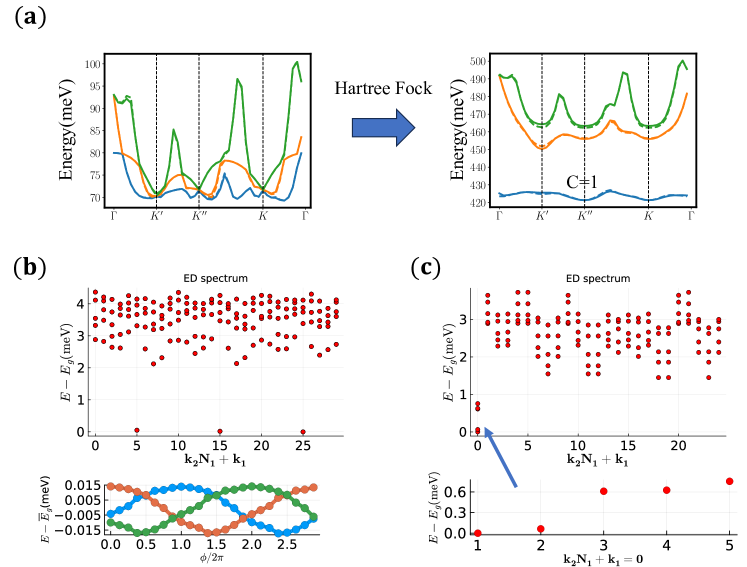
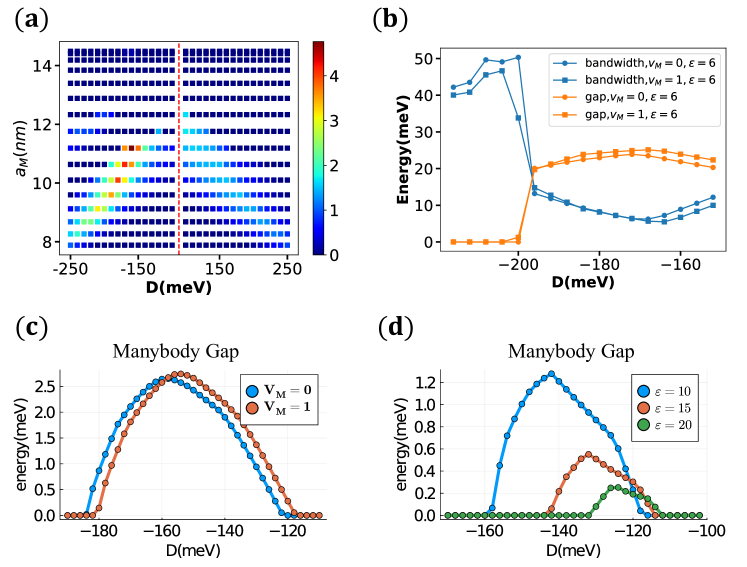
The standard theoretical framework for fractional quantum anomalous Hall effect (FQAH) assumes an isolated flat Chern band in the single particle level. In this paper we challenges this paradigm for the FQAH recently observed in the pentalayer rhombohedral stacked graphene aligned with hexagon boron nitride (hBN). We show that the external moiré superlattice potential is simply a perturbation in a model with continuous translation symmetry. Through Hartree Fock calculation, we find that interaction opens a sizable remote band gap, resulting an isolated narrow $C=1$ Chern band at filling $ν=1$. From exact diagonalization (ED) we identify FQAH phases at various fillings. But they exist also in the calculations without any external moiré potential. We suggest that the QAH insulator at $ν=1$ should be viewed as an interaction driven topological Wigner crystal with QAH effect, which is then pinned by a small moiré potential. The $C=1$ QAH crystal is robust with a crystal period around $10\mathrm{nm}$ in 4-layer, 5-layer, 6-layer and 7-layer graphene systems. Our work suggests a new direction to exploring the interplay of topology and FQAH with spontaneous crystal formation in the vanishing moiré potential limit. We also propose a new system to generate and control both honeycomb and triangular moiré superlattice potential through Coulomb interaction from another control layer, which can stabilize or suppress the QAH crystal depending on the density of the control layer.
Motivation & Objective
- To resolve the paradox of FQAH states in pentalayer rhombohedral graphene despite a negligible external moiré potential.
- To challenge the standard paradigm that FQAH requires an engineered flat Chern band from an external moiré superlattice.
- To propose a new platform where the moiré potential is generated via Coulomb coupling to a twisted bilayer graphene layer.
- To demonstrate that the QAH-Wigner crystal and FQAH phases are robust in the moiréless limit and survive to zero external potential.
- To explore tunability of superlattice potential and period through hBN thickness and twist angle in a Coulomb-imprinted setup.
Proposed method
- Perform Hartree-Fock calculations to study the formation of a C=1 Chern band at ν=1 in n-layer rhombohedral graphene with spin-valley polarization.
- Use exact diagonalization (ED) to identify FQAH states at fractional fillings of the Hartree-Fock-renormalized band.
- Analyze the system with and without an external moiré potential to isolate the role of the moiré lattice.
- Propose a Coulomb-imprinted superlattice by placing n-layer graphene above a twisted bilayer graphene (TBG) layer separated by thin hBN.
- Derive the effective moiré potential in the n-layer graphene as V_l(G_M) ∝ e^(-G_M (d + l d_layer)) / (G_M a_M), with a_M controlled by the TBG twist angle.
- Vary the hBN thickness d to tune the strength of the induced moiré potential independently from the lattice period.
Experimental results
Research questions
- RQ1Why are FQAH states stabilized in pentalayer rhombohedral graphene despite an external moiré potential of only ~0.05 meV, which is negligible in the band structure?
- RQ2Can the QAH insulator at ν=1 be understood as a spontaneously formed topological Wigner crystal rather than a moiré-induced Chern band?
- RQ3Does the FQAH phase persist in the absence of any external moiré potential, indicating intrinsic topological order from electron interactions?
- RQ4Can a moiré superlattice be generated purely via Coulomb coupling to a twisted bilayer graphene layer, and can it stabilize FQAH states?
- RQ5How does tuning the hBN thickness and TBG twist angle allow independent control over the moiré potential strength and period in the n-layer graphene?
Key findings
- A narrow C=1 Chern band with a sizable band gap forms at ν=1 in 4-, 5-, 6-, and 7-layer rhombohedral graphene due to electron interactions, even without an external moiré potential.
- The ν=1 state is identified as a QAH-Wigner crystal that spontaneously breaks continuous translation symmetry, with a crystal period of approximately 10 nm.
- FQAH states are stabilized at fractional fillings of the Hartree-Fock-renormalized band, and these states persist even when the external moiré potential is turned off.
- The external moiré potential acts only as a weak pinning field and is not essential for the formation of the topological band or FQAH phases.
- In the Coulomb-imprinted setup, the moiré potential can be tuned via hBN thickness d, and the QAH-Wigner crystal and FQAH phases remain robust in the d→∞ limit.
- For d=1 nm and ε=6, the induced moiré potential in the n-layer graphene is 0.84 meV when using monolayer graphene as the source, confirming feasibility of weak, tunable superlattices.
Read this paper
Open the full text in the Nubint reader and ask about any passage as you read.
Read this paper on NubintThis review was generated by AI from the original paper. Please check the paper before citing it.