
[Paper Review] Frequency-driven Imperceptible Adversarial Attack on Semantic Similarity
This paper proposes SSAH, a frequency-driven adversarial attack that targets semantic similarity in deep feature representations to generate highly imperceptible perturbations. By constraining perturbations to high-frequency components via a low-frequency constraint, SSAH achieves superior imperceptibility and strong transferability across models and datasets, outperforming SOTA methods on CIFAR-10, CIFAR-100, ImageNet-1K, and real-world online APIs.
Current adversarial attack research reveals the vulnerability of learning-based classifiers against carefully crafted perturbations. However, most existing attack methods have inherent limitations in cross-dataset generalization as they rely on a classification layer with a closed set of categories. Furthermore, the perturbations generated by these methods may appear in regions easily perceptible to the human visual system (HVS). To circumvent the former problem, we propose a novel algorithm that attacks semantic similarity on feature representations. In this way, we are able to fool classifiers without limiting attacks to a specific dataset. For imperceptibility, we introduce the low-frequency constraint to limit perturbations within high-frequency components, ensuring perceptual similarity between adversarial examples and originals. Extensive experiments on three datasets (CIFAR-10, CIFAR-100, and ImageNet-1K) and three public online platforms indicate that our attack can yield misleading and transferable adversarial examples across architectures and datasets. Additionally, visualization results and quantitative performance (in terms of four different metrics) show that the proposed algorithm generates more imperceptible perturbations than the state-of-the-art methods. Code is made available at.
Motivation & Objective
- Address the limitation of existing adversarial attacks that rely on closed-set classification layers and fail to generalize across datasets.
- Improve perceptual imperceptibility by constraining perturbations to high-frequency components, which are less noticeable to the human visual system (HVS).
- Develop a black-box attack framework effective in open-set scenarios where the target class is unknown during attack generation.
- Enable transferable adversarial examples across diverse architectures and real-world online models without query access.
Proposed method
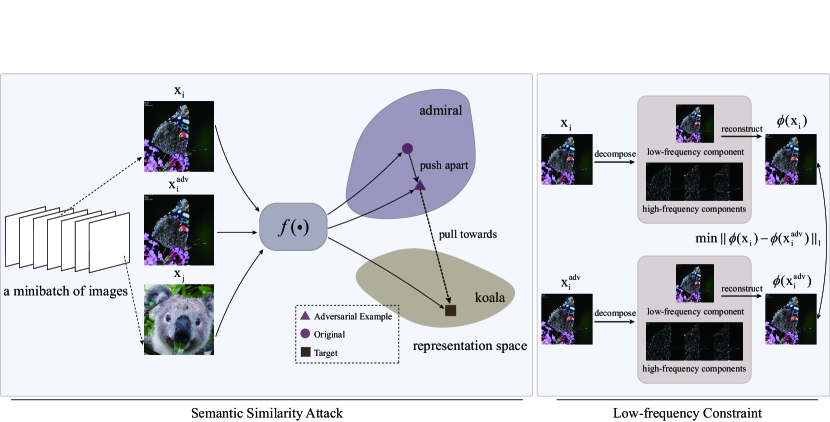
- Propose a semantic similarity attack (SSA) that manipulates feature representations to push benign examples away from their original class and pull them toward a target class, without relying on classification layer outputs.
- Introduce a low-frequency constraint that limits adversarial perturbations to high-frequency components of the image, ensuring perceptual similarity with the original image.
- Formulate the attack as a joint optimization problem minimizing the ℓ₂ and ℓ∞ norms of the perturbation while minimizing the difference in low-frequency components between original and adversarial images.
- Apply self-paced weighting (SPW) to dynamically adjust the importance of the semantic similarity loss during optimization, improving convergence and perturbation quality.
- Use frequency-domain analysis to measure perceptual variation through the low-frequency component of the image, treating deviations in this band as perceptual distortion.
- Leverage t-SNE visualization and feature space trajectory analysis to validate the effectiveness of the attack in manipulating feature representations toward the target class.
Experimental results
Research questions
- RQ1Can an adversarial attack be designed to be effective in open-set scenarios where the target class is not part of the model’s known categories?
- RQ2How can adversarial perturbations be constrained to high-frequency components to improve perceptual imperceptibility without sacrificing attack success rate?
- RQ3To what extent does the proposed low-frequency constraint improve the perceptual quality of adversarial examples compared to standard ℓp-norm constraints?
- RQ4How transferable are the adversarial examples generated by the proposed method across different deep learning architectures and real-world online inference platforms?
Key findings
- On ImageNet-1K, SSAH achieves a low-frequency (LF) metric of 0.06, significantly lower than SSA (1.05) and SSA without SPW (1.40), demonstrating the effectiveness of the low-frequency constraint in reducing perceptible distortion.
- SSAH achieves a 37.98% attack success rate on Tencent Cloud’s online model, outperforming C&W (21.71%), AdvDrop (16.26%), and PerC-AL (18.61%) in a black-box setting without queries.
- The ablation study confirms that self-paced weighting (SPW) reduces Fréchet Inception Distance (FID) by 1.20 points compared to the variant without SPW, improving image quality.
- t-SNE visualization shows that SSAH successfully guides adversarial examples from their original class to the target class in feature space, with more stable and directed trajectories than C&W.
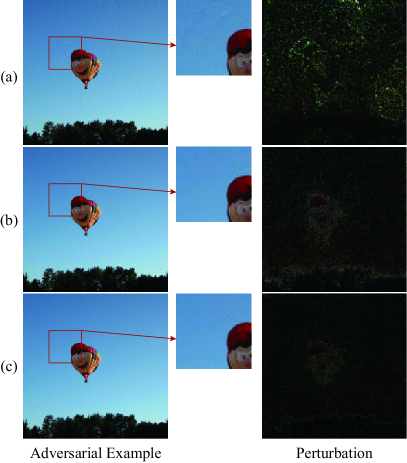
- Perturbation visualization confirms that SSAH concentrates changes on object edges and textures—regions less perceptible to HVS—while minimizing changes on smooth backgrounds.
- SSAH achieves state-of-the-art performance in both imperceptibility (measured by FID, LF, and perceptual metrics) and transferability across models and datasets.
Read this paper
Open the full text in the Nubint reader and ask about any passage as you read.
Read this paper on NubintThis review was generated by AI from the original paper. Please check the paper before citing it.