
[Paper Review] From ORAN to Cell-Free RAN: Architecture, Performance Analysis, Testbeds and Trials
This paper proposes a cell-free RAN (CF-RAN) architecture built on Open RAN (ORAN) to enable scalable, high-performance 6G wireless networks. By introducing Edge Data Units (EDUs) for distributed joint detection and precoding, the system achieves up to 78% of joint MMSE performance with significantly improved scalability and real-time feasibility using commercial off-the-shelf O-RUs.
Open radio access network (ORAN) provides an open architecture to implement radio access network (RAN) of the fifth generation (5G) and beyond mobile communications. As a key technology for the evolution to the sixth generation (6G) systems, cell-free massive multiple-input multiple-output (CF-mMIMO) can effectively improve the spectrum efficiency, peak rate and reliability of wireless communication systems. Starting from scalable implementation of CF-mMIMO, we study a cell-free RAN (CF-RAN) under the ORAN architecture. Through theoretical analysis and numerical simulation, we investigate the uplink and downlink spectral efficiencies of CF-mMIMO with the new architecture. We then discuss the implementation issues of CF-RAN under ORAN architecture, including time-frequency synchronization and over-the-air reciprocity calibration, low layer splitting, deployment of ORAN radio units (O-RU), artificial intelligent based user associations. Finally, we present some representative experimental results for the uplink distributed reception and downlink coherent joint transmission of CF-RAN with commercial off-the-shelf O-RUs.
Motivation & Objective
- To enable scalable, cell-free massive MIMO (CF-mMIMO) deployment under the Open RAN (ORAN) architecture for 6G systems.
- To address the scalability-performance tradeoff in CF-mMIMO by introducing Edge Data Units (EDUs) for distributed joint processing.
- To validate the feasibility and performance of CF-RAN using commercial off-the-shelf (COTS) ORAN radio units (O-RUs) in real-world testbeds.
- To optimize system-level performance through dynamic user-centric O-RU and EDU association, time-frequency synchronization, and over-the-air reciprocity calibration.
Proposed method
- Introduces a hybrid architecture where CF-mMIMO processing is distributed across multiple EDUs, enabling a flexible tradeoff between centralized performance and distributed scalability.
- Employs a modified 5G NR double-symbol Type 2 DMRS with 24 ports to support uplink channel estimation and user multiplexing in the prototype system.
- Applies Wiener interpolation with uniform power delay profile for accurate channel estimation in OFDM symbols within the same slot.
- Uses a time-division-based reciprocity calibration method with a 5ms delay model to account for LO phase drift in over-the-air (OTA) calibration.
- Implements a genetic algorithm-based user association strategy between UEs, O-RUs, and EDUs to optimize user-centric resource allocation.
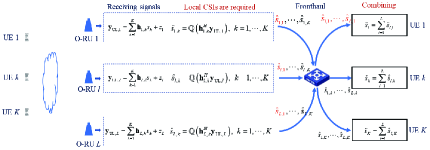
- Deploys a prototype system with 16 COTS O-RUs and 12 UEs at 4.9GHz, using EDU-MMSE and L-MMSE receivers for uplink and downlink processing.
Experimental results
Research questions
- RQ1How can CF-mMIMO be scaled efficiently under the ORAN architecture while maintaining high spectral efficiency?
- RQ2What is the performance tradeoff between fully centralized, fully distributed, and hybrid EDU-based joint processing in CF-RAN?
- RQ3How does over-the-air reciprocity calibration with a 5ms delay impact downlink joint precoding performance in a real-world CF-RAN setup?
- RQ4What deployment strategies (e.g., interleaved vs. clustered O-RU layout) yield optimal spectral efficiency in CF-RAN?
- RQ5Can a practical CF-RAN system using COTS ORAN devices achieve near-optimal performance with real-time, scalable processing?
Key findings
- The EDU-based CF-RAN achieves up to 78% of the spectral efficiency of a fully centralized joint MMSE receiver, significantly outperforming fully distributed MRC and L-MMSE schemes.
- With two EDUs and 5ms calibration delay, EDU-MMSE precoding achieves approximately 80% of the performance of joint MMSE with perfect CSI feedback, despite phase drift effects.
- The performance loss due to 5ms calibration delay is about 10% for EDU-MMSE, demonstrating the feasibility of real-time reciprocity calibration in practical systems.
- Interleaved O-RU deployment with genetic algorithm-based user association yields better spectral efficiency than clustered deployment in both uplink and downlink.
- When the number of antennas per EDU exceeds the number of uplink data streams, the performance gain from EDU-based joint detection is most significant.
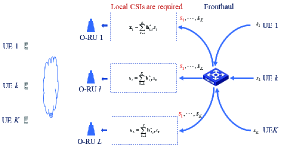
- The prototype system with 16 COTS O-RUs and 12 UEs confirms the feasibility of uplink distributed reception and downlink coherent joint transmission using standard ORAN interfaces and commercial hardware.
Read this paper
Open the full text in the Nubint reader and ask about any passage as you read.
Read this paper on NubintThis review was generated by AI from the original paper. Please check the paper before citing it.