
[Paper Review] From Questions to Insightful Answers: Building an Informed Chatbot for University Resources
This paper presents BarkPlug v.2, a Retrieval-Augmented Generation (RAG)-based LLM chatbot for Mississippi State University that enhances access to campus resources by retrieving domain-specific data from a curated university corpus and generating accurate, contextually relevant responses. The system achieves a mean RAGAS score of 0.96 and strong usability (SUS), demonstrating high performance and user satisfaction in answering academic and administrative queries.
This paper presents BARKPLUG V.2, a Large Language Model (LLM)-based chatbot system built using Retrieval Augmented Generation (RAG) pipelines to enhance the user experience and access to information within academic settings.The objective of BARKPLUG V.2 is to provide information to users about various campus resources, including academic departments, programs, campus facilities, and student resources at a university setting in an interactive fashion. Our system leverages university data as an external data corpus and ingests it into our RAG pipelines for domain-specific question-answering tasks. We evaluate the effectiveness of our system in generating accurate and pertinent responses for Mississippi State University, as a case study, using quantitative measures, employing frameworks such as Retrieval Augmented Generation Assessment(RAGAS). Furthermore, we evaluate the usability of this system via subjective satisfaction surveys using the System Usability Scale (SUS). Our system demonstrates impressive quantitative performance, with a mean RAGAS score of 0.96, and experience, as validated by usability assessments.
Motivation & Objective
- To address the limitations of static university websites in delivering personalized, real-time responses to academic and administrative inquiries.
- To reduce student and prospective applicant frustration caused by fragmented information and long response times from human support.
- To develop a scalable, accurate, and interactive chatbot that leverages university-specific data for domain-specific question-answering.
- To evaluate both the factual correctness of generated responses and the usability of the system in a real-world academic setting.
- To establish a reusable framework for deploying AI-powered chatbots in higher education institutions using RAG pipelines.
Proposed method
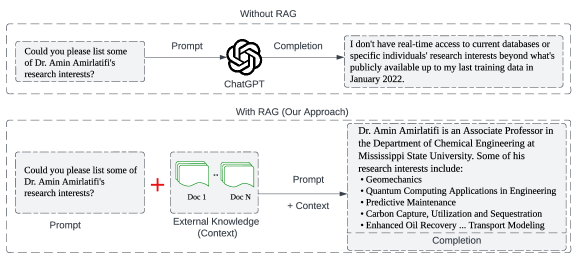
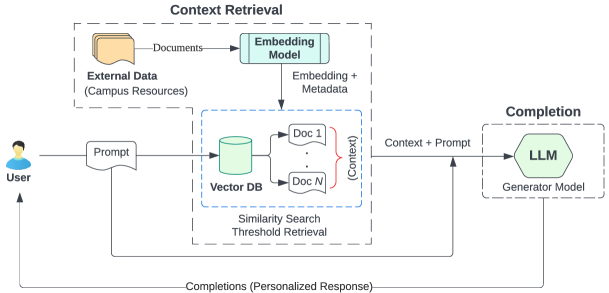
- The system uses a Retrieval-Augmented Generation (RAG) pipeline with a retriever and a generator based on OpenAI’s gpt-3.5-turbo LLM.
- University data—such as academic programs, facilities, and student services—was extracted, cleaned, and structured into a master JSON file for indexing.
- Text chunks of 8000 tokens with 1200-token overlap were created using Recursive Character Text Splitter for efficient retrieval.
- Embeddings were generated using OpenAI’s text-embedding-3-large model and stored in Chroma DB for vector-based similarity search.
- The RAG pipeline retrieves relevant context using semantic similarity search and generates responses via the LLM with retrieved context as prompt.
- The system was implemented using Django (backend), HTML/CSS/JS (frontend), and deployed via a third-party cloud service with user authentication and conversation history features.
Experimental results
Research questions
- RQ1Can a RAG-based LLM chatbot effectively retrieve and generate accurate, contextually relevant answers to diverse university-related queries?
- RQ2How does the performance of the RAG pipeline compare to standalone LLMs in terms of factual correctness and answer relevance for domain-specific queries?
- RQ3To what extent does the chatbot improve user satisfaction and usability in accessing university resources?
- RQ4What are the key technical limitations affecting retrieval accuracy and response reliability in a university information system?
- RQ5How can the system be extended to support multilingual users and multimodal interaction (e.g., voice)?
Key findings
- BarkPlug v.2 achieved a mean RAGAS score of 0.96, indicating high factual correctness and relevance in response generation.
- The system demonstrated strong usability, with a System Usability Scale (SUS) score indicating a practical and effective user experience.
- The integration of university-specific data via RAG significantly reduced hallucinations compared to using a standalone LLM.
- The use of vector retrieval with semantic embeddings enabled efficient and accurate context retrieval for complex queries.
- The system supports user authentication, conversation history, and email sharing, enhancing personalization and usability.
- Despite strong performance, the system faces limitations in multilingual support, ASR integration, and token context window constraints.
Read this paper
Open the full text in the Nubint reader and ask about any passage as you read.
Read this paper on NubintThis review was generated by AI from the original paper. Please check the paper before citing it.