
[Paper Review] FusionDTI: Fine-grained Binding Discovery with Token-level Fusion for Drug-Target Interaction
FusionDTI proposes a token-level fusion model that leverages pre-trained language models (Saprot and SELFormer) with SELFIES and structure-aware protein tokenization to capture fine-grained drug-target interactions at the atomic and residue level. It achieves state-of-the-art performance with a 6% accuracy gain over the best baseline on BindinDB, while enhancing explainability through attention visualization of binding sites.
Predicting drug-target interaction (DTI) is critical in the drug discovery process. Despite remarkable advances in recent DTI models through the integration of representations from diverse drug and target encoders, such models often struggle to capture the fine-grained interactions between drugs and protein, i.e. the binding of specific drug atoms (or substructures) and key amino acids of proteins, which is crucial for understanding the binding mechanisms and optimising drug design. To address this issue, this paper introduces a novel model, called FusionDTI, which uses a token-level Fusion module to effectively learn fine-grained information for Drug-Target Interaction. In particular, our FusionDTI model uses the SELFIES representation of drugs to mitigate sequence fragment invalidation and incorporates the structure-aware (SA) vocabulary of target proteins to address the limitation of amino acid sequences in structural information, additionally leveraging pre-trained language models extensively trained on large-scale biomedical datasets as encoders to capture the complex information of drugs and targets. Experiments on three well-known benchmark datasets show that our proposed FusionDTI model achieves the best performance in DTI prediction compared with seven existing state-of-the-art baselines. Furthermore, our case study indicates that FusionDTI could highlight the potential binding sites, enhancing the explainability of the DTI prediction.
Motivation & Objective
- To address the limitation of existing DTI models in capturing fine-grained interactions between specific drug atoms and target amino acids.
- To improve the explainability of DTI predictions by identifying and visualizing key binding sites at the token level.
- To enhance representation learning for drugs and proteins by integrating structural information through SELFIES and structure-aware (SA) vocabulary.
- To develop a fusion mechanism that effectively captures cross-modal interactions between drug and target tokens for improved prediction performance.
Proposed method
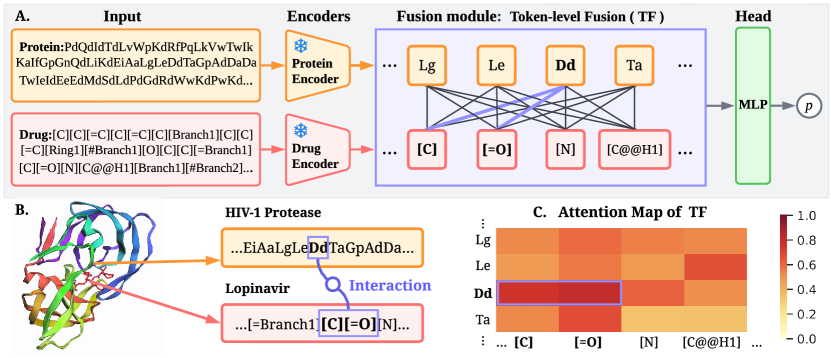
- Uses SELFIES representation for drugs to ensure chemical validity and encode structural information.
- Employs Saprot, a pre-trained language model with structure-aware (SA) vocabulary, to encode protein sequences with 3D structural context.
- Applies SELFormer, a pre-trained language model for molecular sequences, to generate contextual embeddings for drug molecules.
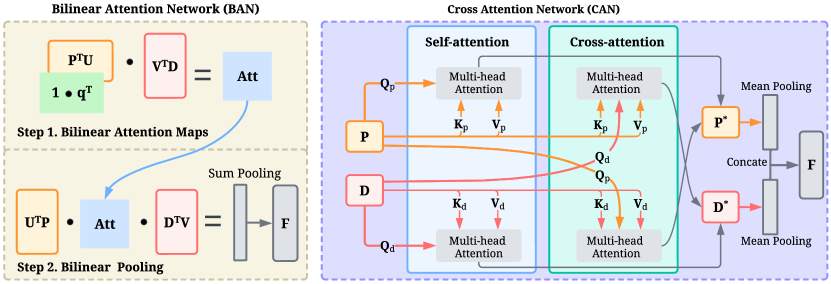
- Implements a Token-level Fusion (TF) module using Cross Attention Network (CAN) and Bilinear Attention Network (BAN) to learn fine-grained interactions between drug and target tokens.
- Utilizes cross-attention maps to visualize the contribution of individual drug atoms and amino acid residues to the final DTI prediction.
- Trains the model on three benchmark datasets using frozen encoders and a classifier head for binary interaction prediction.
Experimental results
Research questions
- RQ1Can token-level fusion between drug and target representations improve the accuracy of DTI prediction compared to existing state-of-the-art models?
- RQ2Does the use of SELFIES and structure-aware protein tokenization enhance the model’s ability to capture chemically meaningful and structurally informed interactions?
- RQ3Can the fusion module highlight specific binding sites at the atomic and residue level, improving model explainability?
- RQ4Which fusion mechanism—CAN or BAN—yields better performance and efficiency in capturing fine-grained interactions for DTI?
Key findings
- FusionDTI achieves the best performance among seven state-of-the-art baselines on three benchmark datasets, with a 6% accuracy improvement over the best baseline on the BindinDB dataset.
- The Cross Attention Network (CAN) module outperforms BAN across all fusion scale settings, demonstrating superior effectiveness and efficiency in capturing fine-grained interactions.
- The model successfully highlights potential binding sites in case studies, including new predictions not identified by DrugBAN, such as interactions involving sulfonamide oxygen and amino groups with specific residues.
- The combination of Saprot and SELFormer as encoders yields the highest performance, confirming their effectiveness in capturing rich semantic and structural information.
- Attention visualization confirms that the model focuses on biologically relevant residues and functional groups, enhancing interpretability of predictions.
- The use of structure-aware vocabulary enables the model to incorporate 3D structural context into protein representations, improving interaction modeling beyond standard amino acid sequences.
Read this paper
Open the full text in the Nubint reader and ask about any passage as you read.
Read this paper on NubintThis review was generated by AI from the original paper. Please check the paper before citing it.