
[Paper Review] Fuzzy Gene Selection and Cancer Classification Based on Deep Learning Model
This paper proposes a novel fuzzy gene selection (FGS) method integrated with a multilayer perceptron (MLP) deep learning model to improve cancer classification from high-dimensional gene expression data. By combining mutual information, F-ClassIf, and chi-squared scores with fuzzification and defuzzification, FGS identifies key genes, reducing dimensionality and boosting classifier performance—achieving 96.5% accuracy, 96.2% precision, 96% recall, and 95.9% F1-score across six datasets, significantly outperforming standard MLP without gene selection.
Machine learning (ML) approaches have been used to develop highly accurate and efficient applications in many fields including bio-medical science. However, even with advanced ML techniques, cancer classification using gene expression data is still complicated because of the high dimensionality of the datasets employed. We developed a new fuzzy gene selection technique (FGS) to identify informative genes to facilitate cancer classification and reduce the dimensionality of the available gene expression data. Three feature selection methods (Mutual Information, F-ClassIf, and Chi-squared) were evaluated and employed to obtain the score and rank for each gene. Then, using Fuzzification and Defuzzification methods to obtain the best single score for each gene, which aids in the identification of significant genes. Our study applied the fuzzy measures to six gene expression datasets including four Microarray and two RNA-seq datasets for evaluating the proposed algorithm. With our FGS-enhanced method, the cancer classification model achieved 96.5%,96.2%,96%, and 95.9% for accuracy, precision, recall, and f1-score respectively, which is significantly higher than 69.2% accuracy, 57.8% precision, 66% recall, and 58.2% f1-score when the standard MLP method was used. In examining the six datasets that were used, the proposed model demonstrates it's capacity to classify cancer effectively.
Motivation & Objective
- Address the challenge of high-dimensional gene expression data in cancer classification, which hinders model performance and increases training time.
- Reduce dataset dimensionality by selecting only the most informative genes to mitigate overfitting and improve training efficiency.
- Develop a fuzzy-based gene selection framework that integrates multiple feature scoring methods to enhance gene ranking and selection accuracy.
- Improve the performance of deep learning classifiers—particularly MLP—on gene expression data through optimized gene subset selection.
- Provide a biologically interpretable set of candidate genes for further experimental validation in cancer research and early diagnosis.
Proposed method
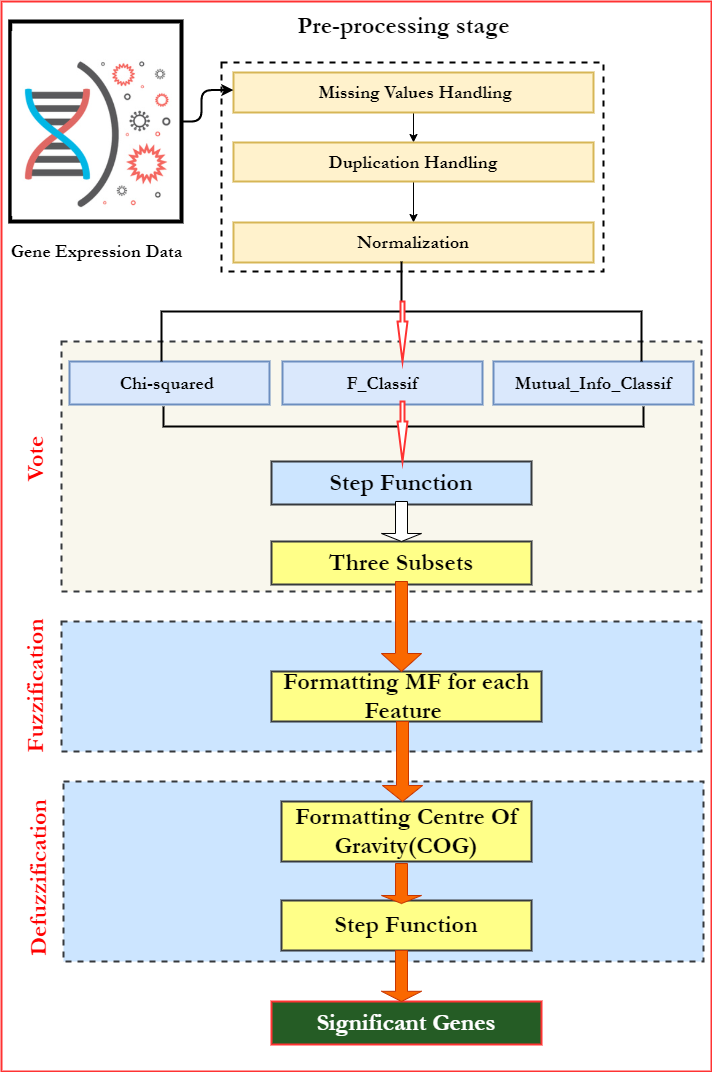
- Apply three feature selection methods—Mutual Information, F-ClassIf, and Chi-squared—to compute initial scores and ranks for each gene across six gene expression datasets.
- Use fuzzification to convert crisp feature scores into fuzzy membership values, capturing uncertainty and improving robustness in gene ranking.
- Apply defuzzification techniques (e.g., center of gravity) to derive a single, unified fuzzy score per gene, enabling clear gene prioritization.
- Integrate the top-ranked genes from the FGS process as input features for a multilayer perceptron (MLP) classifier to perform cancer classification.
- Train and evaluate the FGS-MLP model using 5-fold cross-validation across four microarray and two RNA-seq datasets from GEO and TCGA repositories.
- Optimize the model using standard deep learning hyperparameters and validate performance using accuracy, precision, recall, and F1-score metrics.
Experimental results
Research questions
- RQ1Can a fuzzy-based gene selection method effectively reduce the dimensionality of high-dimensional gene expression data while preserving classification-relevant features?
- RQ2How does the integration of FGS with a deep learning classifier (MLP) improve cancer classification performance compared to standard MLP without gene selection?
- RQ3To what extent does FGS reduce overfitting and training time in cancer classification models trained on gene expression data?
- RQ4Which combination of feature selection methods (Mutual Information, F-ClassIf, Chi-squared) yields the most robust and consistent gene rankings when fused through fuzzy logic?
- RQ5Can the selected genes from the FGS process serve as biologically meaningful biomarkers for further experimental investigation in cancer pathogenesis?
Key findings
- The FGS-MLP model achieved an average accuracy of 96.5% across six gene expression datasets, significantly outperforming standard MLP, which reached only 69.2% accuracy.
- Precision, recall, and F1-score improved to 96.2%, 96%, and 95.9% respectively with FGS, compared to 57.8%, 66%, and 58.2% without it, indicating substantial performance gains.
- The FGS method reduced the number of input genes to a minimal, biologically relevant set, thereby decreasing training time and mitigating overfitting risks.
- MLP showed the highest improvement rate (27.3%) in accuracy when combined with FGS, demonstrating its strong synergy with the proposed gene selection approach.
- The model achieved classification accuracy ranging from 93% to 99% across individual datasets, with the highest accuracy (99%) observed in the GSE33630 thyroid cancer dataset.
- The selected genes from FGS are biologically plausible and can serve as candidate biomarkers for further validation in cancer research and early diagnosis.
Read this paper
Open the full text in the Nubint reader and ask about any passage as you read.
Read this paper on NubintThis review was generated by AI from the original paper. Please check the paper before citing it.