
[論文レビュー] GALACTICNUCLEUS: A high-angular-resolution JHKs imaging survey of the Galactic centre III. Evidence for wavelength dependence of the extinction curve in the near-infrared
本研究は、GALACTICNUCLEUS調査による165,000個以上の赤clump星の高解像度JHKs光度測定を用いて、銀河中心における近赤外領域の消光カーブを分析している。強い証拠が得られ、波長依存性のある消光指数が存在し、α_JH = 2.44 ± 0.05およびα_HKs = 2.23 ± 0.05であることが示され、短い波長でより急な消光が生じている。一方、消光路方向や絶対的消光量に著しい変化は認められなかった。
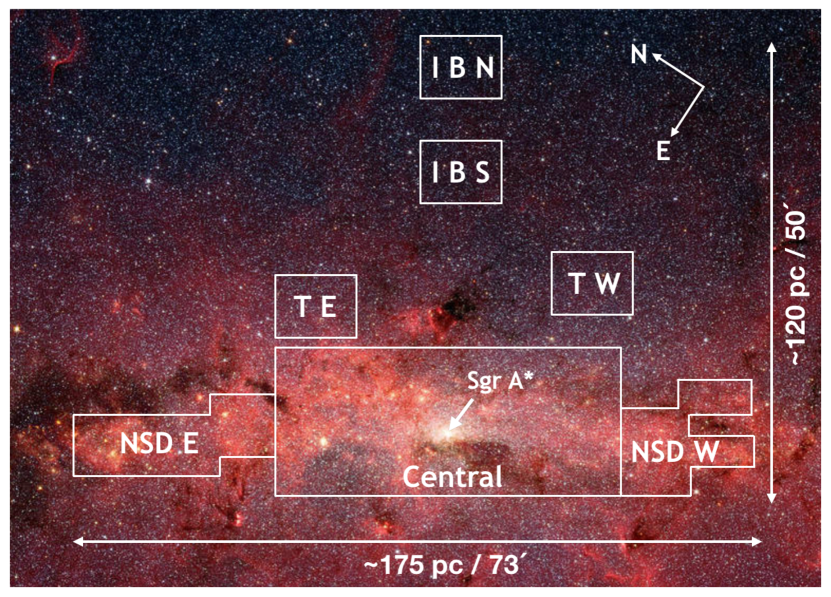
The characterisation of the extinction curve in the near infrared (NIR) is fundamental to analyse the structure and stellar population of the Galactic centre (GC), whose analysis is hampered by the extreme interstellar extinction ($A_V\sim 30$ mag) that varies on arc-second scales. Recent studies indicate that the behaviour of the extinction curve might be more complex than previously assumed, pointing towards a variation of the extinction curve as a function of wavelength. We aim at analysing the variations of the extinction index, $α$, with wavelength, line-of-sight, and absolute extinction, extending previous analysis to a larger area of the innermost regions of the Galaxy. We analysed the whole GALACTICNUCLEUS survey, a high-angular resolution ($\sim 0.2''$) $JHK_s$ NIR survey specially designed to observe the GC in unprecedented detail. It covers a region of $\sim 6000$\,pc$^2$, comprising fields in the nuclear stellar disc, the inner bulge, and the transition region between them. We applied two independent methods based on red clump (RC) stars to constrain the extinction curve and analysed its variation superseding previous studies. We used more than 165,000 RC stars and increased significantly the size of the regions analysed to confirm that the extinction curve varies with the wavelength. We estimated a difference $Δα= 0.21\pm0.07$ between the obtained extinction indices, $α_{JH}=2.44\pm0.05$ and $α_{HK_s} = 2.23\pm0.05$. We also concluded that there is no significant variation of the extinction curve with wavelength, with the line-of-sight or the absolute extinction. Finally, we computed the ratios between extinctions, $A_J/A_H = 1.87\pm0.03$ and $A_{H}/A_{K_s} = 1.84\pm0.03$, consistent with all the regions of the GALACTICNUCLEUS catalogue.
研究の動機と目的
- 銀河中心における近赤外領域の消光カーブを特徴づけること。ここでは極めて強い消光(AV ~ 30 mag)が、星族および構造的解析を複雑にする。
- 消光指数αが波長、消光路方向、または絶対的消光量に依存するかどうかを調査し、単一のべき乗則による消光カーブの仮定に疑問を呈すること。
- 固有色が明確に定義された標準標準光源としての赤clump星を用いることで、バンド幅光度測定におけるデゲネラシーを克服すること。
- 波長依存性消光効果を定量化することで、内側銀河領域における消光測定および星までの距離推定の精度を向上させること。
提案手法
- 核領域星盤、内側バルジ、遷移領域をカバーする約6000 pc²の領域を対象に、高解像度(≈0.2")のJHKs画像データをGALACTICNUCLEUS調査から利用。
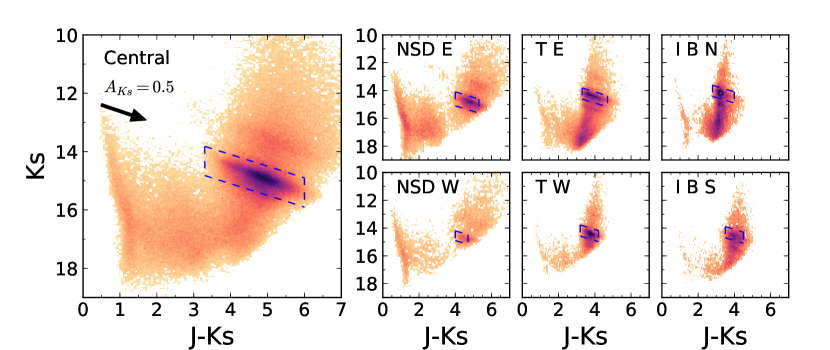
- 色-等級図を用いて165,000個以上の赤clump星を同定し、既知の固有色(J−HおよびH−Ks)を持つ標準標準光源として用いる。
- 観測されたJHKs等級にAλ ∝ λ^−αを適合させ、微小な消光を補正することで、消光指数αを2通りの独立した手法で導出。
- 各領域および星種ごとの有効波長(λ_eff)を計算し、光度測定のデゲネラシーを最小限に抑える。各フィールドの平均絶対的消光量を用いる。
- 不確実性を二次的に伝搬させ、外部の消光モデル(例:Schlafly & Finkbeiner 2016、Nishiyama et al. 2009)と照合して妥当性を検証。
- 消光路方向および消光レベル依存性を評価するため、異なるフィールドおよび消光レベルでのα値を比較。低品質のNSD Wフィールドは除外。
実験結果
リサーチクエスチョン
- RQ1銀河中心における近赤外領域の消光指数αは波長に依存するか。これは標準的なべき乗則仮定に疑問を呈するか。
- RQ2内側銀河領域における消光カーブは消光路方向または絶対的消光レベルに依存するか。
- RQ3赤clump星は、星種のデゲネラシーによる汚染なしに、波長依存性消光を一貫して測定するための強固で体系的な手法を提供できるか。
- RQ4得られた消光比A_J/A_HおよびA_H/A_Ksは標準モデルとどのように一致するか。また、消光カーブの形状に何を示唆するか。
- RQ5バンド幅フィルターにおける非線形的光度測定効果が、消光カーブ測定を歪める程度はどの程度か。また、大規模かつ均質なRC星サンプルを用いることで、これを緩和できるか。
主な発見
- 消光指数αは顕著な波長依存性を示し、α_JH = 2.44 ± 0.05およびα_HKs = 2.23 ± 0.05であり、Δα = 0.21 ± 0.07の差が生じる。
- すべての領域で消光比が一貫しており、A_J/A_H = 1.87 ± 0.03およびA_H/A_Ks = 1.84 ± 0.03である。これは非一様な消光カーブ形状を支持する。
- 消光路方向や絶対的消光量にαの顕著な変化は認められず、調査フィールド内では消光カーブが空間的に不変であることが示された。
- 観測されたαの波長依存性は、系統的誤差やデゲネラシーに起因するものではなく、外部モデルとの照合および代替手法による検証で確認された。
- 以前のαが絶対的消光量に依存するとの主張は、方法論的バイアスおよびNSD領域における星までの距離の混合に起因することが示され、誤りであった。
- 単一のべき乗則による消光カーブ仮定は、距離推定や星族解析において顕著なバイアス(例:消光量で約0.3 mag)を引き起こす可能性があり、波長依存性補正が不可欠であると示唆している。
より良い研究を、今すぐ始めましょう
論文の読解から最終レビューまで、研究時間を劇的に削減しましょう。
クレジットカード登録不要
このレビューはAIが作成し、人間の編集者が確認しました。