
[Paper Review] Gaussian Grouping: Segment and Edit Anything in 3D Scenes
Gaussian Grouping extends 3D Gaussian Splatting by introducing learnable identity encodings to group Gaussians into object instances and stuff segments, enabling joint 3D reconstruction and fine-grained segmentation using only 2D masks from SAM and 3D spatial consistency regularization. The method achieves high-fidelity, editable 3D scenes with minimal supervision and supports efficient local editing without retraining.
The recent Gaussian Splatting achieves high-quality and real-time novel-view synthesis of the 3D scenes. However, it is solely concentrated on the appearance and geometry modeling, while lacking in fine-grained object-level scene understanding. To address this issue, we propose Gaussian Grouping, which extends Gaussian Splatting to jointly reconstruct and segment anything in open-world 3D scenes. We augment each Gaussian with a compact Identity Encoding, allowing the Gaussians to be grouped according to their object instance or stuff membership in the 3D scene. Instead of resorting to expensive 3D labels, we supervise the Identity Encodings during the differentiable rendering by leveraging the 2D mask predictions by Segment Anything Model (SAM), along with introduced 3D spatial consistency regularization. Compared to the implicit NeRF representation, we show that the discrete and grouped 3D Gaussians can reconstruct, segment and edit anything in 3D with high visual quality, fine granularity and efficiency. Based on Gaussian Grouping, we further propose a local Gaussian Editing scheme, which shows efficacy in versatile scene editing applications, including 3D object removal, inpainting, colorization, style transfer and scene recomposition. Our code and models are at https://github.com/lkeab/gaussian-grouping.
Motivation & Objective
- To enable fine-grained, instance-level 3D scene understanding in open-world environments without requiring expensive 3D annotations.
- To extend 3D Gaussian Splatting with identity-aware representations that support both reconstruction and segmentation.
- To enable versatile 3D scene editing—such as object removal, inpainting, and re-composition—directly from the grouped 3D Gaussians.
- To leverage zero-shot 2D segmentation (SAM) and 3D spatial consistency to supervise 3D grouping without manual 3D labeling.
- To achieve high-fidelity 3D reconstruction and segmentation with efficient training and rendering, outperforming implicit NeRF-based methods in editability and speed.
Proposed method
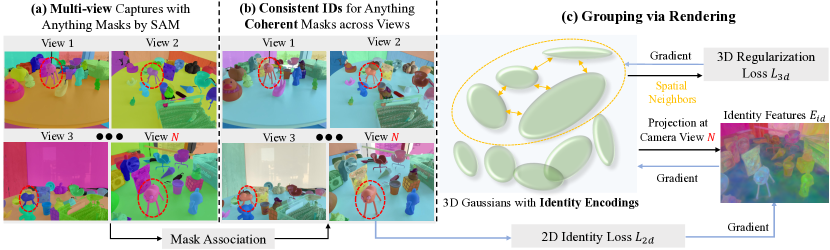
- Augment each 3D Gaussian with a 16-dimensional learnable identity encoding to represent object instance or stuff membership.
- Train identity encodings via differentiable rendering by projecting 3D Gaussians onto 2D views and classifying splatted embeddings using a shared linear layer.
- Supervise identity grouping using a 2D cross-entropy loss on SAM-generated masks and a 3D spatial consistency regularization loss that aligns top-K nearest Gaussians in feature space.
- Use a differentiable rasterization pipeline with CUDA-optimized forward and backward passes, similar to spherical harmonics, for efficient end-to-end training.
- Integrate standard Gaussian Splatting optimization with pruning and densification, while preserving identity encodings during refinement.
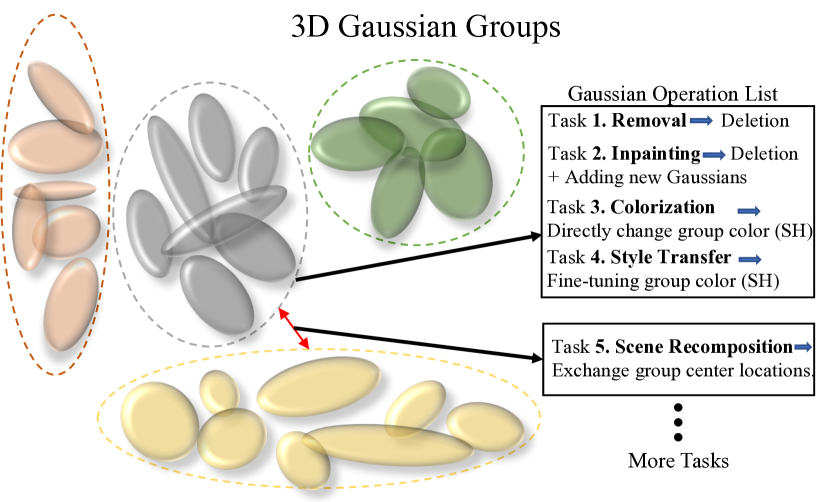
- Enable local editing via direct manipulation of grouped Gaussians, including removal, colorization, and repositioning, with minimal fine-tuning for inpainting.
Experimental results
Research questions
- RQ1Can 3D Gaussians be extended with learnable identity encodings to enable joint 3D reconstruction and fine-grained segmentation without 3D supervision?
- RQ2How effective is 2D mask supervision from SAM combined with 3D spatial consistency regularization in achieving accurate 3D grouping?
- RQ3Can discrete, grouped 3D Gaussians support efficient and high-quality 3D scene editing, including object removal, inpainting, and re-composition?
- RQ4How does the performance of Gaussian Grouping compare to implicit NeRF-based methods in terms of reconstruction quality, segmentation accuracy, and editability?
- RQ5To what extent does the method generalize to open-world 3D scenes with diverse object types and complex compositions?
Key findings
- Gaussian Grouping achieves high visual quality in 3D novel view synthesis and dense 3D segmentation using only 2D masks from SAM and 3D spatial consistency regularization.
- The method enables direct 3D editing—such as object removal, colorization, and location exchange—without any training, leveraging the compositional structure of grouped Gaussians.
- 3D object inpainting requires only minutes of fine-tuning, demonstrating efficient adaptation to editing tasks.
- The 3D spatial consistency regularization loss improves grouping accuracy, especially for occluded or low-visibility Gaussians, by enforcing feature consistency among neighboring points.
- Training on one A100 GPU for 30K iterations achieves state-of-the-art performance in reconstruction and segmentation with fast inference and rendering.
- The approach outperforms implicit NeRF-based methods in editability and efficiency due to the explicit, discrete, and decomposable nature of grouped 3D Gaussians.
Read this paper
Open the full text in the Nubint reader and ask about any passage as you read.
Read this paper on NubintThis review was generated by AI from the original paper. Please check the paper before citing it.