
[Paper Review] General Facial Representation Learning in a Visual-Linguistic Manner
This paper proposes FaRL, a visual-linguistic framework for general facial representation learning that jointly optimizes contrastive loss for high-level semantics and masked image modeling for low-level details using a large-scale face-specific dataset (LAION-FACE). FaRL achieves state-of-the-art performance on face parsing and face alignment, outperforming prior pre-trained models, especially in low-data regimes.
How to learn a universal facial representation that boosts all face analysis tasks? This paper takes one step toward this goal. In this paper, we study the transfer performance of pre-trained models on face analysis tasks and introduce a framework, called FaRL, for general Facial Representation Learning in a visual-linguistic manner. On one hand, the framework involves a contrastive loss to learn high-level semantic meaning from image-text pairs. On the other hand, we propose exploring low-level information simultaneously to further enhance the face representation, by adding a masked image modeling. We perform pre-training on LAION-FACE, a dataset containing large amount of face image-text pairs, and evaluate the representation capability on multiple downstream tasks. We show that FaRL achieves better transfer performance compared with previous pre-trained models. We also verify its superiority in the low-data regime. More importantly, our model surpasses the state-of-the-art methods on face analysis tasks including face parsing and face alignment.
Motivation & Objective
- To investigate the transferability of visual-linguistic pre-trained models to diverse face analysis tasks.
- To address the challenge of limited labeled data in face analysis by learning a universal facial representation.
- To improve facial representation learning by jointly modeling high-level semantics and low-level image details.
- To develop a general-purpose facial representation framework that can be rapidly adapted to downstream tasks.
- To demonstrate superior performance in low-data regimes compared to existing pre-trained models.
Proposed method
- The framework uses contrastive loss on paired face images and natural language descriptions to learn high-level semantic representations.
- It incorporates masked image modeling (MIM) inspired by BEiT to capture low-level visual details during pre-training.
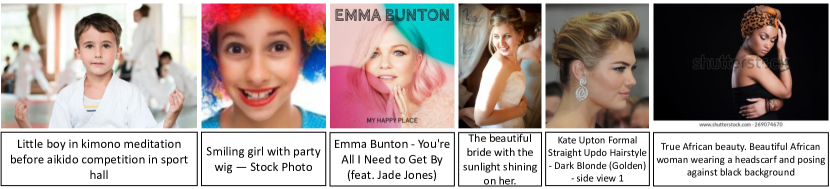
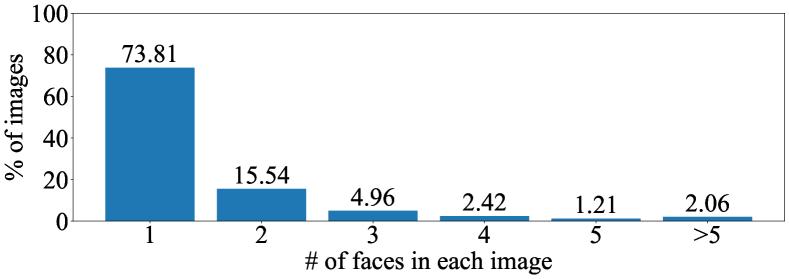
- Pre-training is conducted on LAION-FACE, a curated dataset of 20 million face image-text pairs extracted from LAION-400M.
- The backbone is a Vision Transformer (ViT) or DeiT, fine-tuned only on downstream tasks with frozen features for transfer evaluation.
- Data augmentation includes random rotation, rescaling, translation, and noise for robustness in downstream training.
- The model is evaluated on face parsing, face alignment, and attribute prediction with frozen feature extraction.
Experimental results
Research questions
- RQ1Can visual-linguistic pre-training on large-scale, open-source image-text pairs improve transfer performance on face analysis tasks?
- RQ2Does jointly modeling high-level semantics and low-level image details enhance facial representation learning?
- RQ3How does FaRL perform in low-data regimes compared to existing pre-trained models?
- RQ4Can FaRL surpass state-of-the-art methods on challenging face analysis benchmarks like face parsing and face alignment?
- RQ5Is the curated LAION-FACE dataset effective for learning general facial representations?
Key findings
- FaRL achieves state-of-the-art performance on face parsing and face alignment, outperforming existing methods on both benchmarks.
- The model demonstrates superior few-shot transfer performance, especially in low-data regimes, due to robust representation learning.
- Joint optimization of contrastive loss and masked image modeling leads to better feature representations than using either component alone.
- Pre-training on LAION-FACE, a 20M-image subset of LAION-400M, yields significantly better downstream performance than ImageNet or CLIP pre-training.
- The framework shows strong generalization across diverse face analysis tasks, including attribute prediction and alignment, with frozen feature extraction.
- FaRL surpasses strong baselines such as CLIP, MoCo v3, and BEiT in multiple evaluation settings, confirming its effectiveness.
Read this paper
Open the full text in the Nubint reader and ask about any passage as you read.
Read this paper on NubintThis review was generated by AI from the original paper. Please check the paper before citing it.