
[Paper Review] Generalist Multimodal AI: A Review of Architectures, Challenges and Opportunities
This paper introduces a novel taxonomy—unifiability, modularity, and adaptability—to systematically analyze generalist multimodal AI (GMMs) that operate across diverse modalities beyond text and vision. It reviews recent architectures and training strategies, identifies key challenges like weak benchmarks and scaling limits, and outlines future research directions for advancing robust, zero-shot capable, and human-interpretable multimodal models.
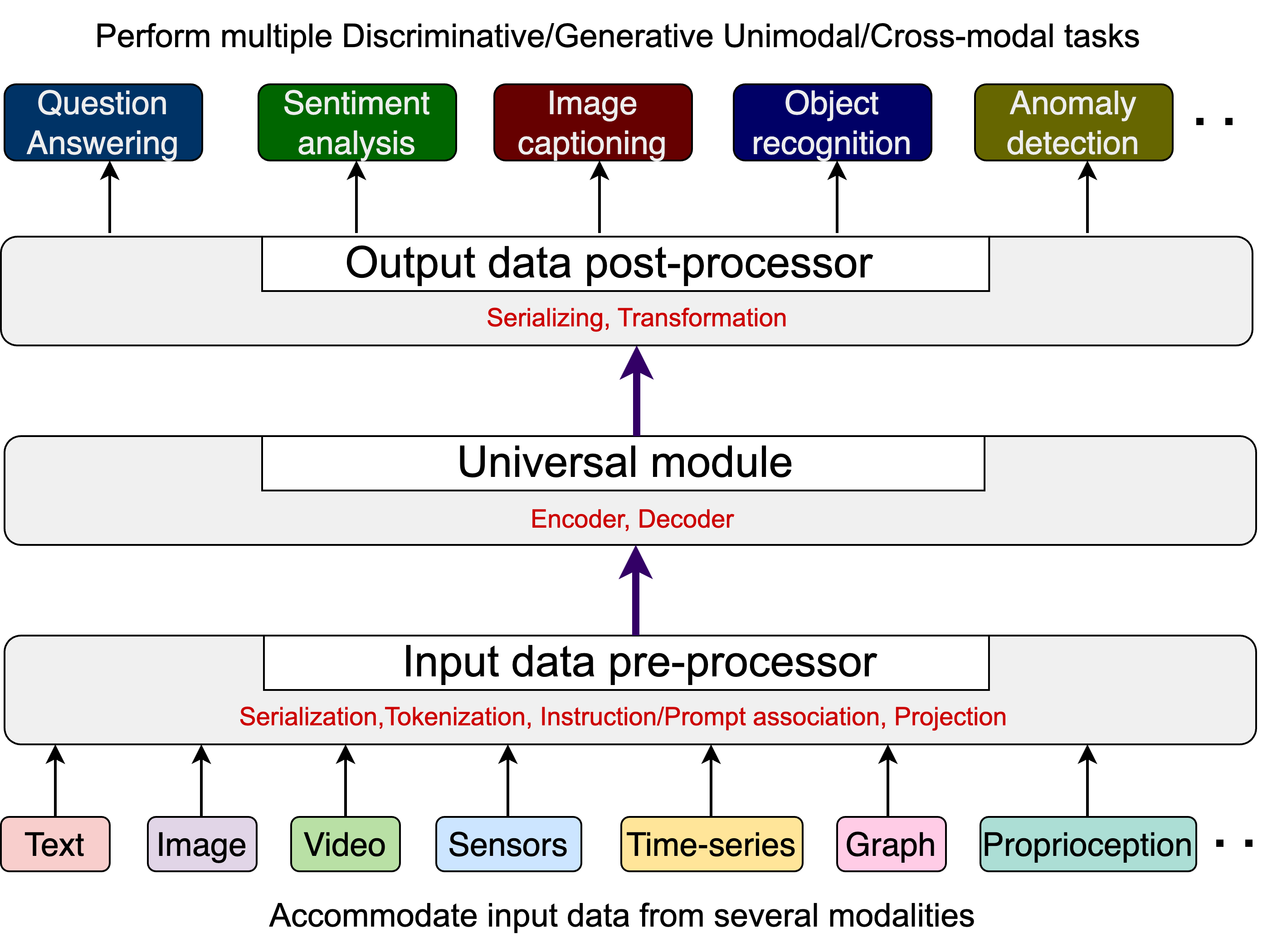
Multimodal models are expected to be a critical component to future advances in artificial intelligence. This field is starting to grow rapidly with a surge of new design elements motivated by the success of foundation models in natural language processing (NLP) and vision. It is widely hoped that further extending the foundation models to multiple modalities (e.g., text, image, video, sensor, time series, graph, etc.) will ultimately lead to generalist multimodal models, i.e. one model across different data modalities and tasks. However, there is little research that systematically analyzes recent multimodal models (particularly the ones that work beyond text and vision) with respect to the underling architecture proposed. Therefore, this work provides a fresh perspective on generalist multimodal models (GMMs) via a novel architecture and training configuration specific taxonomy. This includes factors such as Unifiability, Modularity, and Adaptability that are pertinent and essential to the wide adoption and application of GMMs. The review further highlights key challenges and prospects for the field and guide the researchers into the new advancements.
Motivation & Objective
- To address the lack of systematic analysis of generalist multimodal models (GMMs) beyond text and vision modalities.
- To identify and categorize key architectural and training design patterns in emerging GMMs.
- To propose a novel taxonomy—unifiability, modularity, and adaptability—specifically tailored for GMMs to guide future research.
- To highlight critical challenges such as weak multimodal benchmarks, low scaling efficiency, and limited zero-shot generalization.
- To outline emerging research directions, including retrieval-augmented generation, human-model interaction, and world model integration.
Proposed method
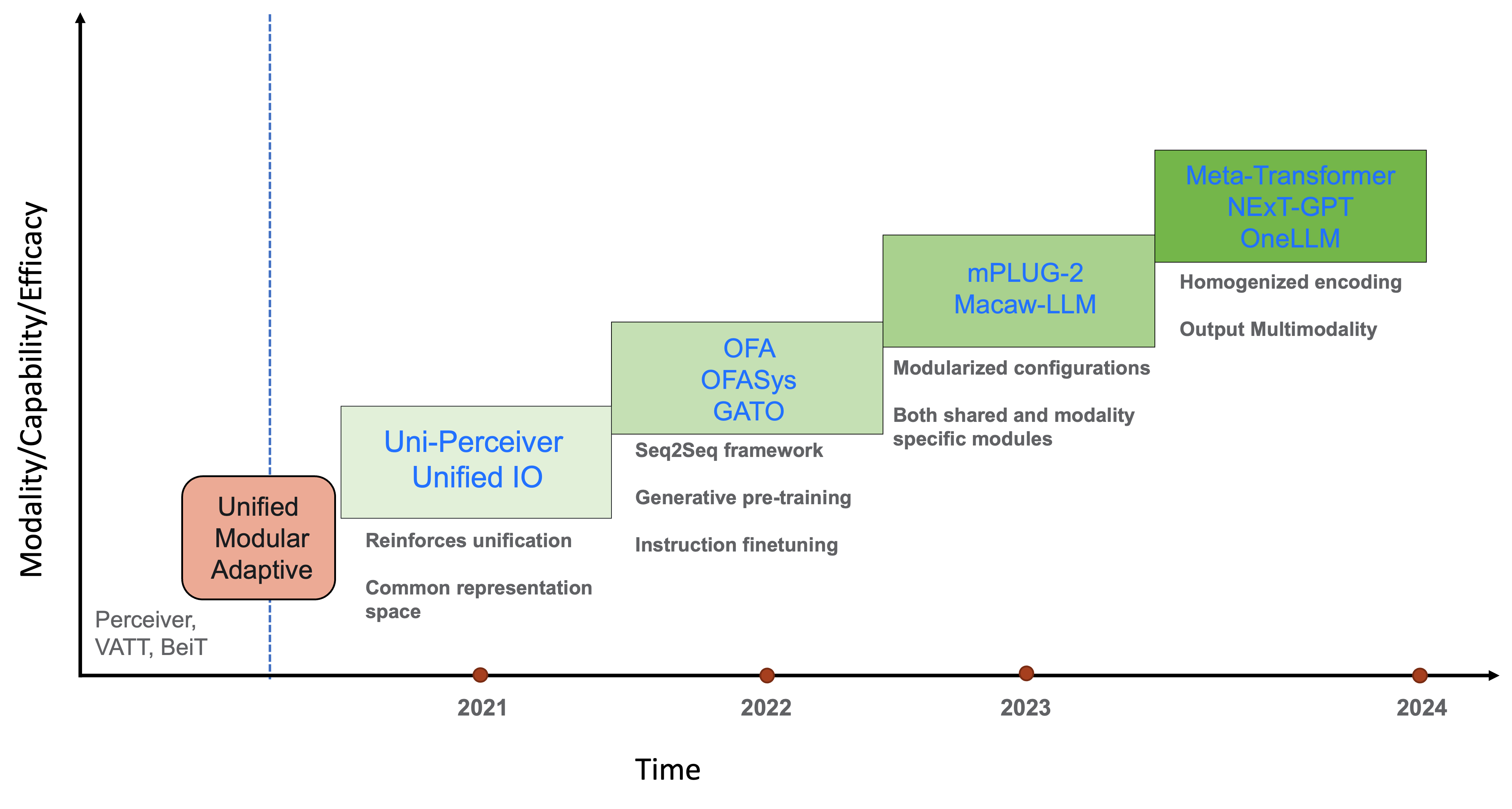
- Proposes a new taxonomy based on three core properties: unifiability (unified representation learning across modalities), modularity (flexible component reuse), and adaptability (robust zero-shot and few-shot generalization).
- Analyzes recent GMMs such as GATO, OFA, META-TRANSFORMER, and NEXT-GPT through the lens of the proposed taxonomy.
- Examines architectural choices including unified encoders/decoders, cross-attention mechanisms, and modality-specific tokenization strategies.
- Evaluates training configurations such as multi-task pretraining with diverse data streams and prompt-based fine-tuning for zero-shot transfer.
- Explores emerging frameworks like retrieval-augmented generation, where relevant multimodal inputs are retrieved before generation.
- Considers the integration of GMMs as world models for embodied AI, enabling lifelong learning and policy generation in robotics and simulation.
Experimental results
Research questions
- RQ1How can generalist multimodal models be systematically categorized based on their architectural and training design principles?
- RQ2What architectural properties—unifiability, modularity, and adaptability—most significantly influence the performance and generalization of GMMs?
- RQ3How do different modality sequences during pretraining affect downstream task performance and representation alignment?
- RQ4To what extent can GMMs achieve high zero-shot or few-shot generalization across diverse unimodal and cross-modal tasks?
- RQ5What are the key challenges in evaluating GMMs, and how can benchmarks be improved to reflect real-world multimodal complexity?
Key findings
- The proposed taxonomy of unifiability, modularity, and adaptability effectively captures the core design principles of state-of-the-art generalist multimodal models.
- GMMs such as OFA, GATO, and META-TRANSFORMER demonstrate strong zero-shot generalization across diverse modalities including text, image, video, sensor, and time series.
- Modular architectures allow flexible composition of components for unimodal and multimodal tasks, enhancing reusability and scalability.
- Despite progress, current benchmarks remain weak in evaluating multimodal generalization, especially for non-visual modalities like sensor and time series data.
- Emerging frameworks like retrieval-augmented generation and world model integration show promise in improving reasoning and long-horizon task performance.
- Human interaction with GMMs remains underexplored, particularly in terms of trust, hallucination mitigation, and explainability through attention maps and natural language rationales.
Read this paper
Open the full text in the Nubint reader and ask about any passage as you read.
Read this paper on NubintThis review was generated by AI from the original paper. Please check the paper before citing it.