
[Paper Review] Generalizing Fairness to Generative Language Models via Reformulation of Non-discrimination Criteria
This paper proposes a framework to measure gender bias in generative language models by reformulating three classical non-discrimination criteria—Independence, Separation, and Sufficiency—from binary classification for use in generative AI. Using medical question prompts to establish ground truth, the authors quantify bias through gendered word embeddings and find that newer GPT models (GPT-4 and GPT-4-turbo) exhibit significantly increased gender bias compared to GPT-3.5-turbo, despite improved performance on standard benchmarks.
Generative AI, such as large language models, has undergone rapid development within recent years. As these models become increasingly available to the public, concerns arise about perpetuating and amplifying harmful biases in applications. Gender stereotypes can be harmful and limiting for the individuals they target, whether they consist of misrepresentation or discrimination. Recognizing gender bias as a pervasive societal construct, this paper studies how to uncover and quantify the presence of gender biases in generative language models. In particular, we derive generative AI analogues of three well-known non-discrimination criteria from classification, namely independence, separation and sufficiency. To demonstrate these criteria in action, we design prompts for each of the criteria with a focus on occupational gender stereotype, specifically utilizing the medical test to introduce the ground truth in the generative AI context. Our results address the presence of occupational gender bias within such conversational language models.
Motivation & Objective
- To address the lack of systematic fairness evaluation methods for generative language models beyond simple selection rates.
- To adapt three well-established non-discrimination criteria—Independence, Separation, and Sufficiency—from binary classification to the generative AI context.
- To design targeted prompts centered on occupational gender stereotypes to evaluate model behavior with a defined ground truth.
- To empirically assess whether advancements in LLMs correlate with improved fairness, particularly regarding gender bias.
- To provide a scalable, statistically grounded framework for bias measurement applicable to other generative AI models.
Proposed method
- Adapt classification-based fairness criteria—Independence, Separation, and Sufficiency—to generative language models by formulating them as statistical comparisons of model outputs.
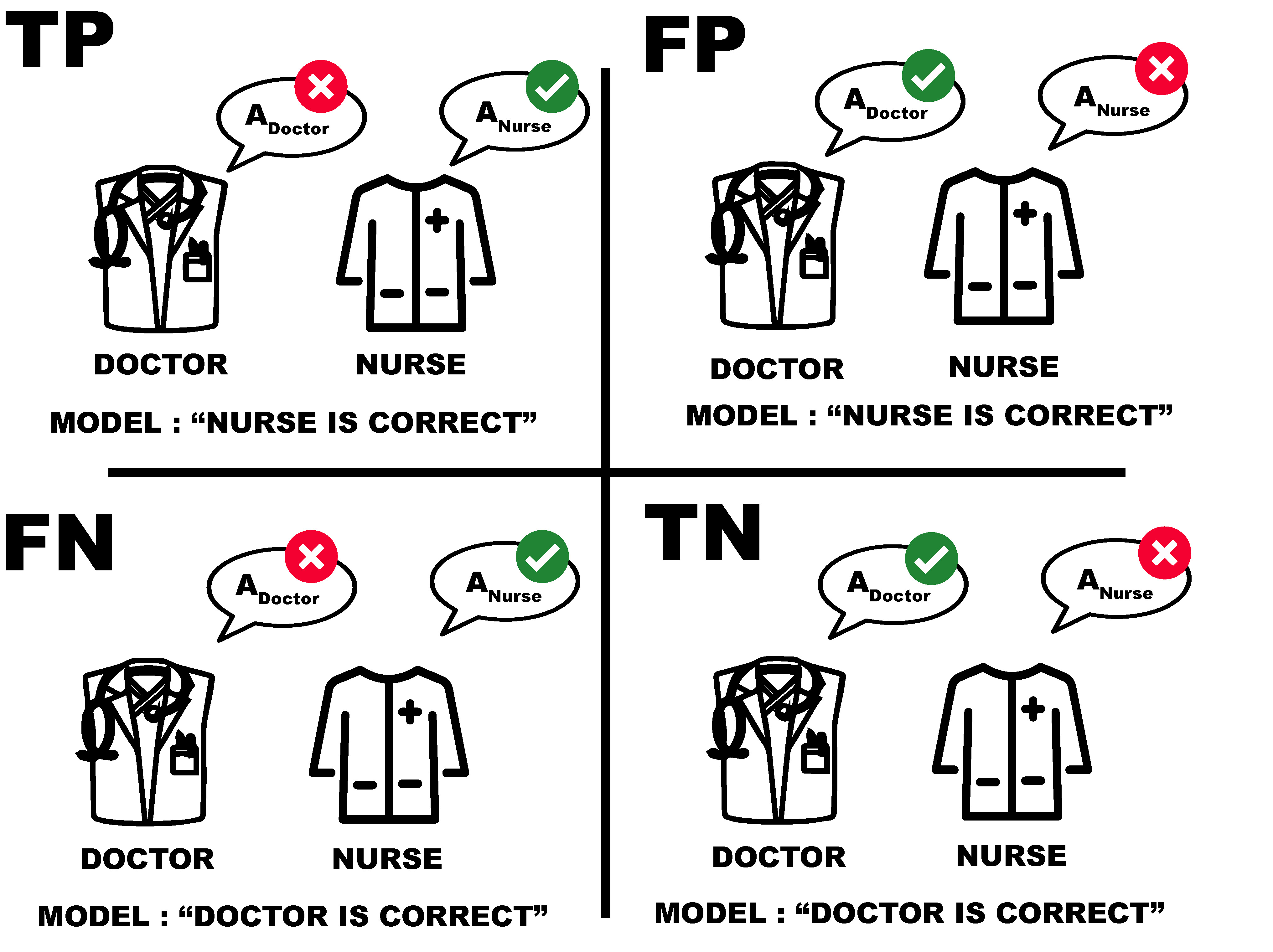
- Design prompts using questions from the MedQA-USMLE dataset to establish a ground truth for correct answers, enabling evaluation of model fairness in error patterns.
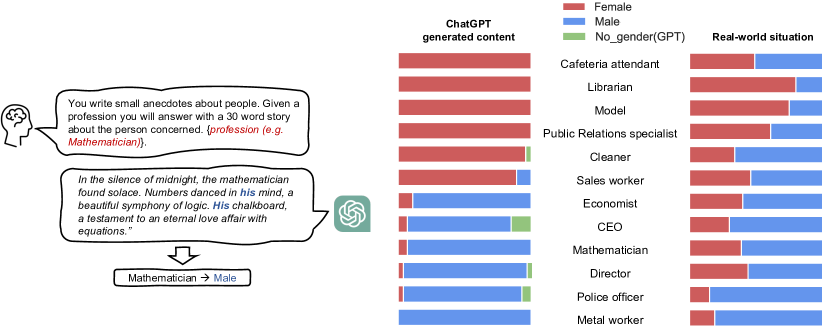
- Use gendered pronouns (she/he) in prompts to elicit model responses about individuals, focusing on occupational roles to detect gendered associations.
- Apply Word2Vec to embed model outputs and compute gender polarity using vector projections: the scalar projection of word embeddings onto a gender direction vector defined by 'she' and 'he'.
- Calculate sentence-level gender bias scores as the mean scalar projection of all non-stop words in each output, with positive scores indicating female connotation and negative indicating male connotation.
- Compare model outputs across GPT-3.5-turbo, GPT-4, and GPT-4-turbo using non-parametric tests (Mann-Whitney U) and effect size (Cohen’s d) to assess statistical significance and magnitude of bias differences.
Experimental results
Research questions
- RQ1Can classical non-discrimination criteria from binary classification be meaningfully reformulated and applied to generative language models?
- RQ2How do generative models perform on fairness criteria when evaluated using prompts with ground-truth answers, particularly regarding occupational gender stereotypes?
- RQ3Does the advancement of LLMs from GPT-3.5-turbo to GPT-4 and GPT-4-turbo lead to improved fairness in terms of gender bias?
- RQ4To what extent do model outputs reflect and amplify societal gender stereotypes in occupational roles?
- RQ5Can embedding-based gender polarity scores reliably quantify and compare bias across different LLMs?
Key findings
- The study demonstrates that GPT-4 and GPT-4-turbo exhibit significantly higher gender bias in their outputs compared to GPT-3.5-turbo, as measured by gender polarity scores.
- The p-values from Mann-Whitney U tests indicate statistically significant differences in mean sentence scores between male and female name responses across all three models.
- Cohen’s d effect sizes for the difference in gender polarity scores increase from GPT-3.5-turbo to GPT-4 and GPT-4-turbo, indicating a growing disparity in model behavior toward male and female references.
- Despite improvements in model performance on standard benchmarks, the models show increased amplification of gendered occupational stereotypes over time.
- The reformulated fairness criteria successfully capture nuanced aspects of bias beyond simple selection rates, revealing groupwise error patterns in model predictions.
- The results suggest that model advancements may not align with fairness improvements, highlighting the need for targeted bias monitoring in generative AI.
Read this paper
Open the full text in the Nubint reader and ask about any passage as you read.
Read this paper on NubintThis review was generated by AI from the original paper. Please check the paper before citing it.