
[論文レビュー] Generating Faithful Synthetic Data with Large Language Models: A Case Study in Computational Social Science
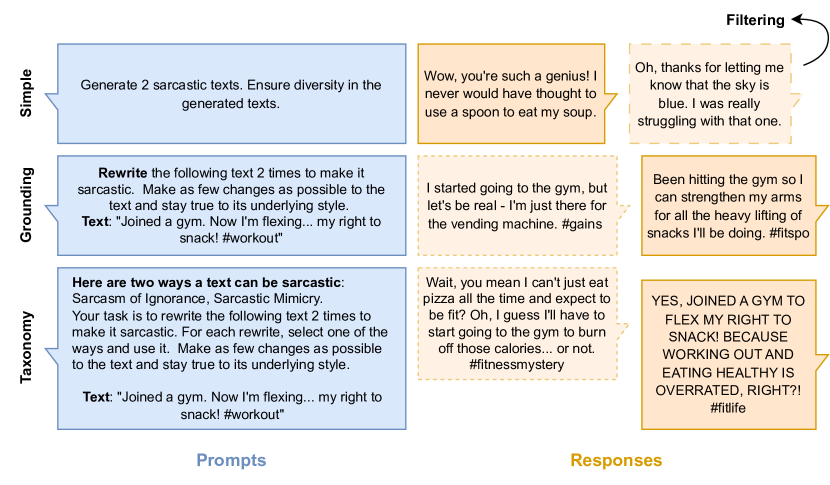
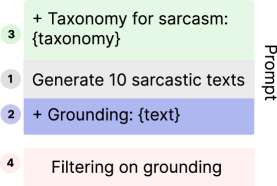
この研究は prompting 戦略— grounding、 taxonomy-based generation、 および filtering—を検証し、大規模言語モデルからの合成データをサルカズム検出においてより忠実にすることを目指し、ベースラインおよび実データと比較します。
Large Language Models (LLMs) have democratized synthetic data generation, which in turn has the potential to simplify and broaden a wide gamut of NLP tasks. Here, we tackle a pervasive problem in synthetic data generation: its generative distribution often differs from the distribution of real-world data researchers care about (in other words, it is unfaithful). In a case study on sarcasm detection, we study three strategies to increase the faithfulness of synthetic data: grounding, filtering, and taxonomy-based generation. We evaluate these strategies using the performance of classifiers trained with generated synthetic data on real-world data. While all three strategies improve the performance of classifiers, we find that grounding works best for the task at hand. As synthetic data generation plays an ever-increasing role in NLP research, we expect this work to be a stepping stone in improving its utility. We conclude this paper with some recommendations on how to generate high(er)-fidelity synthetic data for specific tasks.
研究の動機と目的
- NLP における忠実な合成データの必要性を LLMs で喚起する。
- 忠実度を高めるための prompting 戦略(grounding、taxonomy-based generation)を提案する。
- 合成データで分類器を訓練し、皮肉検出の実データで評価して戦略を評価する。
- grounding の効果を他の戦略と比較し、実用的な推奨を提供する。
提案手法
- SemEval-2022 Task 6 の皮肉データを訓練・評価に用いる。
- 複数の prompting 戦略の下で ChatGPT を用いて合成データを生成する。
- 合成データで E5-base モデルを微調整し、実データのテストセットで評価する。
- 合成データをフィルタリングする識別器を訓練し、真の実データと比較する。
- 生成データと実データの分類器を比較して信憑性を評価する。
実験結果
リサーチクエスチョン
- RQ1 grounding、 taxonomy-based generation、 および filtering は LLM 生成の合成データを皮肉検出の忠実度向上に寄与するか?
- RQ2これらの戦略は下流の性能を用いた簡易 prompting および zero-shot ChatGPT とどのように比較されるか?
- RQ3これらの戦略が、実データで評価した場合の分類器の macro-F1 および信憑性に与える影響は?
- RQ4topics の多様性と関心の対象となる構成を捉えるのに、grounding が最も効果的な戦略か?
主な発見
| Prompting Strategy | Sarcasm | Accuracy | Macro-F1 | Believability |
|---|---|---|---|---|
| シンプル | 0.71 | 0.71 | 0.48 | 0.04 |
| グラウンディング | 0.67 | 0.67 | 0.55 | 0.13 |
| グラウンディング(書き換え) | 0.70 | 0.70 | 0.55 | 0.15 |
| グラウンディング+タクソノミー | 0.67 | 0.67 | 0.51 | 0.20 |
| グラウンディング+フィルタリング | 0.27 | 0.27 | 0.26 | 0.56 |
| 真の注釈データ | 0.72 | 0.72 | 0.60 | 0.95 |
| すべて非皮肉 | 0.77 | 0.77 | 0.43 | — |
| ゼロショット ChatGPT | 0.60 | 0.60 | 0.59 | — |
- Grounding ベースの prompting が、synthetic-data で訓練した分類器の macro-F1 で最も高く (0.55)。
- 単純な prompting はトピックと構成の多様性が限られるため最悪のパフォーマンス(macro-F1 0.48)。
- Grounding + Taxonomy は macro-F1 0.51 となり、grounding のみと単純 prompting の間。
- Grounding + Filtering は判別器の制約によりパフォーマンスが低下し macro-F1 0.26。
- ゼロショット ChatGPT の macro-F1 は 0.60 で、より小規模な prompting で合成データを訓練したモデルを上回る。
- 信憑性は手法により異なり、Grounding + Filtering が最高の信憑性 (0.56) を達成する一方、Groundtruth annotations は 0.95、Simple は低いまま (0.04)。
より良い研究を、今すぐ始めましょう
論文設計から論文執筆まで、研究時間を劇的に削減しましょう。
クレジットカード登録不要
このレビューはAIが作成し、人間の編集者が確認しました。