
[Paper Review] Generative Dual Adversarial Network for Generalized Zero-shot Learning
This paper proposes Generative Dual Adversarial Network (GDAN), a unified framework for generalized zero-shot learning that jointly learns visual-to-semantic mapping, semantic-to-visual generation, and metric learning via cyclic consistency and dual adversarial loss. GDAN achieves state-of-the-art performance by generating high-quality visual features for unseen classes while preserving high accuracy on seen classes across four benchmark datasets.
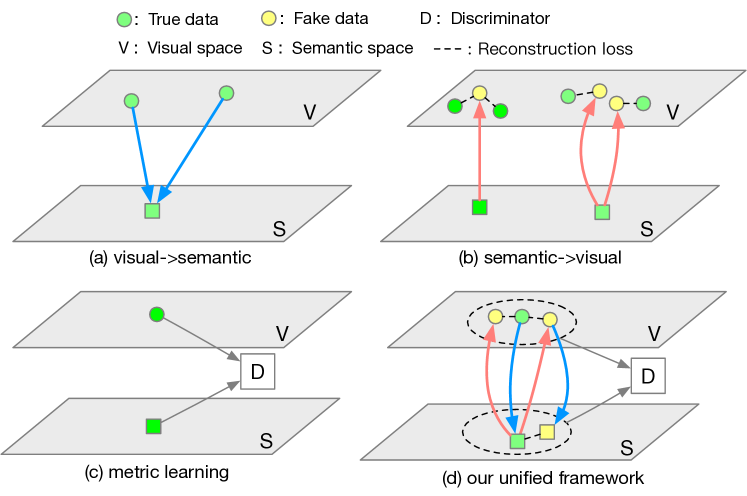
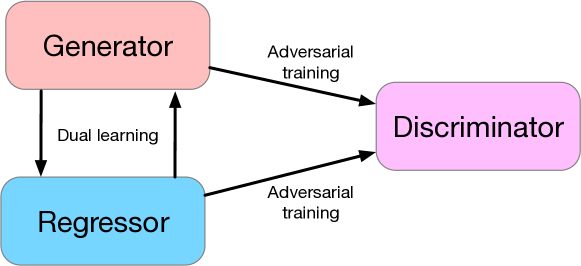
This paper studies the problem of generalized zero-shot learning which requires the model to train on image-label pairs from some seen classes and test on the task of classifying new images from both seen and unseen classes. Most previous models try to learn a fixed one-directional mapping between visual and semantic space, while some recently proposed generative methods try to generate image features for unseen classes so that the zero-shot learning problem becomes a traditional fully-supervised classification problem. In this paper, we propose a novel model that provides a unified framework for three different approaches: visual-> semantic mapping, semantic->visual mapping, and metric learning. Specifically, our proposed model consists of a feature generator that can generate various visual features given class embeddings as input, a regressor that maps each visual feature back to its corresponding class embedding, and a discriminator that learns to evaluate the closeness of an image feature and a class embedding. All three components are trained under the combination of cyclic consistency loss and dual adversarial loss. Experimental results show that our model not only preserves higher accuracy in classifying images from seen classes, but also performs better than existing state-of-the-art models in in classifying images from unseen classes.
Motivation & Objective
- To address the limitations of existing zero-shot learning models that rely on fixed one-directional mappings between visual and semantic spaces.
- To unify three complementary approaches—visual-to-semantic mapping, semantic-to-visual generation, and metric learning—into a single end-to-end framework.
- To improve generalization to unseen classes while maintaining high accuracy on seen classes in the generalized zero-shot learning setting.
- To develop a novel dual adversarial loss that enables mutual learning between the regressor and discriminator, enhancing feature alignment and similarity evaluation.
Proposed method
- The model consists of a generator that synthesizes visual features from class embeddings, a regressor that maps visual features back to semantic embeddings, and a discriminator that evaluates the match between visual and semantic features.
- The generator and regressor are trained via cyclic consistency loss, ensuring that generated features can be reconstructed to their original semantic embeddings.
- The generator and discriminator are trained via a dual adversarial loss, where the discriminator distinguishes real from fake (generated) feature pairs, and the generator learns to produce realistic, matching pairs.
- The entire framework is jointly optimized using a combination of cyclic consistency loss and dual adversarial loss to improve feature quality and alignment.
- The model supports semi-supervised learning and avoids the hubness problem by not relying on a shared latent space, instead learning flexible, adversarial-based similarity metrics.
- t-SNE visualization is used to qualitatively evaluate the distribution of synthetic and real image features, showing that generated features closely match real ones.
Experimental results
Research questions
- RQ1Can a unified deep learning framework effectively combine visual-to-semantic mapping, semantic-to-visual generation, and metric learning for generalized zero-shot learning?
- RQ2Does the proposed dual adversarial loss mechanism improve feature alignment and classification performance compared to single-directional or non-adversarial approaches?
- RQ3How does joint training of generator, regressor, and discriminator affect performance on both seen and unseen classes?
- RQ4To what extent do synthetic visual features generated by the model resemble real features in distribution and discriminability?
Key findings
- GDAN achieves state-of-the-art performance on four benchmark datasets (CUB, SUN, AwA2, aPY), outperforming existing methods in zero-shot classification accuracy for unseen classes.
- The model maintains high accuracy on seen classes, effectively balancing performance across seen and unseen classes in the generalized zero-shot learning setting.
- Component analysis shows that all three components (generator, regressor, discriminator) benefit from joint training, demonstrating the effectiveness of the unified framework.
- Increasing the number of synthetic samples improves performance on unseen classes, with saturation around 400 samples, especially benefiting datasets with more unseen classes like CUB and SUN.
- t-SNE visualization confirms that synthetic image features are well-distributed and closely aligned with real image features, particularly for classes like blue whale, sheep, and giraffe.
- Failure cases, such as the rat and statue classes, show that high semantic similarity or visual complexity can challenge the model’s generation capability.
Read this paper
Open the full text in the Nubint reader and ask about any passage as you read.
Read this paper on NubintThis review was generated by AI from the original paper. Please check the paper before citing it.