
[Paper Review] GenPhys: From Physical Processes to Generative Models
This paper introduces GenPhys, a unified framework that transforms smooth, generative partial differential equations (PDEs) from physical processes into new generative models. By identifying 's-generative' PDEs—those that smooth over time and describe density flows—it generalizes diffusion and Poisson flow models and discovers new families, such as Yukawa generative models, expanding the design space of physics-inspired generative modeling.
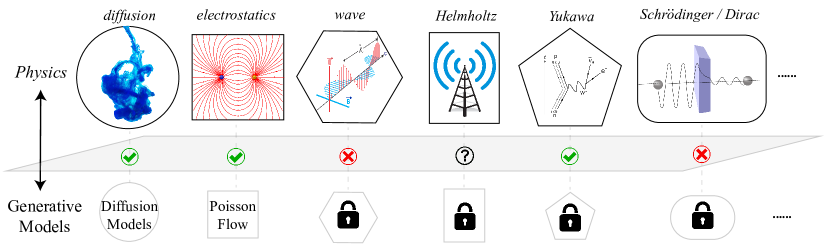
Since diffusion models (DM) and the more recent Poisson flow generative models (PFGM) are inspired by physical processes, it is reasonable to ask: Can physical processes offer additional new generative models? We show that the answer is yes. We introduce a general family, Generative Models from Physical Processes (GenPhys), where we translate partial differential equations (PDEs) describing physical processes to generative models. We show that generative models can be constructed from s-generative PDEs (s for smooth). GenPhys subsume the two existing generative models (DM and PFGM) and even give rise to new families of generative models, e.g., "Yukawa Generative Models" inspired from weak interactions. On the other hand, some physical processes by default do not belong to the GenPhys family, e.g., the wave equation and the Schrödinger equation, but could be made into the GenPhys family with some modifications. Our goal with GenPhys is to explore and expand the design space of generative models.
Motivation & Objective
- To establish a systematic framework for deriving generative models from physical processes described by PDEs.
- To identify a broad class of PDEs—designated as 's-generative'—that can generate valid generative models through smoothing and density flow dynamics.
- To unify existing generative models like diffusion and Poisson flow models under a single theoretical framework.
- To discover new generative model families, such as Yukawa generative models, inspired by physical interactions like weak nuclear forces.
- To explore the theoretical and practical potential of non-smoothing and nonlinear PDEs beyond the current s-generative constraint.
Proposed method
- Define 's-generative' PDEs as those satisfying two conditions: (C1) they describe a density flow, and (C2) their solutions become smoother over time via faster decay of high-frequency modes.
- Use dispersion relations to rigorously assess whether a PDE satisfies the smoothing condition (C2), enabling classification of PDEs into s-generative, conditionally s-generative, or non-s-generative categories.
- Map physical PDEs (e.g., diffusion, Poisson, Yukawa) to corresponding generative models via the GenPhys framework, ensuring the PDEs meet the s-generative criteria.
- Formulate the generative process as a continuous time evolution from a simple initial distribution (e.g., Gaussian) to the data distribution, guided by the PDE’s flow.
- Apply the framework to known models: diffusion models correspond to the heat equation, Poisson flow models to the Poisson equation, and new models to equations like the Yukawa equation.
- Propose extensions to nonlinear, time-dependent, and asymmetric PDEs as future directions, despite focusing on linear, time-independent, symmetric PDEs in the core analysis.
Experimental results
Research questions
- RQ1Can physical processes described by PDEs be systematically converted into generative models?
- RQ2What mathematical conditions on a PDE ensure it can generate a valid generative model through smoothing and density flow dynamics?
- RQ3Do existing generative models like diffusion and Poisson flow models emerge as special cases within a broader framework of physical process-based generative modeling?
- RQ4Can new families of generative models be derived from physical PDEs beyond the known diffusion and Poisson types?
- RQ5What are the limitations of the current framework, particularly regarding non-smoothing, nonlinear, or time-dependent PDEs?
Key findings
- The framework successfully subsumes both diffusion models and Poisson flow generative models as special cases of GenPhys, with the diffusion equation and Poisson equation being s-generative PDEs.
- The paper introduces 'Yukawa generative models' as a new family of generative models derived from the Yukawa (screened Poisson) equation, inspired by weak nuclear interactions.
- The concept of 's-generative' PDEs is formalized using dispersion relations, providing a rigorous criterion to determine whether a PDE produces a smoothing flow suitable for generative modeling.
- PDEs such as the wave equation and Schrödinger equation are not s-generative by default, but can be modified to become s-generative, suggesting potential for future extensions.
- The framework reveals that the duality between physics and generative modeling is not coincidental but mathematically grounded in the structure of PDEs that describe smoothing density flows.
- The paper identifies significant unexplored opportunities, including nonlinear PDEs (e.g., Navier-Stokes), time-dependent PDEs, and asymmetric PDEs, which may yield new generative model families beyond the current s-generative scope.
Read this paper
Open the full text in the Nubint reader and ask about any passage as you read.
Read this paper on NubintThis review was generated by AI from the original paper. Please check the paper before citing it.