
[Paper Review] Geometric phase and holonomy in the space of 2-by-2 symmetric operators
The paper defines a conic metric on 2x2 real symmetric matrices, shows eigenvector frames are parallel, derives Berry connection and curvature, and analyzes geometric phase and holonomy, including a covering-space unwinding to manage nontrivial holonomy.
We present a non-trivial metric tensor field on the space of 2-by-2 real-valued, symmetric matrices whose Levi-Civita connection renders frames of eigenvectors parallel. This results in fundamental reimagining of the space of symmetric matrices as a curved manifold (rather than a flat vector space) and reduces the computation of eigenvectors of one-parameter-families of matrices to a single computation of eigenvectors at an initial point, while the rest are obtained by the parallel transport ODE. Our work has important applications to vibrations of physical systems whose topology is directly explained by the non-trivial holonomy of the spaces of symmetric matrices.
Motivation & Objective
- Reconceptualize the space of symmetric matrices as a curved manifold via a metric that parallelizes eigenvector frames.
- Derive explicit intrinsic expressions for the Berry connection and curvature in the 2x2 symmetric case.
- Characterize geometric phase and holonomy for curves in the space, including closed curves and winding numbers.
- Show how parallel transport reduces eigenvector computation along parameter paths to initial-point eigenvectors.
- Propose a covering-space construction to manage nontrivial holonomy near singular subspaces.
Proposed method
- Define a cone-like metric on the space of 2x2 real symmetric matrices with zero trace, extend to all symmetric matrices by a direct sum with a z-coordinate.
- Construct an orthonormal frame (e1, e2) in polar coordinates and derive the Levi-Civita connection form ω and curvature form dω.
- Show that the connection equals the Berry connection for unit-length eigenvector fields, i.e., ∇E ≡ 0 for eigenvector fields E along curves.
- Compute explicit expressions for ω and dω, yielding geometric phase θ(γ) = ∫ im(γ) ω and, for closed curves, θ(γ) = π W(γ;0).
- Extend the construction to Sym(2, R) by adding a z-coordinate and show dω remains a delta-supported curvature at the singular line, producing a Z4 holonomy.
Experimental results
Research questions
- RQ1What is the intrinsic geometric structure on the space of 2x2 symmetric matrices that makes eigenvector frames parallel?
- RQ2How do Berry connection and curvature appear in this intrinsic metric without embedding into flat space?
- RQ3What is the geometric phase for parameterized families of symmetric matrices, and how is holonomy characterized?
- RQ4How can one handle nontrivial holonomy via covering spaces, and what are the implications for eigenvector tracking?
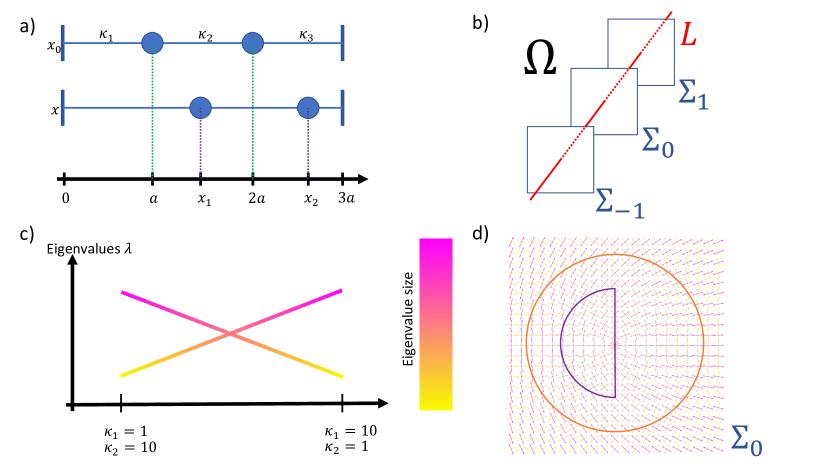
- RQ5How can these ideas be applied to parameter-dependent mass-spring systems via pulled-back metrics?
Key findings
- A conic metric on 2x2 symmetric matrices yields a non-flat space with singular subspaces of infinite curvature and non-trivial holonomy.
- The Levi-Civita connection of this metric provides the Berry connection for eigenvectors, with explicit formulas ω = 1/2 dφ and dω supported on a delta function at the origin.
- Geometric phase for closed curves equals π times the winding number around the singular set, yielding Hol(Sigma a0 0) = Z2 and Hol(Sigma) = Z4.
- Extending to Sym(2,R) introduces a singular line L, where the curvature concentrates, and yields Hol(Sym(2,R)a0L) = Z2 and Hol(Sym(2,R)) = Z4, with a covering-space unwinding to reduce holonomy.
- A practical framework is provided to compute eigenvectors along parameter paths via parallel transport, reducing repeated eigenvalue computations to initial eigenvector evaluation followed by ODE integration.
- The mass-spring system example shows how the pulled-back metric on parameter space K can encode dynamics and topology of the Hessian map.
Read this paper
Open the full text in the Nubint reader and ask about any passage as you read.
Read this paper on NubintThis review was generated by AI from the original paper. Please check the paper before citing it.