
[Paper Review] GIAOTracker: A comprehensive framework for MCMOT with global information and optimizing strategies in VisDrone 2021
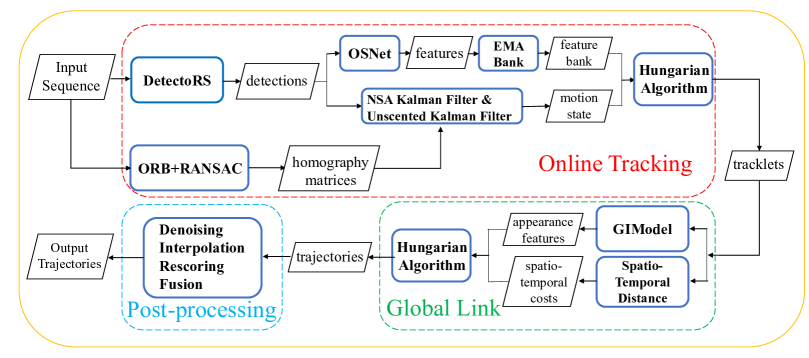
GIAOTracker is a novel three-stage framework for multi-class multi-object tracking (MCMOT) in drone videos, integrating global information and optimization strategies to achieve state-of-the-art performance. It enhances tracking through adaptive motion modeling, a global feature extractor (GIModel), and four post-processing techniques, achieving 54.18 mAP and 2nd place in the VisDrone2021 MOT Challenge.
In recent years, algorithms for multiple object tracking tasks have benefited from great progresses in deep models and video quality. However, in challenging scenarios like drone videos, they still suffer from problems, such as small objects, camera movements and view changes. In this paper, we propose a new multiple object tracker, which employs Global Information And some Optimizing strategies, named GIAOTracker. It consists of three stages, i.e., online tracking, global link and post-processing. Given detections in every frame, the first stage generates reliable tracklets using information of camera motion, object motion and object appearance. Then they are associated into trajectories by exploiting global clues and refined through four post-processing methods. With the effectiveness of the three stages, GIAOTracker achieves state-of-the-art performance on the VisDrone MOT dataset and wins the 3rd place in the VisDrone2021 MOT Challenge.
Motivation & Objective
- Address the challenges of small objects, camera motion, and view changes in drone video tracking.
- Improve tracking robustness and accuracy by integrating global information and optimizing tracking stages.
- Develop a comprehensive framework that enhances online tracking, global association, and post-processing for MCMOT in complex UAV scenarios.
- Reduce tracking errors from detection noise and occlusions through novel feature and motion modeling strategies.
- Demonstrate the effectiveness of post-processing techniques such as trajectory denoising, interpolation, re-scoring, and model fusion.
Proposed method
- Proposes EMA Bank, a feature storage and update strategy that maintains dynamic feature states and tracks feature change information.
- Introduces Noise Scale Adaptive Kalman (NSA Kalman), which dynamically adjusts measurement noise scale based on detection quality for improved motion modeling.
- Designs GIModel, a tracklet feature extractor that fuses global and part-level appearance features with a self-attention based temporal modeling block for robust representation.
- Employs a global link stage that uses tracklet features and spatio-temporal distances to associate tracklets into full trajectories.
- Applies four post-processing strategies: temporal-IoU-based NMS for denoising, linear interpolation for missing detections, length-dependent re-scoring, and TrackNMS for model fusion.
- Uses a hierarchical tracking pipeline: online tracking → global link → post-processing, enabling robust and accurate trajectory construction.
Experimental results
Research questions
- RQ1How can global information be effectively leveraged to improve trajectory association in drone video MCMOT?
- RQ2To what extent do adaptive motion modeling and optimized feature representation enhance tracking robustness in challenging UAV scenarios?
- RQ3Can a combination of post-processing techniques significantly improve tracking performance beyond the base tracker?
- RQ4How does model fusion via TrackNMS impact tracking mAP in complex drone video sequences?
- RQ5What is the relative contribution of detection quality versus tracking framework design in achieving high performance on VisDrone2021?
Key findings
- GIAOTracker achieves 54.18 mAP on the VisDrone2021 test-challenge set, ranking 2nd among 157 submissions.
- With annotation-based detections, GIAOTracker achieves 82.97 mAP on the test-dev set, a 92.4% improvement over its best single-model result.
- The post-processing stage contributes significantly, with denoising, interpolation, and rescoring improving mAP by 0.14, 0.23, and 1.64 points respectively.
- Model fusion via TrackNMS boosts performance from 43.12 mAP to 44.46 mAP, demonstrating the effectiveness of ensemble tracking.
- The global link stage significantly enhances tracking by reducing trajectory fractures, especially under occlusion and view changes.
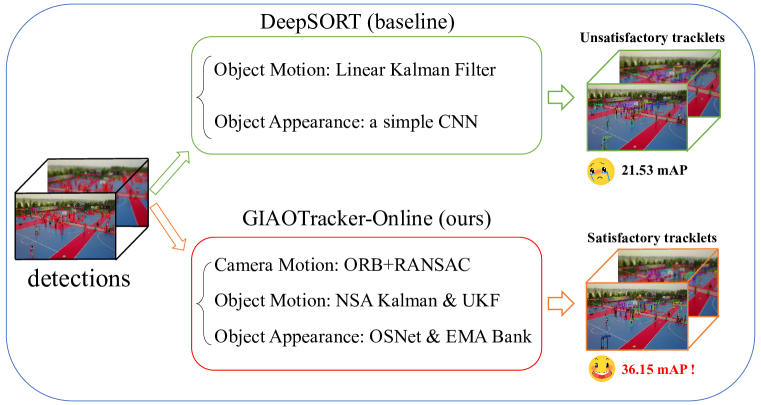
- NSA Kalman and GIModel outperform standard linear Kalman filters and baseline feature extractors, proving their effectiveness in motion and appearance modeling.
Read this paper
Open the full text in the Nubint reader and ask about any passage as you read.
Read this paper on NubintThis review was generated by AI from the original paper. Please check the paper before citing it.