
[Paper Review] GLoRe: When, Where, and How to Improve LLM Reasoning via Global and Local Refinements
This paper proposes GLoRe, a framework that improves LLM reasoning by decomposing refinement into when, where, and how to refine using synthetic data. It introduces Stepwise Outcome Reward Models (SORMs) to better detect errors in intermediate reasoning steps than standard Outcome Reward Models (ORMs), and combines global and local refinement with ORM-based reranking to boost accuracy from 53% to 65% on GSM8K using a LLaMA-2 13B model.
State-of-the-art language models can exhibit impressive reasoning refinement capabilities on math, science or coding tasks. However, recent work demonstrates that even the best models struggle to identify extit{when and where to refine} without access to external feedback. Outcome-based Reward Models ( extbf{ORMs}), trained to predict correctness of the final answer indicating when to refine, offer one convenient solution for deciding when to refine. Process Based Reward Models ( extbf{PRMs}), trained to predict correctness of intermediate steps, can then be used to indicate where to refine. But they are expensive to train, requiring extensive human annotations. In this paper, we propose Stepwise ORMs ( extbf{SORMs}) which are trained, only on synthetic data, to approximate the expected future reward of the optimal policy or $V^{\star}$. More specifically, SORMs are trained to predict the correctness of the final answer when sampling the current policy many times (rather than only once as in the case of ORMs). Our experiments show that SORMs can more accurately detect incorrect reasoning steps compared to ORMs, thus improving downstream accuracy when doing refinements. We then train extit{global} refinement models, which take only the question and a draft solution as input and predict a corrected solution, and extit{local} refinement models which also take as input a critique indicating the location of the first reasoning error. We generate training data for both models synthetically by reusing data used to train the SORM. We find combining global and local refinements, using the ORM as a reranker, significantly outperforms either one individually, as well as a best of three sample baseline. With this strategy we can improve the accuracy of a LLaMA-2 13B model (already fine-tuned with RL) on GSM8K from 53\% to 65\% when greedily sampled.
Motivation & Objective
- To address the brittleness of LLM self-refinement on reasoning tasks without external feedback.
- To improve the detection of reasoning errors by refining reward models for intermediate steps.
- To develop a scalable, synthetic-data-based method for training accurate intermediate-step reward models.
- To combine global and local refinement strategies using reward-based reranking for superior performance.
- To demonstrate that synthetic data can effectively train models that outperform baselines without human-annotated supervision.
Proposed method
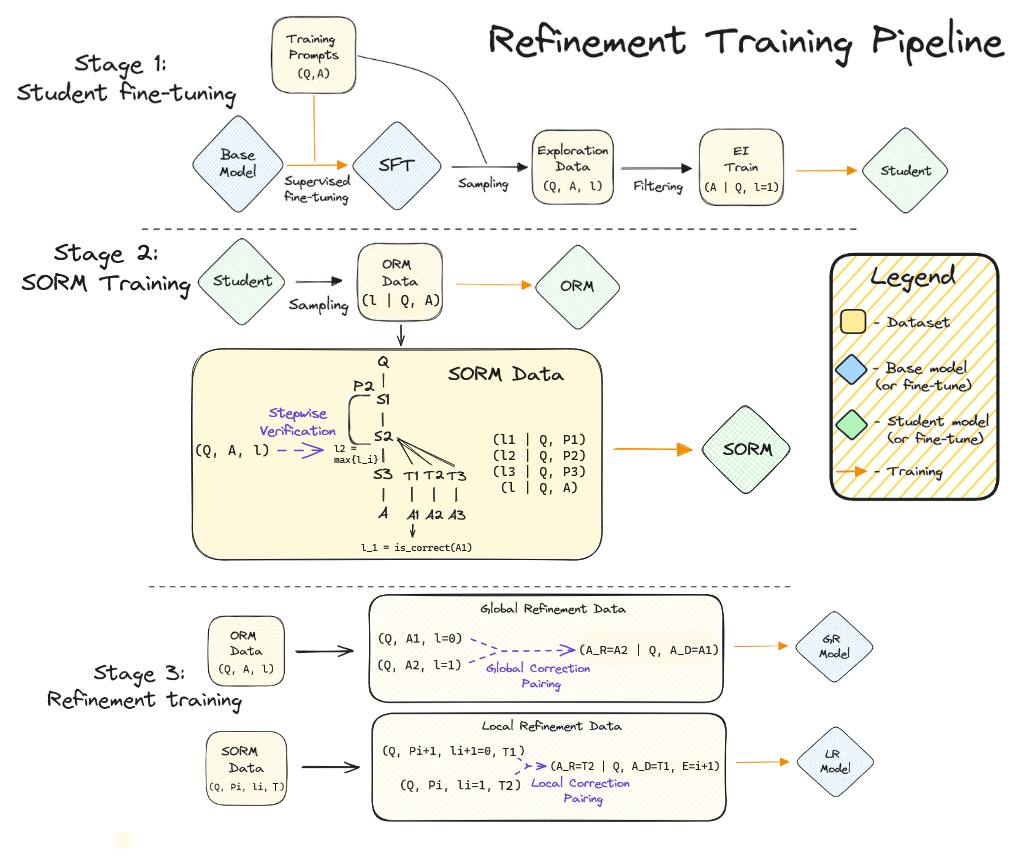
- Introduce Stepwise Outcome Reward Models (SORMs) trained on synthetic data by sampling a policy multiple times from each intermediate step to estimate final answer correctness.
- Use rejection sampling and post-processing to approximate the optimal policy π* and generate training labels for SORMs.
- Train global refinement models using synthetic pairs of incorrect and correct solutions to correct entire reasoning traces.
- Train local refinement models that use SORM feedback to identify and correct the first erroneous reasoning step.
- Combine global and local refinements and use the ORM as a reranker to select the best output among draft, global, and local refinements.
- Reuse SORM and ORM training data for all components, enabling full synthetic data training without human annotations.
Experimental results
Research questions
- RQ1Can outcome-based reward models (ORMs) reliably assess the correctness of intermediate reasoning steps in LLMs?
- RQ2How can we improve intermediate step evaluation without relying on expensive human-annotations for process-based reward models (PRMs)?
- RQ3Can synthetic data be used to train reward models that better detect errors in reasoning chains than standard ORMs?
- RQ4Does combining global and local refinement strategies with reward-based reranking improve overall reasoning accuracy?
- RQ5Can SORMs generalize better than ORMs to harder reasoning tasks where the policy is far from optimal?
Key findings
- SORMs outperform ORMs in detecting incorrect reasoning steps, especially on harder tasks where the policy is far from optimal.
- Using SORMs to guide local refinement improves accuracy on intermediate steps, reducing false negatives compared to ORMs.
- Global and local refinement models solve largely disjoint sets of problems, indicating strong complementarity.
- Combining both refinement types with ORM-based reranking improves GSM8K accuracy from 53% to 65% on LLaMA-2 13B, surpassing the best-of-three baseline by 8-13%.
- The best performance is achieved when both global and local refinements are reranked by the ORM, fixing up to 41% of problems previously failed by the base model.

Read this paper
Open the full text in the Nubint reader and ask about any passage as you read.
Read this paper on NubintThis review was generated by AI from the original paper. Please check the paper before citing it.