
[Paper Review] Google Scanned Objects: A High-Quality Dataset of 3D Scanned Household Items
This paper introduces Google Scanned Objects (GSO), a high-quality, open-source dataset of over 1,000 3D-scanned household items, captured using a custom stereo vision and structured light scanning pipeline. The dataset is preprocessed for use in simulation platforms like Ignition Gazebo and Bullet, enabling realistic physical and visual simulation for robotics and computer vision research, with demonstrated impact across 10 projects in vision, navigation, and manipulation.
Interactive 3D simulations have enabled breakthroughs in robotics and computer vision, but simulating the broad diversity of environments needed for deep learning requires large corpora of photo-realistic 3D object models. To address this need, we present Google Scanned Objects, an open-source collection of over one thousand 3D-scanned household items released under a Creative Commons license; these models are preprocessed for use in Ignition Gazebo and the Bullet simulation platforms, but are easily adaptable to other simulators. We describe our object scanning and curation pipeline, then provide statistics about the contents of the dataset and its usage. We hope that the diversity, quality, and flexibility of Google Scanned Objects will lead to advances in interactive simulation, synthetic perception, and robotic learning.
Motivation & Objective
- To address the lack of diverse, high-fidelity 3D object models for training deep learning systems in interactive robotics simulations.
- To provide a scalable, curated dataset of real-world household objects with accurate geometry and photorealistic textures.
- To enable sim-to-real transfer learning by offering physically plausible and visually realistic 3D models.
- To support research in robotic manipulation, navigation, and synthetic perception through a standardized, accessible dataset.
- To establish a reusable pipeline for high-quality 3D scanning and curation of everyday objects for simulation use.
Proposed method
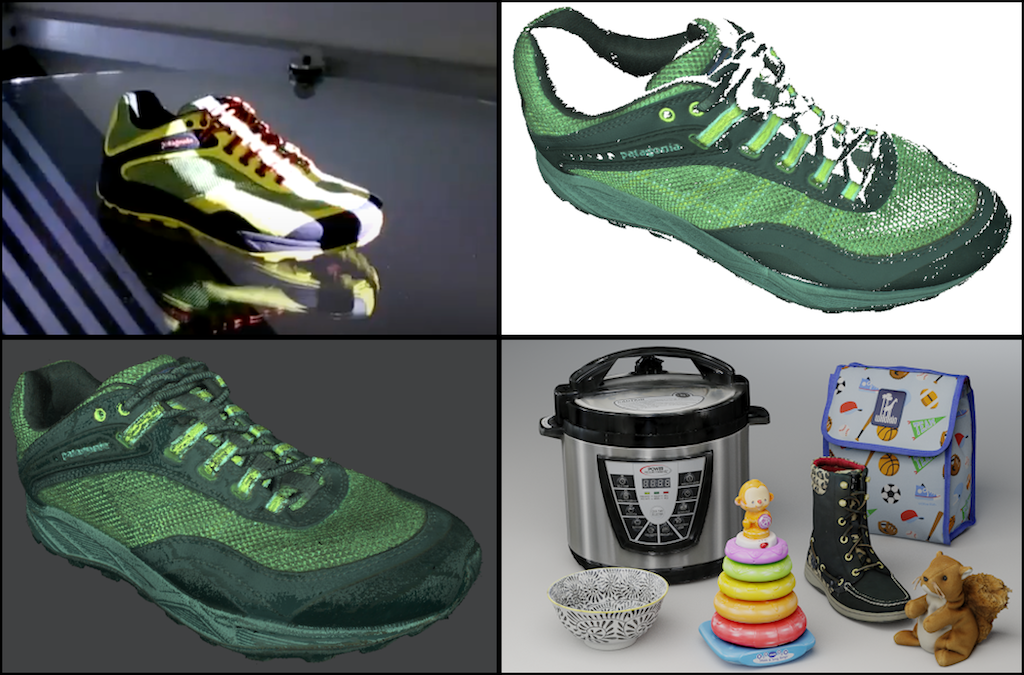
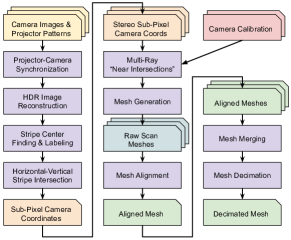
- Employed a custom scanning setup with dual machine vision cameras, a DSLR for HDR color capture, and a projector for structured light patterns to capture high-resolution 3D meshes.
- Used a calibration-based pipeline to align sub-pixel camera coordinates and merge stereo pairs into coherent raw mesh reconstructions.
- Implemented a quality assurance and curation process to filter and refine scans, ensuring watertight, high-fidelity models.
- Preprocessed all models into SDF format for native compatibility with Ignition Gazebo and Bullet simulation platforms.
- Applied diffuse texture mapping to preserve visual fidelity while maintaining compatibility across simulators.
- Hosted the dataset on Ignition Fuel to enable discoverability, versioning, and easy integration into research workflows.
Experimental results
Research questions
- RQ1Can a scalable, high-quality 3D scanning pipeline produce a large corpus of realistic household objects suitable for robotics simulation?
- RQ2To what extent do high-fidelity 3D scans improve the realism and performance of simulated environments in robotic learning tasks?
- RQ3How effective is the GSO dataset in enabling sim-to-real transfer for vision and manipulation tasks compared to synthetic or hand-modeled objects?
- RQ4What is the impact of diverse, real-world object geometry and texture on the generalization of deep learning models in simulation?
- RQ5Can a curated, open-source dataset of scanned objects accelerate research in synthetic perception, navigation, and robotic manipulation?
Key findings
- The GSO dataset contains 1,030 high-quality 3D-scanned household objects, each with accurate geometry and photorealistic textures, suitable for physical simulation.
- The scanning pipeline achieved high geometric fidelity, with smooth surfaces and accurate silhouette edges, outperforming typical RGB-D scan results.
- The dataset has been integrated into 10 distinct research projects across computer vision, robotics, and graphics, including iGibson, NViSII, and IBRNet.
- Projects using GSO reported improved visual realism and performance gains in sim-to-real transfer, particularly in grasping and navigation tasks.
- The dataset enabled validation of differentiable stereo and keypoint deformation models due to its high-quality, real-world geometry.
- Internal extensions of the dataset with cleaned specular and transparent materials enhanced performance in generative models like RetinaGAN and RL-CycleGAN.
Read this paper
Open the full text in the Nubint reader and ask about any passage as you read.
Read this paper on NubintThis review was generated by AI from the original paper. Please check the paper before citing it.