
[Paper Review] Graph Learning under Distribution Shifts: A Comprehensive Survey on Domain Adaptation, Out-of-distribution, and Continual Learning
This survey provides a comprehensive taxonomy and analysis of graph learning under distribution shifts, categorizing methods into domain adaptation, out-of-distribution, and continual learning based on distribution observability and supervision availability. It synthesizes state-of-the-art techniques, identifies key challenges, and outlines future research directions for robust, generalizable graph neural networks in dynamic real-world settings.
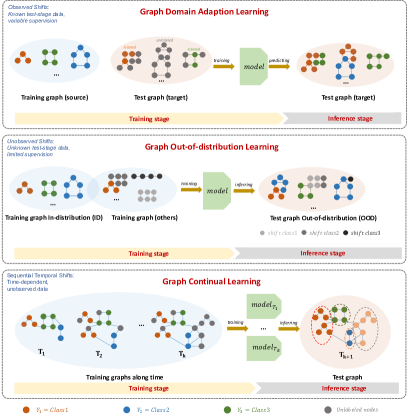
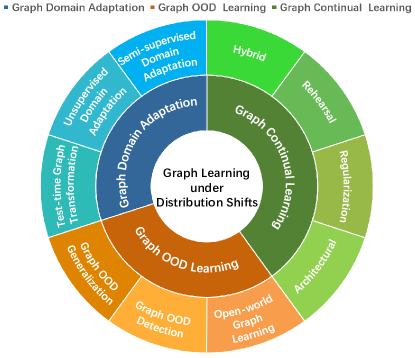
Graph learning plays a pivotal role and has gained significant attention in various application scenarios, from social network analysis to recommendation systems, for its effectiveness in modeling complex data relations represented by graph structural data. In reality, the real-world graph data typically show dynamics over time, with changing node attributes and edge structure, leading to the severe graph data distribution shift issue. This issue is compounded by the diverse and complex nature of distribution shifts, which can significantly impact the performance of graph learning methods in degraded generalization and adaptation capabilities, posing a substantial challenge to their effectiveness. In this survey, we provide a comprehensive review and summary of the latest approaches, strategies, and insights that address distribution shifts within the context of graph learning. Concretely, according to the observability of distributions in the inference stage and the availability of sufficient supervision information in the training stage, we categorize existing graph learning methods into several essential scenarios, including graph domain adaptation learning, graph out-of-distribution learning, and graph continual learning. For each scenario, a detailed taxonomy is proposed, with specific descriptions and discussions of existing progress made in distribution-shifted graph learning. Additionally, we discuss the potential applications and future directions for graph learning under distribution shifts with a systematic analysis of the current state in this field. The survey is positioned to provide general guidance for the development of effective graph learning algorithms in handling graph distribution shifts, and to stimulate future research and advancements in this area.
Motivation & Objective
- To address the critical challenge of distribution shifts in real-world graph data, which degrade model generalization and adaptation in dynamic environments.
- To systematically categorize graph learning methods based on observability of test distributions and availability of supervision, enabling clearer understanding of methodological distinctions.
- To provide a detailed taxonomy of existing approaches in graph domain adaptation, out-of-distribution learning, and continual learning, highlighting key technical advances and open problems.
- To identify and analyze key challenges in trustworthiness, including adversarial robustness, explainability, and fairness under distribution shifts.
- To guide future research by proposing evaluation protocols, cross-modal integration, and scalable frameworks for robust graph learning in complex, evolving distributions.
Proposed method
- Proposes a three-way categorization of graph learning under distribution shifts: graph domain adaptation (observed shifts with variable supervision), out-of-distribution learning (unobserved shifts with limited supervision), and continual learning (sequential distribution shifts with incremental data).
- Introduces a detailed taxonomy for each category, analyzing core techniques such as domain-invariant representation learning, distribution discrepancy minimization, and uncertainty-aware message passing.
- Emphasizes the use of flexible message passing mechanisms to adapt to structural and feature distribution shifts across domains.
- Highlights the integration of cross-modal dependencies in graph construction (e.g., from images or text) to support learning under complex, multi-source distribution shifts.
- Proposes evaluation protocols that assess model performance across diverse graph distributions, including near and far OOD generalization on datasets from different domains.
- Advocates for unified metrics to quantify distribution discrepancy at both node-level and graph-level, enabling fair comparison across models under varying shift degrees.
Experimental results
Research questions
- RQ1How can graph learning models be effectively adapted to unseen graph data distributions when test-time distributions are observable but differ from training data?
- RQ2What techniques enable robust generalization to out-of-distribution graph data when test distributions are unknown and supervision is limited?
- RQ3How can graph learning models maintain performance and adaptability when exposed to sequential, conceptually shifting graph distributions over time?
- RQ4What evaluation protocols are needed to fairly compare models across diverse distribution shift scenarios, including cross-domain OOD generalization?
- RQ5How can trustworthiness dimensions—adversarial robustness, explainability, privacy, and fairness—be preserved under complex distribution shifts in graph learning?
Key findings
- Graph domain adaptation methods achieve improved generalization by learning domain-invariant representations through distribution discrepancy minimization and adversarial alignment.
- Out-of-distribution generalization techniques benefit from uncertainty estimation and distributionally robust optimization, enhancing model reliability on unseen graph structures.
- Continual graph learning methods that incorporate experience replay and parameter regularization show improved retention of prior knowledge while adapting to new distributions.
- Current evaluation protocols lack standardization, with significant performance gaps observed when transferring models from citation networks to social networks, highlighting the need for cross-domain benchmarks.
- Trustworthiness challenges such as adversarial vulnerability and fairness bias are exacerbated under distribution shifts, necessitating robustness-aware and explainable design in future models.
- Future graph learning under distribution shifts must integrate cross-modal graph construction (e.g., from images or text) with adaptive message passing to handle complex, evolving data distributions.
Read this paper
Open the full text in the Nubint reader and ask about any passage as you read.
Read this paper on NubintThis review was generated by AI from the original paper. Please check the paper before citing it.