
[Paper Review] GraphLLM: Boosting Graph Reasoning Ability of Large Language Model
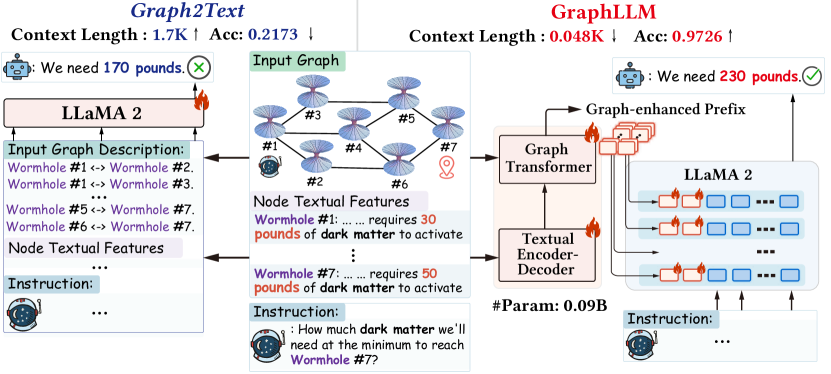
GraphLLM proposes an end-to-end framework that integrates graph neural networks with large language models (LLMs) to significantly enhance graph reasoning capabilities. By replacing the conventional Graph2Text conversion with a compact, fixed-length graph embedding prefix, GraphLLM achieves a 54.44% average accuracy gain and 96.45% context length reduction across four graph reasoning tasks, while enabling 3.42x faster inference.
The advancement of Large Language Models (LLMs) has remarkably pushed the boundaries towards artificial general intelligence (AGI), with their exceptional ability on understanding diverse types of information, including but not limited to images and audio. Despite this progress, a critical gap remains in empowering LLMs to proficiently understand and reason on graph data. Recent studies underscore LLMs' underwhelming performance on fundamental graph reasoning tasks. In this paper, we endeavor to unearth the obstacles that impede LLMs in graph reasoning, pinpointing the common practice of converting graphs into natural language descriptions (Graph2Text) as a fundamental bottleneck. To overcome this impediment, we introduce GraphLLM, a pioneering end-to-end approach that synergistically integrates graph learning models with LLMs. This synergy equips LLMs with the ability to proficiently interpret and reason on graph data, harnessing the superior expressive power of graph learning models. Our empirical evaluations across four fundamental graph reasoning tasks validate the effectiveness of GraphLLM. The results exhibit a substantial average accuracy enhancement of 54.44%, alongside a noteworthy context reduction of 96.45% across various graph reasoning tasks.
Motivation & Objective
- To address the poor performance of LLMs on fundamental graph reasoning tasks despite their success in other modalities.
- To identify Graph2Text conversion as a key bottleneck in LLM-based graph reasoning due to context length and structural ambiguity.
- To develop an end-to-end method that synergistically combines LLMs with graph learning models for superior graph reasoning.
- To reduce context length and improve inference efficiency while maintaining or enhancing reasoning accuracy.
- To demonstrate the effectiveness of the proposed method across diverse graph reasoning benchmarks.
Proposed method
- GraphLLM replaces Graph2Text by using a graph transformer to encode input graphs into a fixed-length prefix embedding.
- The prefix embedding is concatenated with the instruction prompt and fed into the LLM for reasoning, bypassing lengthy textual descriptions.
- The framework employs a unified, end-to-end training strategy that jointly optimizes the graph encoder and LLM for downstream tasks.
- It uses prefix tuning and LoRA fine-tuning to adapt the LLM to the graph reasoning task using the compact graph representation.
- The graph transformer processes node features and edge connections to generate expressive structural representations before LLM inference.
- The method supports zero-shot and few-shot prompting with minimal context overhead, enabling scalability to larger graphs.
Experimental results
Research questions
- RQ1Why do LLMs underperform on graph reasoning tasks despite their strong generalization in other domains?
- RQ2To what extent does the Graph2Text conversion strategy limit LLMs' ability to reason over graph structures?
- RQ3Can an end-to-end integration of graph neural networks and LLMs significantly improve graph reasoning accuracy and efficiency?
- RQ4How does the context length and inference speed of GraphLLM compare to Graph2Text-based baselines as graph size increases?
- RQ5Can the proposed method maintain high performance even when graph size exceeds the context window of standard LLMs?
Key findings
- GraphLLM achieves an average accuracy improvement of 54.44% across four graph reasoning tasks compared to Graph2Text-based baselines.
- The method reduces average context length by 96.45% compared to Graph2Text, with context lengths dropping to 0.04–0.055K tokens.
- GraphLLM maintains high performance on graphs with up to 45 nodes, while Graph2Text-based methods fail or drop to 0% accuracy when context limits are exceeded.
- Inference speed is accelerated by 3.42x compared to the best-performing Graph2Text-based method, despite the added graph encoder computation.
- The model achieves 96.45% accuracy on substructure counting with 45-node graphs, outperforming gpt-3.5-turbo-16k, which failed due to context overflow.
- GraphLLM demonstrates robustness and scalability, remaining effective even when graph size exceeds the context window of standard LLMs.

Read this paper
Open the full text in the Nubint reader and ask about any passage as you read.
Read this paper on NubintThis review was generated by AI from the original paper. Please check the paper before citing it.