
[Paper Review] HE-DKSAP: Privacy-Preserving Stealth Address Protocol via Additively Homomorphic Encryption
This paper proposes HE-DKSAP, a privacy-preserving stealth address protocol that leverages additively homomorphic encryption (specifically Paillier) to enhance transaction unlinkability and resistance to quantum attacks. By integrating homomorphic encryption with dual-key stealth address schemes, HE-DKSAP achieves strong security guarantees while maintaining efficient computation and reduced on-chain storage compared to plain DKSAP.
Blockchain transactions have gained widespread adoption across various industries, largely attributable to their unparalleled transparency and robust security features. Nevertheless, this technique introduces various privacy concerns, including pseudonymity, Sybil attacks, and potential susceptibilities to quantum computing, to name a few. In response to these challenges, innovative privacy-enhancing solutions like zero-knowledge proofs, homomorphic encryption, and stealth addresses (SA) have been developed. Among the various schemes, SA stands out as it prevents the association of a blockchain transaction's output with the recipient's public address, thereby ensuring transactional anonymity. However, the basic SA schemes have exhibited vulnerabilities to key leakage and quantum computing attacks. To address these shortcomings, we present a pioneering solution - Homomorphic Encryption-based Dual-Key Stealth Address Protocol (HE-DKSAP), which can be further extended to Fully HE-DKSAP (FHE-DKSAP). By leveraging the power of homomorphic encryption, HE-DKSAP introduces a novel approach to safeguarding transaction privacy and preventing potential quantum computing attacks. This paper delves into the core principles of HE-DKSAP, highlighting its capacity to enhance privacy, scalability, and security in programmable blockchains. Through a comprehensive exploration of its design architecture, security analysis, and practical implementations, this work establishes a privacy-preserving, practical, and efficient stealth address protocol via additively homomorphic encryption.
Motivation & Objective
- To address privacy vulnerabilities in traditional blockchain stealth address protocols, including key leakage and susceptibility to quantum computing attacks.
- To enhance transaction unlinkability and data confidentiality in programmable blockchains without compromising scalability.
- To design a novel protocol that integrates homomorphic encryption with dual-key stealth address mechanisms for stronger security.
- To evaluate the performance trade-offs of homomorphic encryption in stealth address generation, focusing on computation time and on-chain storage.
- To lay the foundation for extending HE-DKSAP to fully homomorphic encryption (FHE-DKSAP) for future quantum-safe blockchain applications.
Proposed method
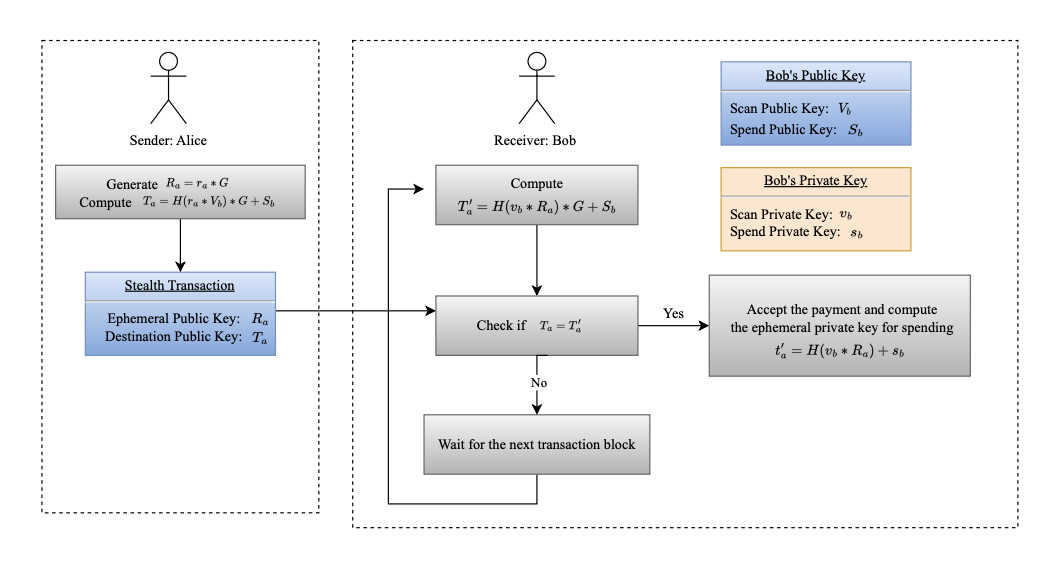
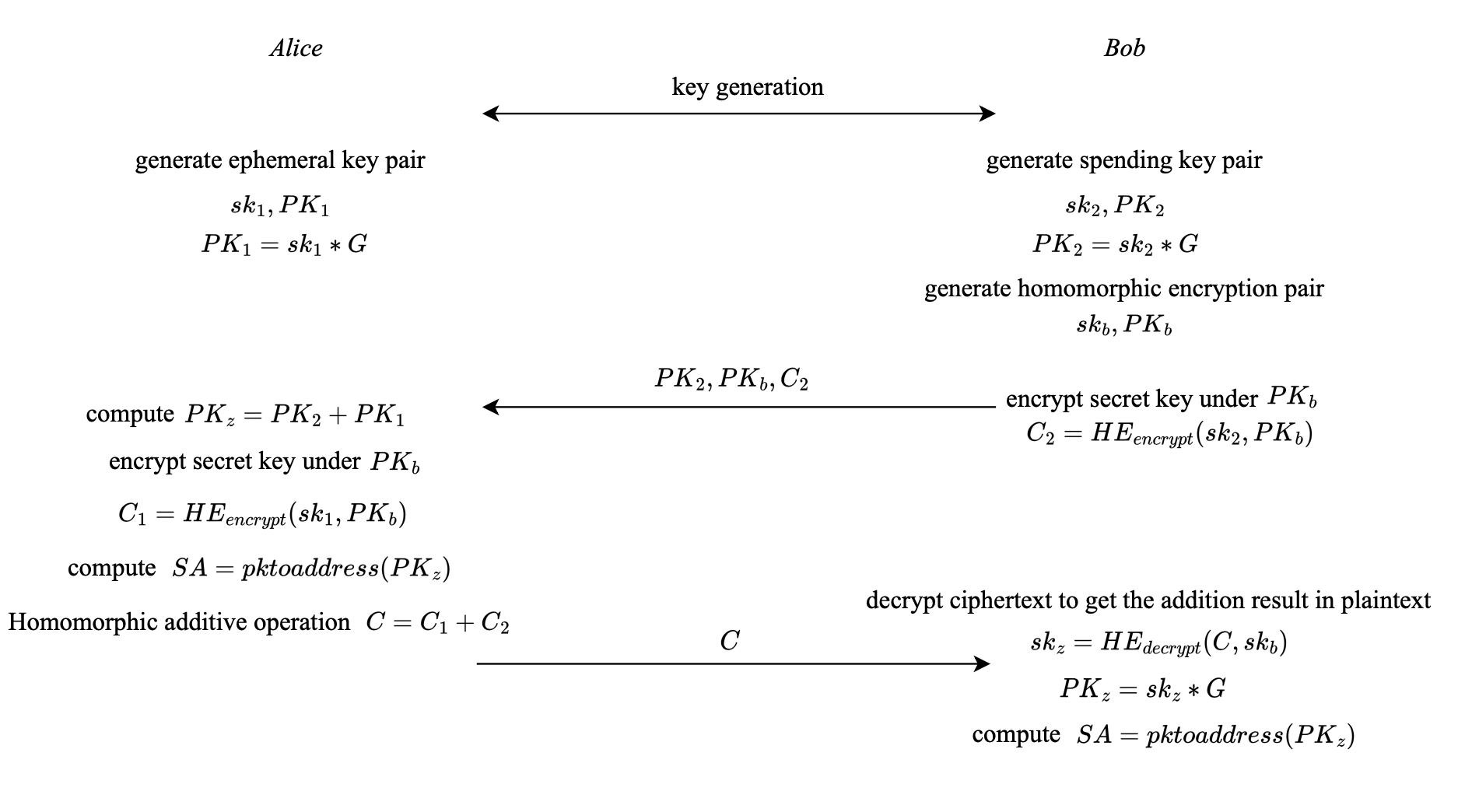
- The protocol uses additively homomorphic encryption (Paillier) to encrypt the recipient’s public key and a random value, enabling homomorphic operations on ciphertexts without decryption.
- A dual-key structure separates the spending key and scanning key, preventing key compromise from exposing the full private key.
- The stealth address is generated via a homomorphic computation: $ C = \text{Enc}_{pk}(R \cdot P) + \text{Enc}_{pk}(r) \mod n^2 $, where $ R $ is the sender’s ephemeral key and $ P $ is the recipient’s public key.
- The protocol is formally proven secure under the Decisional Diffie-Hellman (DDH) assumption and the Learning With Errors (LWE) assumption for the homomorphic encryption layer.
- FHE-DKSAP is extended using the BFV fully homomorphic encryption scheme, enabling computation on encrypted data without decryption.
- Security is formally analyzed for CPA (chosen-plaintext attack) security, unlinkability, and resistance to cipher-policy attacks.
Experimental results
Research questions
- RQ1Can additively homomorphic encryption be effectively integrated into dual-key stealth address protocols to enhance privacy and quantum resistance?
- RQ2How does the computational overhead of homomorphic encryption affect the efficiency of stealth address generation in real-world blockchain systems?
- RQ3What is the on-chain storage footprint of HE-DKSAP compared to standard DKSAP and FHE-DKSAP?
- RQ4To what extent does HE-DKSAP preserve unlinkability and data confidentiality under chosen-plaintext attacks?
- RQ5How does the performance of FHE-DKSAP (BFV) compare to HE-DKSAP (Paillier) and plain DKSAP in terms of computation and storage?
Key findings
- HE-DKSAP-Paillier is approximately 20 times slower than plain DKSAP, with an average computation time of 0.4456 seconds per generation.
- FHE-DKSAP-BFV is significantly faster than HE-DKSAP-Paillier, with an average computation time of 0.0355 seconds, and is only slightly slower than plain DKSAP.
- HE-DKSAP-Paillier and FHE-DKSAP-BFV both require less on-chain storage than plain DKSAP, with FHE-DKSAP-BFV storing only 256 bits for ciphertext components.
- The protocol achieves CPA security under the LWE assumption, confirming resistance to chosen-plaintext attacks.
- Security analysis confirms that HE-DKSAP preserves data confidentiality, transaction unlinkability, and resistance to quantum attacks.
- The use of RUST in FHE-DKSAP-BFV implementation contributes to improved performance, highlighting the importance of low-level language optimization.
Read this paper
Open the full text in the Nubint reader and ask about any passage as you read.
Read this paper on NubintThis review was generated by AI from the original paper. Please check the paper before citing it.