
[Paper Review] HERA bound on x-ray luminosity when accounting for population III stars
This paper revisits HERA's constraint on soft-band X-ray luminosity per unit star formation rate (L_X<2keV/SFR) by incorporating molecular cooling galaxies (MCGs) hosting Population III stars into 21-cm signal simulations. Using machine learning emulators and MCMC inference, it shows that including MCGs reduces the need for high X-ray luminosity, weakening the previous disfavoring of L_X<2keV/SFR ≲ 10^39.5 erg s⁻¹ M☉⁻¹ yr⁻¹ and bringing it into line with local X-ray sources.
Recent upper bounds from the Hydrogen Epoch of Reionization Array (HERA) on the cosmological 21-cm power spectrum at redshifts $z \approx 8, 10$, have been used to constrain $L_{ m X<2 \, keV}/{ m SFR}$, the soft-band X-ray luminosity measured per unit star formation rate (SFR), strongly disfavoring values lower than $\approx 10^{39.5} \, { m erg} \;{ m s}^{-1} \;{ m M}_{\odot}^{-1} \;{ m yr}$. This conclusion is derived from semi-numerical models of the 21-cm signal, specifically focusing on contributions from atomic cooling galaxies that host PopII stars. In this work, we first reproduce the bounds on $L_{ m X<2 \, keV}/{ m SFR}$ and other parameters using a pipeline that combines machine learning emulators for the power spectra and the intergalactic medium characteristics, together with a standard Markov chain Monte Carlo parameter fit. We then use this approach when including molecular cooling galaxies that host PopIII stars in the cosmic dawn 21-cm signal, and show that lower values of $L_{ m X<2 \, keV}/{ m SFR}$ are hence no longer strongly disfavored. The revised HERA bound does not require high-redshift X-ray sources to be significantly more luminous than high-mass X-ray binaries observed at low redshift.
Motivation & Objective
- To re-evaluate the HERA upper bound on the 21-cm power spectrum at z ≈ 8 and 10, which previously disfavored low L_X<2keV/SFR values.
- To investigate whether the inclusion of molecular cooling galaxies (MCGs) hosting Population III stars alters the inferred constraints on X-ray luminosity per unit SFR.
- To develop and validate machine learning emulators for the 21-cm power spectrum, optical depth (τ_e), and neutral fraction (x_HI) to accelerate Bayesian parameter inference.
- To demonstrate that the previous strong disfavoring of low L_X<2keV/SFR values arises primarily from neglecting MCG contributions, which can significantly alter the 21-cm signal during cosmic dawn.
Proposed method
- A machine learning pipeline is developed using neural networks to emulate the 21-cm power spectrum, τ_e, and x_HI as functions of cosmological and astrophysical parameters.
- The emulators are trained on ~20,000 simulations with parameters sampled via Latin Hypercube sampling, normalized to [-1, 1] for stability.
- A signal classifier with ReLU activation, batch normalization, dropout (10%), and sigmoid output is used to distinguish high- vs. low-power 21-cm signals at z ≈ 8 and 10.
- The pipeline integrates emulators with a standard Markov Chain Monte Carlo (MCMC) sampler to perform Bayesian inference on the L_X<2keV/SFR parameter.
- The method compares results with and without MCGs, enabling a direct assessment of how MCG contributions affect the HERA constraint.
- Loss functions are minimized using the Adam optimizer with early stopping and learning rate decay, and the best-performing model weights are retained.
Experimental results
Research questions
- RQ1Does the inclusion of molecular cooling galaxies (MCGs) hosting Population III stars alter the HERA constraint on L_X<2keV/SFR?
- RQ2Can machine learning emulators accurately reproduce the 21-cm power spectrum and related global quantities (τ_e, x_HI) with sufficient precision for cosmological inference?
- RQ3How does the marginalized posterior for L_X<2keV/SFR change when MCGs are included in the 21-cm signal model compared to models with only atomic cooling galaxies (ACGs)?
- RQ4To what extent do MCGs reduce the need for high X-ray luminosity per SFR to match HERA’s upper bound on the 21-cm power spectrum?
- RQ5Is the previous strong disfavoring of L_X<2keV/SFR ≲ 10^39.5 erg s⁻¹ M☉⁻¹ yr⁻¹ robust when MCG contributions are properly accounted for?
Key findings
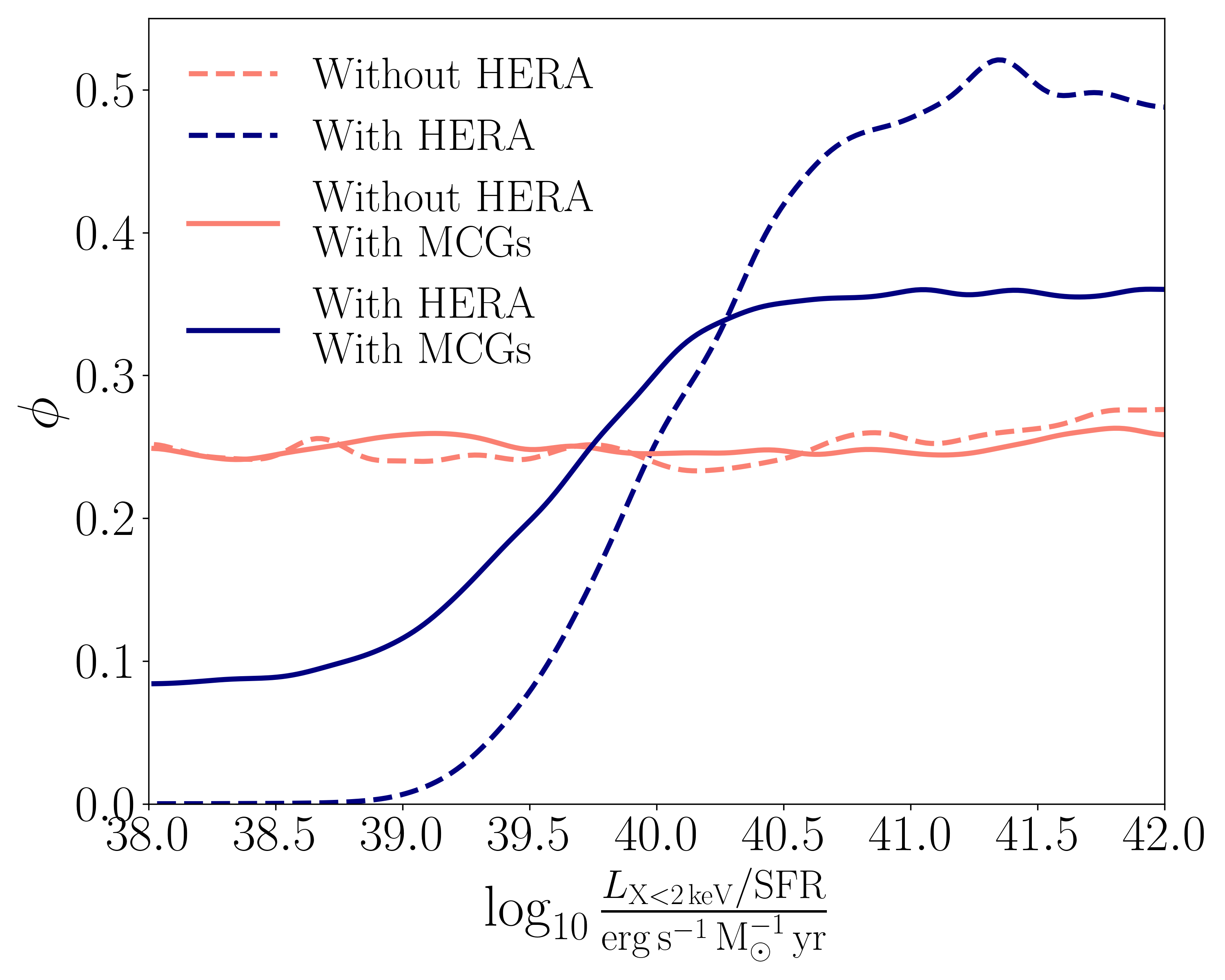
- The inclusion of molecular cooling galaxies (MCGs) hosting Population III stars significantly weakens the disfavoring of low L_X<2keV/SFR values, which were previously ruled out at high significance.
- The revised HERA bound allows for L_X<2keV/SFR ≲ 10^39.5 erg s⁻¹ M☉⁻¹ yr⁻¹ without requiring X-ray sources to be more luminous than local high-mass X-ray binaries.
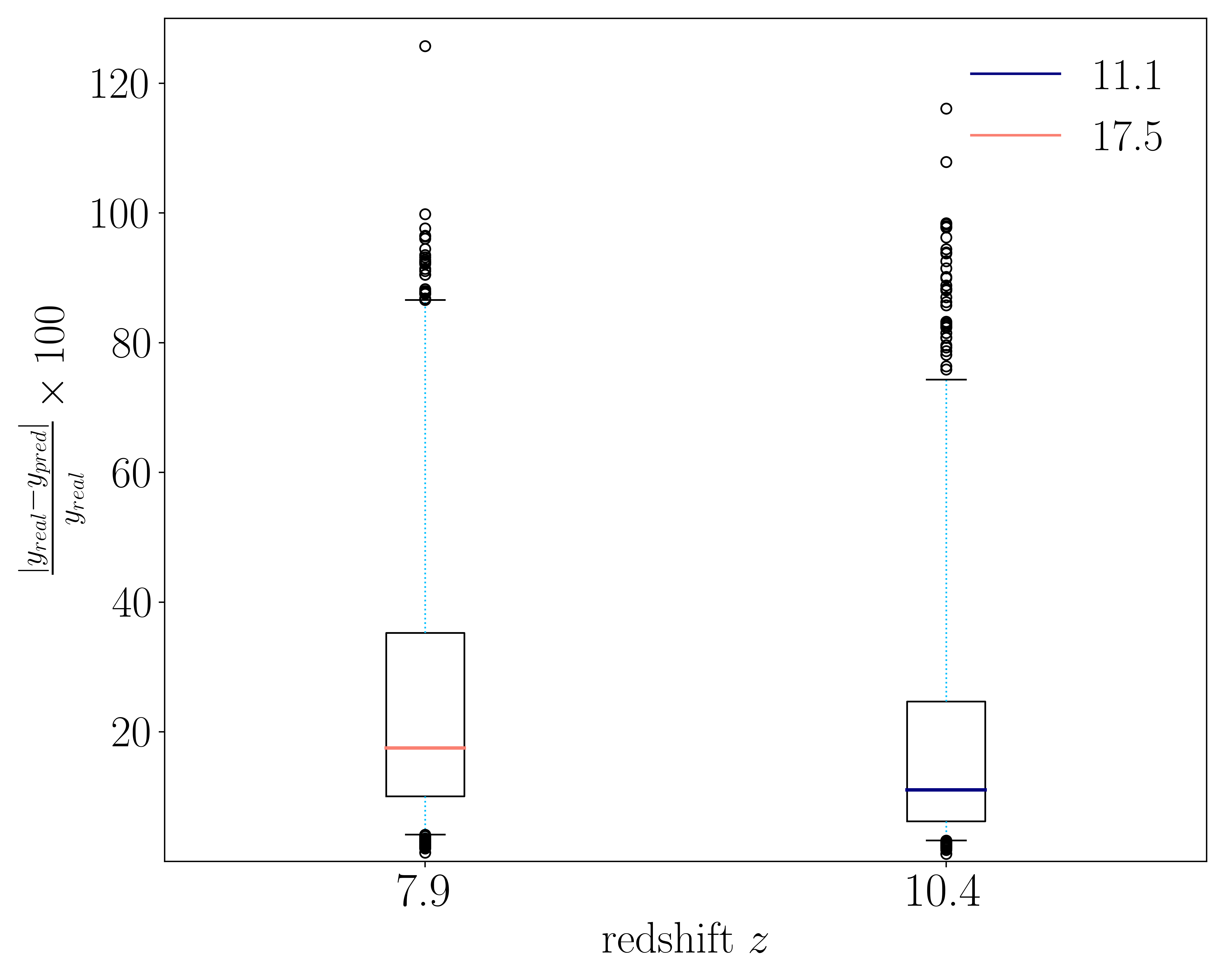
- The machine learning emulators for the 21-cm power spectrum, τ_e, and x_HI achieve high accuracy, with median loss values below 1% and 16th–84th percentile ranges indicating robust performance.
- The signal classifier used in the MCMC pipeline achieves >97% accuracy, ensuring reliable distinction between high- and low-power 21-cm signal regimes.
- The posterior distribution for L_X<2keV/SFR shifts toward lower values when MCGs are included, indicating that MCGs can produce sufficient heating and ionization to explain the data without extreme X-ray luminosity.
- The study demonstrates that neglecting MCGs leads to an overestimation of the X-ray efficiency required from atomic cooling galaxies, highlighting the importance of including early-generation star formation in 21-cm modeling.
Read this paper
Open the full text in the Nubint reader and ask about any passage as you read.
Read this paper on NubintThis review was generated by AI from the original paper. Please check the paper before citing it.