
[Paper Review] Hidden giants in JWST's PEARLS: An ultra-massive z=4.26 sub-millimeter galaxy that is invisible to HST
This study identifies a highly obscured, ultra-massive z = 4.26 sub-millimeter galaxy (850.1) in the JWST PEARLS survey that remains undetected in HST and JWST/NIRCam imaging despite its extreme stellar mass (M∗ ≈ 10¹¹.⁸ M⊙) and high dust extinction (AV ≈ 5). Using multi-wavelength data from SMA, JCMT, NOEMA, JWST, HST, and Spitzer, the authors reveal a compact, massive stellar core with a bar-like morphology, suggesting bar-driven inflow fueling a central starburst, and propose it is the central galaxy of a group merging with a less massive, less obscured companion (850.2).
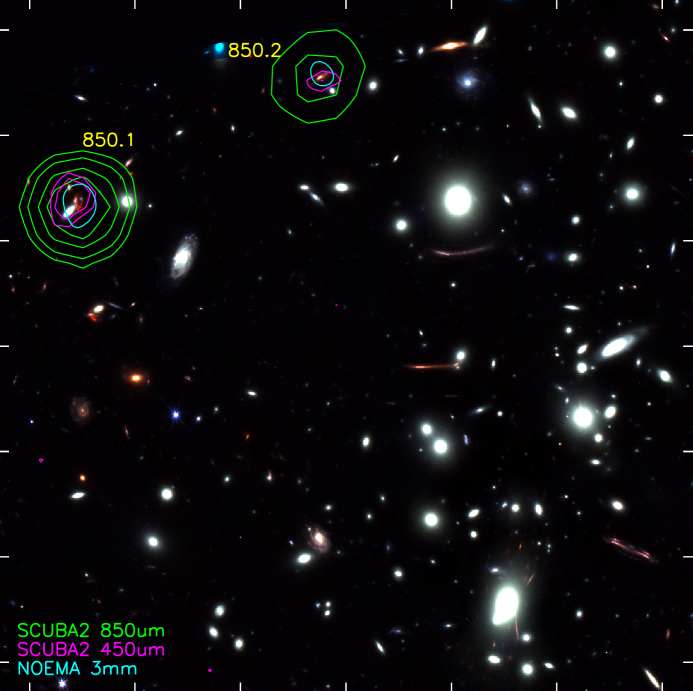
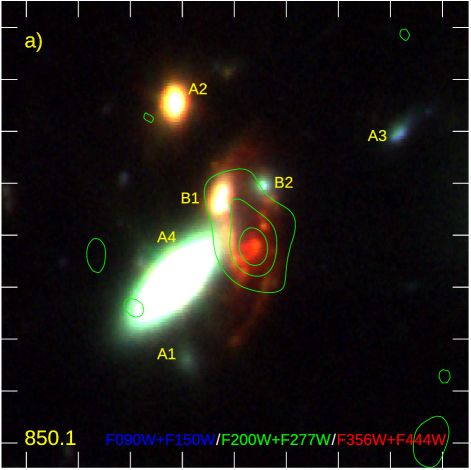
We present a multi-wavelength analysis using SMA, JCMT, NOEMA, JWST, HST, and SST of two dusty strongly star-forming galaxies, 850.1 and 850.2, seen through the massive cluster lens A1489. These SMA-located sources both lie at z=4.26 and have bright dust continuum emission, but 850.2 is a UV-detected Lyman-break galaxy, while 850.1 is undetected at <2um, even with deep JWST/NIRCam observations. We investigate their stellar, ISM, and dynamical properties, including a pixel-level SED analysis to derive sub-kpc-resolution stellar-mass and Av maps. We find that 850.1 is one of the most massive and highly obscured, Av~5, galaxies known at z>4 with M*~10^11.8 Mo (likely forming at z>6), and 850.2 is one of the least massive and least obscured, Av~1, members of the z>4 dusty star-forming population. The diversity of these two dust-mass-selected galaxies illustrates the incompleteness of galaxy surveys at z>3-4 based on imaging at <2um, the longest wavelengths feasible from HST or the ground. The resolved mass map of 850.1 shows a compact stellar mass distribution, Re(mass)~1kpc, but its expected evolution to z~1.5 and then z~0 matches both the properties of massive, quiescent galaxies at z~1.5 and ultra-massive early-type galaxies at z~0. We suggest that 850.1 is the central galaxy of a group in which 850.2 is a satellite that will likely merge in the near future. The stellar morphology of 850.1 shows arms and a linear bar feature which we link to the active dynamical environment it resides within.
Motivation & Objective
- To investigate the physical properties of two dusty, strongly star-forming galaxies (850.1 and 850.2) lensed by the massive cluster A1489 at z ≈ 4.26.
- To understand why one of these galaxies (850.1) remains undetected in HST and JWST/NIRCam imaging despite its extreme mass and dust content.
- To explore the role of dynamical interactions and internal structures—such as bars and compact stellar cores—in fueling intense star formation in high-redshift massive galaxies.
- To assess the completeness of high-redshift galaxy surveys based on UV/optical imaging, particularly at z > 4.
- To determine the evolutionary trajectory of 850.1 by comparing its observed properties to those of massive quiescent galaxies at z ≈ 1.5 and ultra-massive early-type galaxies at z ≈ 0.
Proposed method
- Conducted multi-wavelength observations using SMA, JCMT, NOEMA, JWST, HST, and Spitzer to obtain sub-millimeter, millimeter, near-infrared, and optical data.
- Performed pixel-level spectral energy distribution (SED) fitting to derive sub-kiloparsec resolution maps of stellar mass and dust extinction (AV).
- Utilized gravitational lensing modeling to reconstruct the intrinsic properties of the lensed galaxies, correcting for magnification and distortion.
- Applied galfit and GILDAS software to model the stellar morphology and dust continuum emission, identifying features such as bars and compact cores.
- Compared the observed mass and structural properties of 850.1 to known populations of massive quiescent galaxies at z ≈ 1.5 and ultra-massive early-type galaxies at z ≈ 0 to infer evolutionary pathways.
- Analyzed the spatial relationship between 850.1 and its companion 850.2 to assess merger dynamics and environmental perturbations.
Experimental results
Research questions
- RQ1Why is the ultra-massive galaxy 850.1 undetected at wavelengths ≤2 μm despite its extreme stellar mass and high dust extinction?
- RQ2What is the origin of the compact, bar-like structure observed in the stellar mass distribution of 850.1, and how does it relate to internal fueling mechanisms?
- RQ3How do the structural and dynamical properties of 850.1 compare to those of massive quiescent galaxies at z ≈ 1.5 and ultra-massive early-type galaxies at z ≈ 0?
- RQ4To what extent are current galaxy surveys at z > 4 incomplete when relying solely on UV/optical imaging, given the existence of HST-invisible, highly obscured massive galaxies?
- RQ5What role does the close companion 850.2 play in triggering or sustaining the central starburst in 850.1 through dynamical interactions?
Key findings
- Galaxy 850.1 is one of the most massive (M∗ ≈ 10¹¹.⁸ M⊙) and highly obscured (AV ≈ 5) galaxies known at z > 4, with a compact stellar mass distribution (Re ≈ 1 kpc).
- Despite deep JWST/NIRCam observations, 850.1 remains undetected at λ ≤ 2 μm, confirming its extreme dust obscuration and highlighting the limitations of UV/optical surveys at z > 4.
- The resolved stellar mass map of 850.1 reveals a linear bar feature and spiral arms, indicating active dynamical processes likely driven by interactions with its companion 850.2.
- The morphology and mass concentration of 850.1 are consistent with a bar-driven inflow that fuels a central starburst in its baryon-dominated core.
- The evolutionary trajectory of 850.1 matches that of massive quiescent galaxies at z ≈ 1.5 and ultra-massive early-type galaxies at z ≈ 0, suggesting it may be a progenitor of such systems.
- The system is interpreted as a group with 850.1 as the central galaxy and 850.2 as a massive, less obscured satellite on a merger trajectory, with dynamical perturbations likely enhancing central fueling.
Read this paper
Open the full text in the Nubint reader and ask about any passage as you read.
Read this paper on NubintThis review was generated by AI from the original paper. Please check the paper before citing it.