
[Paper Review] High-coherence hybrid-integrated 780 nm source by self-injection-locked second-harmonic generation in a high-Q silicon-nitride resonator
This paper demonstrates a compact, high-coherence 780 nm visible laser source using self-injection-locked second-harmonic generation in a high-Q silicon-nitride microresonator. By locking a 1560 nm distributed feedback laser to the resonator, the system achieves a record 4 Hz²/Hz frequency noise floor, enabling ultra-stable visible light generation for applications in optical clocks and LiDAR.
By self-injection-locking a 1560 nm distributed feedback semiconductor laser to a high-$Q$ silicon nitride resonator, a high-coherence 780 nm second harmonic signal is generated via the photogalvanic-induced second-order nonlinearity. A record-low frequency noise floor of 4 Hz$^2$/Hz is achieved for the 780 nm emission. The approach can be generalized for signal generation over a wide range of visible and near-visible bands.
Motivation & Objective
- Develop a compact, chip-integrated source of high-coherence visible light for applications beyond laboratory settings.
- Overcome the limitations of bulky, high-cost bench-top visible lasers used in optical atomic clocks, LiDAR, and sensing.
- Achieve ultra-low frequency noise in a visible on-chip laser through self-injection-locking and resonant enhancement.
- Enable scalable, tunable visible light generation across the visible and near-visible spectrum using a single platform.
Proposed method
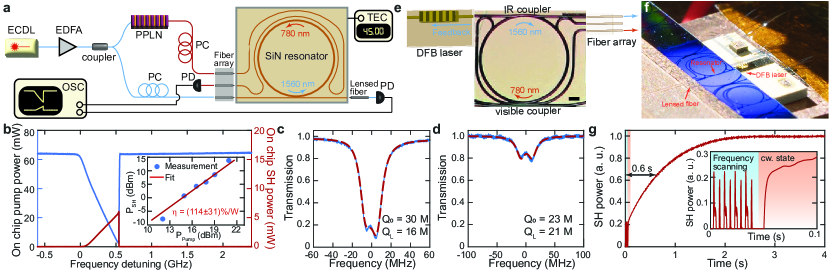
- Use a high-Q silicon-nitride microresonator with a 5 µm waveguide width and 850 µm radius to confine light at 1560 nm and 780 nm.
- Implement dual-mode couplers: a 2.3 µm-wide near-IR coupler and a 1.6 µm-wide visible coupler to minimize cross-coupling.
- Leverage the photogalvanic effect in Si3N4 to induce optical poling and enable quasi-phase-matched second-harmonic generation.
- Apply self-injection-locking by end-fire coupling a 1560 nm DFB laser to the resonator, using backscattered light to stabilize the laser frequency.
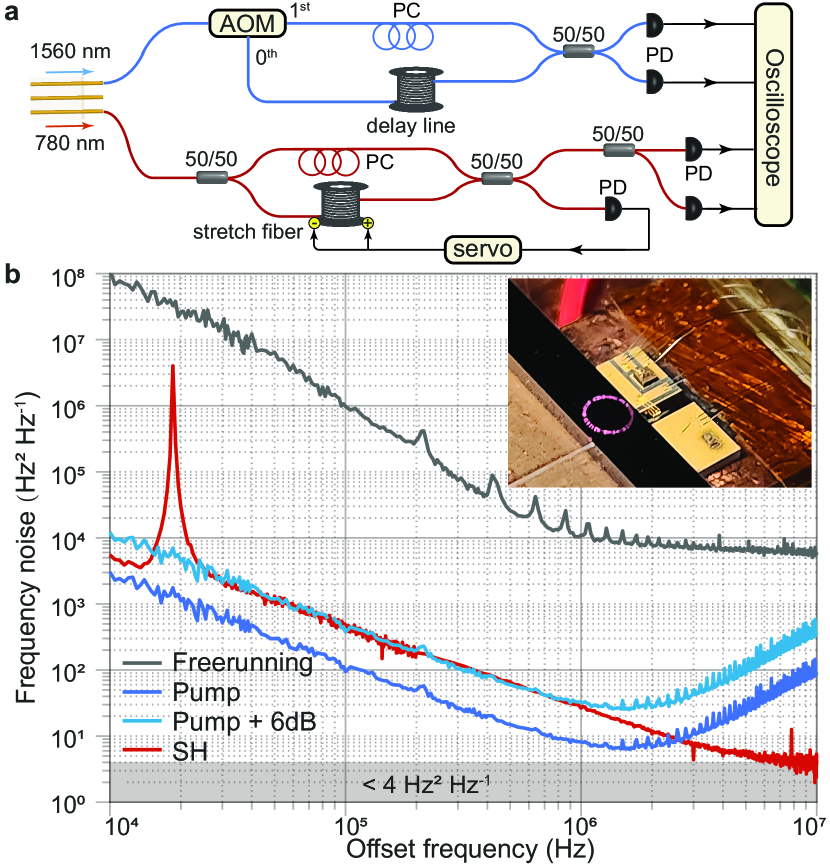
- Characterize frequency noise using a self-heterodyne technique with a balanced cross-correlation method to suppress photodetector noise.
- Control comb formation via laser current tuning and feedback phase to maintain single-mode operation and maximize SH power.
Experimental results
Research questions
- RQ1Can self-injection-locking in a high-Q Si3N4 resonator reduce the frequency noise of a 1560 nm DFB laser to enable high-coherence visible output?
- RQ2To what extent can the photogalvanic effect in Si3N4 enable efficient, quasi-phase-matched second-harmonic generation at 780 nm?
- RQ3How does the system performance scale with resonator quality factor, and what is the theoretical limit for noise reduction?
- RQ4Can the platform be generalized to generate coherent light across the visible and near-visible spectrum with minimal reconfiguration?
- RQ5What are the trade-offs between single-frequency lasing and Kerr comb formation in the feedback system, and how can they be controlled?
Key findings
- The hybrid-integrated 780 nm source achieves a record-low frequency noise floor of 4 Hz²/Hz at 100 kHz offset frequency.
- The self-injection-locked 1560 nm pump laser exhibits a 40 dB noise suppression at 100 kHz and 32 dB at 1 MHz compared to its free-running state.
- Second-harmonic conversion efficiency reaches 114 ± 31% W⁻¹, with up to 24 mW of on-chip SH output power measured.
- The system maintains single-frequency operation over a wide tuning range, avoiding detrimental Kerr frequency comb formation through current and phase control.
- The measured instantaneous linewidth of the 780 nm source is 25 Hz, the narrowest reported for an on-chip visible laser.
- The platform is scalable and can be adapted to other visible and near-visible wavelengths by reconfiguring the waveguide couplers.
Read this paper
Open the full text in the Nubint reader and ask about any passage as you read.
Read this paper on NubintThis review was generated by AI from the original paper. Please check the paper before citing it.