
[Paper Review] High-fidelity remote entanglement of trapped atoms mediated by time-bin photons
This paper demonstrates high-fidelity remote entanglement of two trapped 138Ba+ ions using time-bin-encoded photons, achieving a Bell state fidelity of 97.0(4)%. The protocol uses heralded interference of time-bin photonic qubits and suppresses key errors—particularly from atomic recoil and laser intensity fluctuations—enabling a path toward scalable, modular quantum networks with fidelities exceeding 99.9%.
Photonic interconnects between quantum processing nodes are likely the only way to achieve large-scale quantum computers and networks. The bottleneck in such an architecture is the interface between well-isolated quantum memories and flying photons. We establish high-fidelity entanglement between remotely separated trapped atomic qubit memories, mediated by photonic qubits stored in the timing of their pulses. Such time-bin encoding removes sensitivity to polarization errors, enables long-distance quantum communication, and is extensible to quantum memories with more than two states. Using a measurement-based error detection process and suppressing a fundamental source of error due to atomic recoil, we achieve an entanglement fidelity of 97% and show that fidelities beyond 99.9% are feasible.
Motivation & Objective
- To enable high-fidelity, long-distance quantum interconnects between remote trapped-ion qubits using photonic links.
- To overcome limitations of polarization-encoded photonic qubits, which are sensitive to birefringence in optical components and fibers.
- To demonstrate that time-bin encoding enables robust, scalable remote entanglement with high fidelity and low error rates.
- To identify and suppress dominant error sources such as atomic recoil, laser intensity fluctuations, and detector dark counts.
- To show that fidelities beyond 99.9% are feasible, enabling modular quantum computing and long-distance quantum communication.
Proposed method
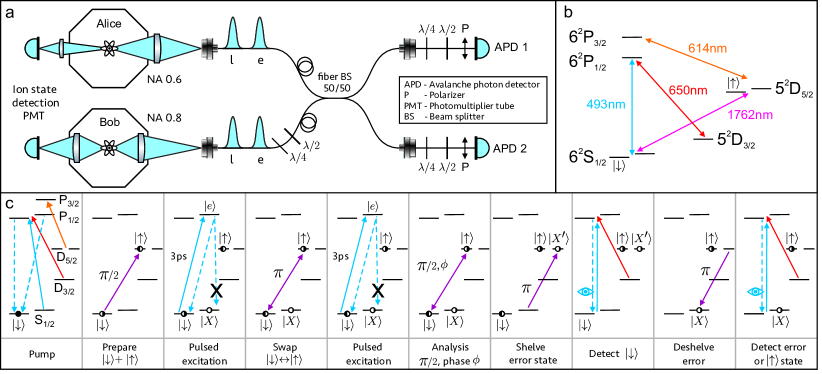
- Time-bin encoding is used to store photonic qubits in the temporal profile of single photons emitted from trapped 138Ba+ ions.
- Photons from two remote ions are collected via high-numerical-aperture objectives and interfered on a beamsplitter for heralded Bell-state measurement.
- A measurement-based error detection protocol flags and purifies erasure errors with minimal overhead.
- The protocol suppresses errors from atomic recoil by stabilizing the timing of ion excitation and photon detection within 10 ns windows.
- Laser intensity fluctuations are minimized through active stabilization, reducing SPAM and state swap errors.
- Doppler cooling limits and motional modes are characterized to estimate recoil-induced errors, with a focus on the most sensitive mode (ion B, y-mode, with n̄D ≈ 826).
Experimental results
Research questions
- RQ1Can time-bin-encoded photons enable high-fidelity remote entanglement between trapped ions, surpassing the fidelity limits of polarization-based protocols?
- RQ2What are the dominant error sources in time-bin-based remote entanglement, and can they be experimentally suppressed?
- RQ3To what extent does atomic recoil from photon emission degrade entanglement fidelity, and can this be mitigated by timing control?
- RQ4Can the fidelity be pushed beyond 99.9% with current experimental techniques, enabling scalable modular quantum architectures?
- RQ5How does the choice of photonic encoding (time-bin vs. polarization) impact scalability and robustness in long-distance quantum networks?
Key findings
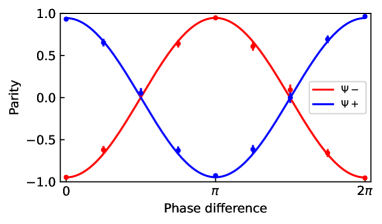
- The experiment achieves a Bell state fidelity of 97.0(4)%, demonstrating high-fidelity remote entanglement between two trapped 138Ba+ ions using time-bin photons.
- The largest fidelity error source is intensity fluctuations in the 1762 nm laser driving qubit rotations, contributing 1.00% error, which is the dominant term in the error budget.
- Photon wavepacket overlap error is minimized to 0.4% through path-length stabilization, matching temporal profiles within 30 ps.
- Recoil-induced errors from photon detection timing jitter (10 ns window) contribute 0.2% to the fidelity error, with additional contributions from motional state entanglement and laser frequency fluctuations.
- Detector dark counts and background light contribute less than 0.2% to the error budget, while beam-splitter imperfections and mode mismatch contribute less than 0.1%.
- The total fidelity error is estimated at 2.00%, with a residual coherence time of 2.1 ms limiting error to less than 0.01% during the 8 μs analysis window.
Read this paper
Open the full text in the Nubint reader and ask about any passage as you read.
Read this paper on NubintThis review was generated by AI from the original paper. Please check the paper before citing it.