
[论文解读] High-T$_C$ superconductivity in $\mathrm{La_3Ni_2O_7}$ based on the bilayer two-orbital t-J model
本研究采用重整化平均场理论下的双层双轨道 t-J 模型,研究了高压下 La$_3$Ni$_2$O$_7$ 中的高 T$_C$ 超导性。结果识别出由层间 $d_{z^2}$ 自旋磁耦合驱动的稳健 $s^\pm$-波配对,预测转变温度 $T_C \sim 80$ K,与实验结果一致,并在全面的超导相图中表明该化合物处于最佳掺杂附近。
The recently discovered high-T$_C$ superconductor La$_3$Ni$_2$O$_7$ has sparked renewed interest in the unconventional superconductivity. Here we study superconductivity in pressurized La$_3$Ni$_2$O$_7$ based on a bilayer two-orbital $t-J$ model, using the renormalized mean-field theory. Our results reveal a robust $s^\pm-$wave pairing driven by the inter-layer $d_{z^2}$ magnetic coupling, which exhibits a transition temperature within the same order of magnitude as the experimentally observed $T_c \sim 80$ K. We establish a comprehensive superconducting phase diagram in the doping plane. Notably, the La$_3$Ni$_2$O$_7$ under pressure is found situated roughly in the optimal doping regime of the phase diagram. When the $d_{x^2-y^2}$ orbital becomes close to half-filling, $d-$wave and $d+is$ pairing can emerge from the system. We discuss the interplay between Fermi surface topology and different pairing symmetries. The stability of the $s^\pm-$wave pairing against Hund's coupling and other magnetic exchange couplings is discussed.
研究动机与目标
- 理解最近发现的高压下高 T$_C$ 镍氧化物 La$_3$Ni$_2$O$_7$ 中的非常规超导机制。
- 确定 La$_3$Ni$_2$O$_7$ 中的配对机制是否类似于铜氧化物,或由于多轨道参与和强层间耦合而代表一种新机制。
- 在掺杂平面中绘制超导相图,识别强电子关联下配对对称性和转变温度。
- 评估 $d_{z^2}$ 轨道杂化及层间磁交换耦合 ($J_\perp$) 在稳定高 T$_C$ 超导性中的作用。
提出的方法
- 基于先前对 La$_3$Ni$_2$O$_7$ 电子结构研究的紧束缚参数,构建包含 $d_{x^2-y^2}$ 和 $d_{z^2}$ 轨道的双层双轨道 $t$-$J$ 模型。
- 应用重整化平均场理论(RMFT),通过掺杂依赖的重整化因子 $g_t$ 和 $g_J$ 纳入强电子关联效应,从而处理 BCS 配对不稳定性。
- 采用磁交换耦合的平均场分解,识别超导配对通道并计算超导序参量 $g_t\Delta$。
- 在 $p_x$-$p_z$ 掺杂平面中构建超导相图,分析不同配对对称性($s^\pm$、$d$-波、$d+is$)在掺杂下的稳定性。
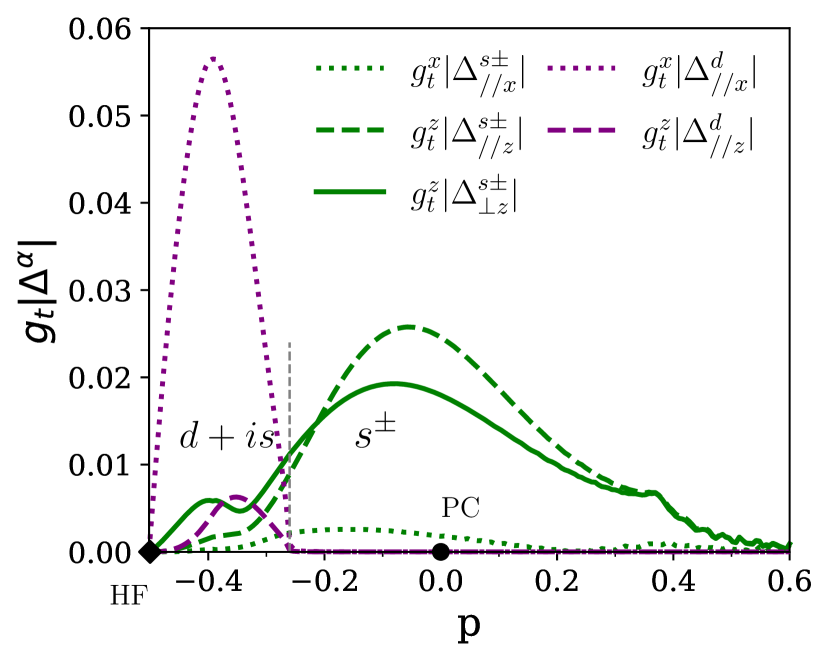
- 与单带 $t$-$J$ 模型基准结果对比,验证 RMFT 实现的正确性,并通过 $|\Delta_{\perp z}^{s^\pm}|$ 和 $g_t^z|\Delta_{\perp z}^{s^\pm}|$ 评估赝能隙行为。

实验结果
研究问题
- RQ1当 $d_{x^2-y^2}$ 和 $d_{z^2}$ 轨道均处于激活状态时,高压下 La$_3$Ni$_2$O$_7$ 中的主导配对对称性是什么?
- RQ2层间 $d_{z^2}$ 磁耦合 ($J_\perp$) 如何影响超导转变温度 $T_C$?
- RQ3La$_3$Ni$_2$O$_7$ 在超导相图中的位置如何?是否处于最佳掺杂区域?
- RQ4费米面拓扑结构与轨道占据(特别是 $d_{z^2}$ 接近半满时)如何影响不同配对态的出现?
- RQ5在 Hund 耦合及其他磁交换相互作用下,$s^\pm$-波配对的稳定性如何?
主要发现
- $s^\pm$-波配对对称性具有鲁棒性,主要由层间 $d_{z^2}$ 磁耦合 ($J_\perp$) 驱动,其大小估计至少为层内 $J_{\parallel}$ 耦合的两倍。
- 计算得到的超导转变温度 $T_C \sim 80$ K 与高压下 La$_3$Ni$_2$O$_7$ 的实验观测值高度一致。
- La$_3$Ni$_2$O$_7$ 位于超导相图的最佳掺杂区域附近,其中 $d_{x^2-y^2}$ 轨道的空穴密度约为 1.5,$d_{z^2}$ 轨道接近半满(空穴密度约 1.0)。
- 当 $d_{z^2}$ 轨道接近半满时,$d$-波和 $d+is$ 配对不稳定性出现,表明不同配对对称性之间存在竞争。
- $s^\pm$-波配对对 Hund 耦合及其他磁交换相互作用具有稳定性,表明其在高 T$_C$ 区域占主导地位。
- 在 $T_C$ 以上的赝能隙表现出非单调的掺杂依赖性,与单带 $t$-$J$ 模型不同,且 $|\Delta_{\perp z}^{s^\pm}|$ 显著大于超导序参量 $g_t^z|\Delta_{\perp z}^{s^\pm}|$。
更好的研究,从现在开始
从阅读论文到最终审阅,大幅缩短您的研究时间。
无需绑定信用卡
本解读由 AI 生成,并经人工编辑审核。