
[Paper Review] High Tide or Riptide on the Cosmic Shoreline? A Water-Rich Atmosphere or Stellar Contamination for the Warm Super-Earth GJ~486b from JWST Observations
This study analyzes JWST NIRSpec/G395H transmission spectroscopy of the warm super-Earth GJ 486b, finding a deviation from a flat spectrum at 2.2–3.3σ significance. The data are equally well-fit by either a water-rich atmosphere (H₂O > 10% at 2σ) or stellar contamination from unocculted starspots, highlighting a degeneracy that requires shorter-wavelength observations to resolve.
Planets orbiting M-dwarf stars are prime targets in the search for rocky exoplanet atmospheres. The small size of M dwarfs renders their planets exceptional targets for transmission spectroscopy, facilitating atmospheric characterization. However, it remains unknown whether their host stars' highly variable extreme-UV radiation environments allow atmospheres to persist. With JWST, we have begun to determine whether or not the most favorable rocky worlds orbiting M dwarfs have detectable atmospheres. Here, we present a 2.8-5.2 micron JWST NIRSpec/G395H transmission spectrum of the warm (700 K, 40.3x Earth's insolation) super-Earth GJ 486b (1.3 R$_{\oplus}$ and 3.0 M$_{\oplus}$). The measured spectrum from our two transits of GJ 486b deviates from a flat line at 2.2 - 3.3 $σ$, based on three independent reductions. Through a combination of forward and retrieval models, we determine that GJ 486b either has a water-rich atmosphere (with the most stringent constraint on the retrieved water abundance of H2O > 10% to 2$σ$) or the transmission spectrum is contaminated by water present in cool unocculted starspots. We also find that the measured stellar spectrum is best fit by a stellar model with cool starspots and hot faculae. While both retrieval scenarios provide equal quality fits ($χ^2_ν$ = 1.0) to our NIRSpec/G395H observations, shorter wavelength observations can break this degeneracy and reveal if GJ 486b sustains a water-rich atmosphere.
Motivation & Objective
- To determine whether the warm super-Earth GJ 486b possesses a detectable, water-rich atmosphere despite its host star's high magnetic activity.
- To assess whether stellar inhomogeneities—specifically unocculted starspots and faculae—can mimic atmospheric absorption features in transmission spectroscopy.
- To resolve the degeneracy between a true atmospheric signal and stellar contamination using multi-reduction, multi-instrument consistency checks.
- To provide robust constraints on the atmospheric composition of a rocky exoplanet orbiting an active M-dwarf star using JWST data.
Proposed method
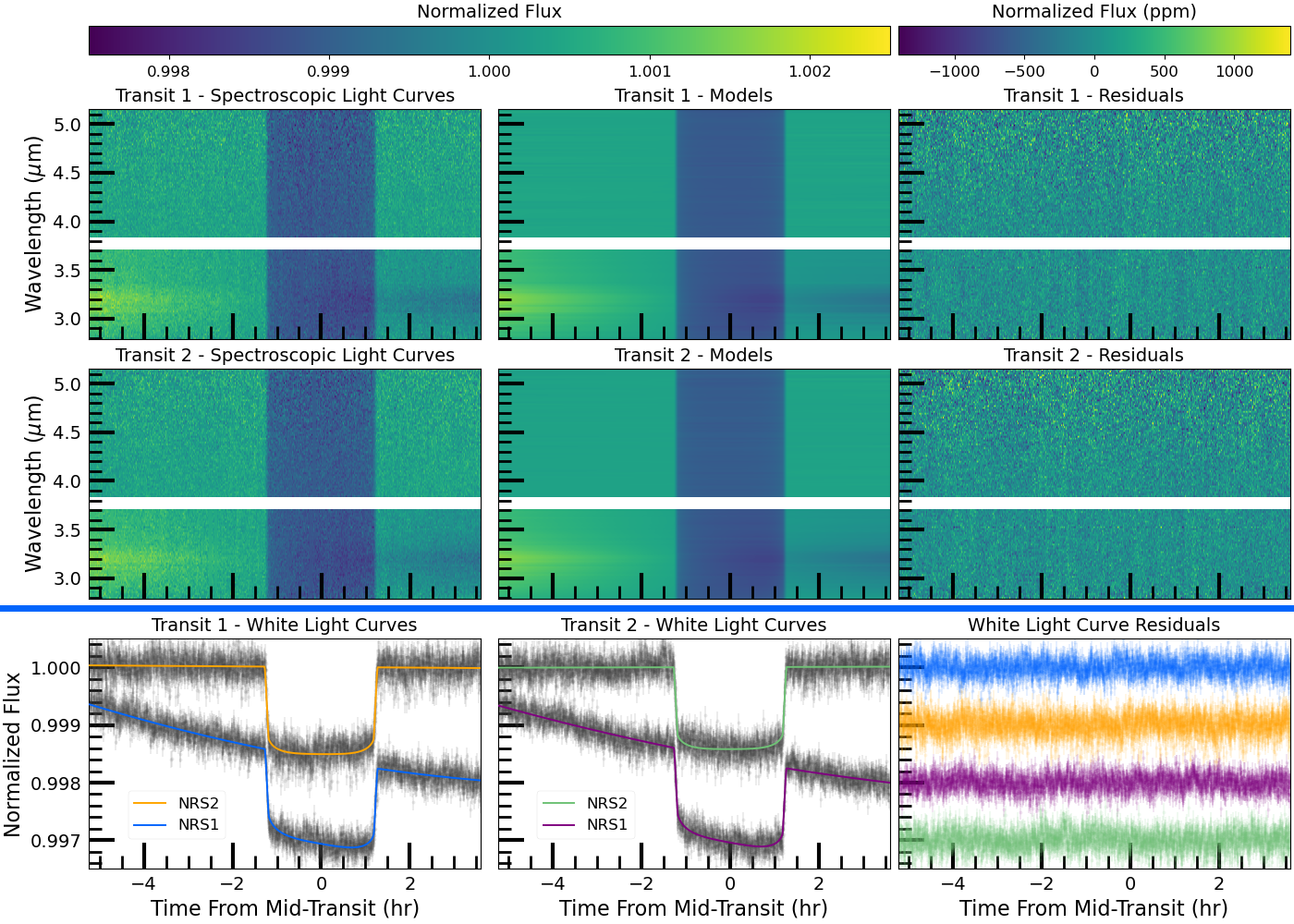
- Acquired 2.8–5.2 μm transmission spectra of GJ 486b using JWST/NIRSpec/G395H during two transits.
- Performed three independent data reductions using Eureka!, FIREFLy, and Tiberius pipelines to ensure consistency and reduce systematic bias.
- Applied superbias detrending in FIREFly and manual offset corrections in Eureka! and Tiberius to correct for detector-level inconsistencies between NRS1 and NRS2.
- Conducted forward modeling with CHIMERA and PICASO to test end-member atmospheric compositions (e.g., H₂O, CO₂, CH₄, Earth-like) against observed spectra.
- Used POSEIDON retrieval framework to compare two competing scenarios: a water-rich atmosphere versus unocculted starspots.
- Evaluated goodness-of-fit using reduced chi-squared (χ²ν) and significance levels (σ) across reductions and models.
Experimental results
Research questions
- RQ1Does the observed spectral deviation in GJ 486b’s transmission spectrum indicate a water-rich atmosphere or stellar contamination?
- RQ2Can unocculted starspots on the M-dwarf host star produce spurious absorption features mimicking a detectable atmospheric signal?
- RQ3How robust are the spectral results across multiple independent data reduction pipelines and detector channels?
- RQ4What is the statistical significance of the spectral deviation from a flat line, and how does it vary across reductions?
- RQ5Can future shorter-wavelength observations break the degeneracy between atmospheric and stellar origin hypotheses?
Key findings
- The observed transmission spectrum deviates from a flat line at 2.2–3.3σ significance across three independent data reductions.
- Both the water-rich atmosphere and unocculted starspot scenarios provide equally good fits to the data, with χ²ν = 1.0 for both models.
- The most stringent constraint from retrieval models indicates H₂O abundance >10% at 2σ confidence if the signal is atmospheric in origin.
- Stellar modeling shows the best fit to the stellar spectrum includes cool starspots and hot faculae, supporting the contamination hypothesis.
- The NRS1 and NRS2 detectors showed consistent transit depths only after applying superbias detrending and manual offsets, resolving instrumental discrepancies.
- The degeneracy between atmospheric and stellar origin cannot be resolved with current data, but shorter-wavelength observations are expected to break it.

Read this paper
Open the full text in the Nubint reader and ask about any passage as you read.
Read this paper on NubintThis review was generated by AI from the original paper. Please check the paper before citing it.