
[Paper Review] Higher-Order Topological Insulators via Momentum-Space Nonsymmorphic Symmetries
This paper proposes a higher-order topological insulator on a momentum-space real projective plane (RP²) Brillouin zone, enabled by Z₂ synthetic gauge fields that induce momentum-space nonsymmorphic (k-NS) symmetries. These symmetries nonlocally quantize bulk and Wannier-sector polarization, leading to a robust isotropic quadrupole phase with corner modes and a bulk gap-closing phase transition, realizable in acoustic, optical, mechanical, and electrical systems.
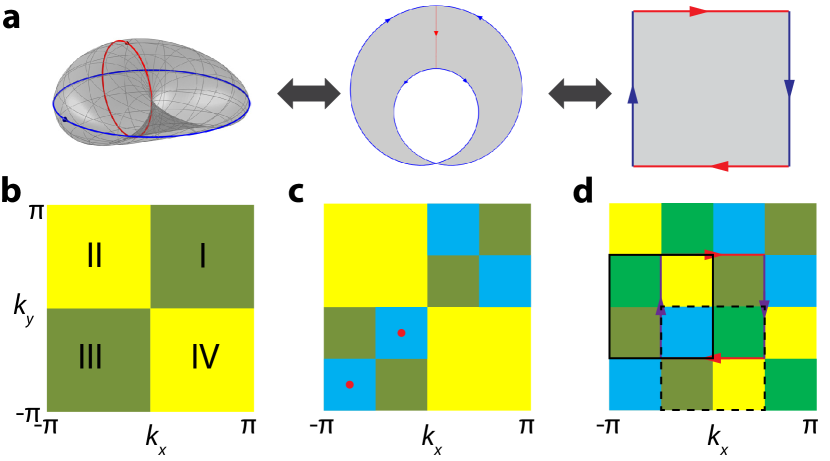
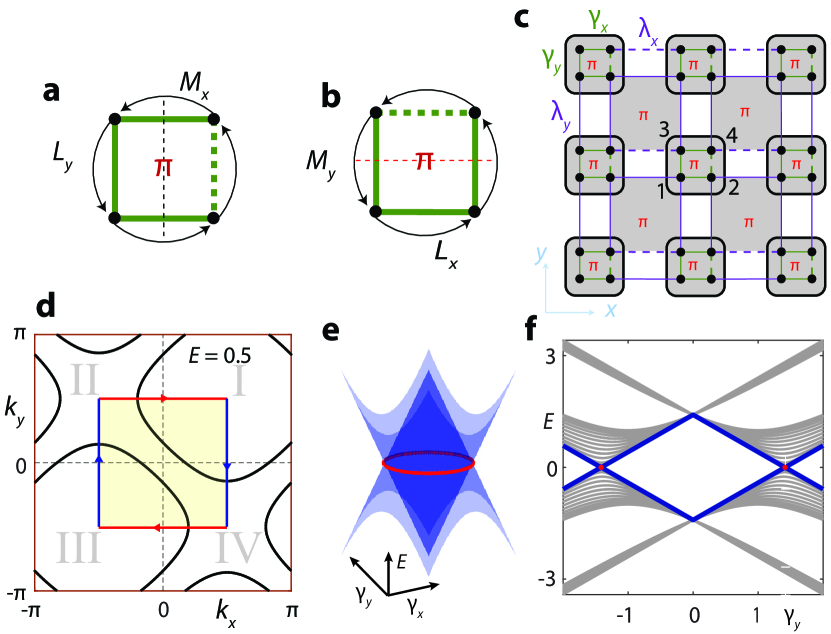
The topology of the Brillouin zone, foundational in topological physics, is always assumed to be a torus. We theoretically report the construction of Brillouin real projective plane ($\mathrm{RP}^2$) and the appearance of quadrupole insulating phase, which are enabled by momentum-space nonsymmorphic symmetries stemming from $\mathbb{Z}_2$ synthetic gauge fields. We show that the momentum-space nonsymmorphic symmetries quantize bulk polarization and Wannier-sector polarization nonlocally across different momenta, resulting in quantized corner charges and an isotropic binary bulk quadrupole phase diagram, where the phase transition is triggered by a bulk energy gap closing. Under open boundary conditions, the nontrivial bulk quadrupole phase manifests either trivial or nontrivial edge polarization, resulting from the violation of momentum-space nonsymmorphic symmetries under lattice termination. We present a concrete design for the $\mathrm{RP}^2$ quadrupole insulator based on acoustic resonator arrays and discuss its feasibility in optics, mechanics, and electrical circuits. Our results show that deforming the Brillouin manifold creates opportunities for realizing high-order band topology.
Motivation & Objective
- To construct a Brillouin real projective plane (RP²) manifold in momentum space, departing from the conventional torus.
- To demonstrate the emergence of a quadrupole insulating phase protected by momentum-space nonsymmorphic (k-NS) symmetries arising from Z₂ synthetic gauge fields.
- To show that k-NS symmetries quantize bulk and Wannier-sector polarization nonlocally across momenta, enabling a robust isotropic quadrupole phase.
- To establish a phase diagram governed by bulk energy gap closing, distinct from Wannier band-closing mechanisms.
- To propose and validate a concrete experimental realization using acoustic resonator arrays and other platforms.
Proposed method
- Utilize Z₂ synthetic gauge fields to projectively modify point-group symmetries into space-group-like nonsymmorphic symmetries in momentum space.
- Implement two k-NS symmetries—mirror reflections Mₓ and Mᵧ, and a π-inversion Pₚ—that partition the original Brillouin torus into equivalent RP² manifolds.
- Define a reduced Brillouin zone using four plaquettes of distinct colors (e.g., red and violet), ensuring topological diagnosis is independent of choice.
- Derive the nonlocal quantization of bulk and Wannier-sector polarization across momenta due to k-NS symmetries, leading to quantized corner charges.
- Construct a binary phase diagram based on bulk energy gap closing, contrasting with Wannier band-closing transitions in conventional quadrupole insulators.
- Design an acoustic resonator array with V-shaped and cross-shaped links to realize positive and negative hoppings, respectively, achieving a large coupling contrast (47 Hz vs. 482.2 Hz) and a 700 Hz bulk band gap.
Experimental results
Research questions
- RQ1Can a higher-order topological insulator be realized on a non-toroidal Brillouin manifold such as RP²?
- RQ2How do momentum-space nonsymmorphic symmetries—induced by synthetic gauge fields—enable nonlocal quantization of polarization and support a robust quadrupole phase?
- RQ3What is the nature of the phase transition in such a system, and how does it differ from Wannier band-closing mechanisms?
- RQ4Why does the bulk-boundary correspondence break down in this system despite a nontrivial bulk quadrupole moment?
- RQ5Can this topological phase be experimentally realized in acoustic, optical, mechanical, or electrical systems?
Key findings
- The momentum-space nonsymmorphic symmetries (k-NS) induced by Z₂ synthetic gauge fields enable the construction of a Brillouin real projective plane (RP²) manifold from the standard torus.
- These k-NS symmetries lead to nonlocal quantization of bulk and Wannier-sector polarization across momenta, resulting in a quantized corner charge of e/4.
- An isotropic binary phase diagram emerges, with phase transitions driven solely by bulk energy gap closing, not Wannier band closing.
- Under open boundary conditions, the nontrivial bulk quadrupole phase can exhibit either trivial or nontrivial edge polarization due to lattice termination breaking k-NS symmetry.
- The acoustic resonator array design realizes a 700 Hz bulk band gap and supports four in-gap corner modes with localized pressure distributions at the corners.
- The same RP² quadrupole insulator can be realized in optical ring resonators, mechanical metamaterials, and electrical circuits, demonstrating broad platform compatibility.
Read this paper
Open the full text in the Nubint reader and ask about any passage as you read.
Read this paper on NubintThis review was generated by AI from the original paper. Please check the paper before citing it.