
[Paper Review] How Can Mixed Reality Benefit From Physiologically-Adaptive Systems? Challenges and Opportunities for Human Factors Applications
This paper proposes that physiologically-adaptive systems—using real-time physiological signals like EEG, EDA, and fNIRS—can enhance Mixed Reality (MR) experiences by enabling biocybernetic control loops that adapt virtual content to users' cognitive and emotional states. By integrating these systems into MR, applications in healthcare, education, and entertainment achieve improved engagement, immersion, and usability, though ethical and privacy challenges around consent, data ownership, and manipulation must be addressed through privacy-by-design principles.
Mixed Reality (MR) allows users to interact with digital objects in a physical environment, but several limitations have hampered widespread adoption. Physiologically adaptive systems detecting user's states can drive interaction and address these limitations. Here, we highlight potential usability and interaction limitations in MR and how physiologically adaptive systems can benefit MR experiences and applications. We specifically address potential applications for human factors and operational settings such as healthcare, education, and entertainment. We further discuss benefits and applications in light of ethical and privacy concerns. The use of physiologically adaptive systems in MR has the potential to revolutionize human-computer interactions and provide users with a more personalized and engaging experience.
Motivation & Objective
- To identify usability and interaction limitations in current Mixed Reality (MR) systems that hinder widespread adoption.
- To investigate how physiologically-adaptive systems—using real-time physiological signals—can address these limitations and enhance user experience.
- To explore practical applications of these systems in human factors domains such as healthcare, education, and entertainment.
- To analyze ethical and privacy challenges related to implicit physiological data collection and system adaptation in MR environments.
- To propose a privacy-by-design framework for responsible implementation of physiologically-adaptive MR systems.
Proposed method
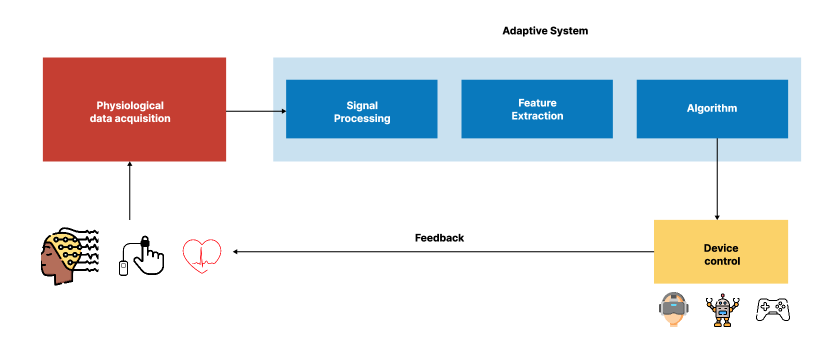
- Employing biocybernetic control loops based on control theory, where physiological signals (e.g., EEG, EDA, fNIRS) are monitored and used to trigger real-time system adaptations.
- Using peripheral and central physiological measures as implicit input to dynamically adjust MR content based on user state (e.g., stress, engagement, cognitive load).
- Designing adaptive MR experiences that shift between physical and virtual reality spectrums to optimize immersion, performance, and engagement.
- Applying a privacy-by-design approach to embed data protection from the outset, including privacy impact assessments and privacy-preserving data collection techniques.
- Conducting domain-specific analysis of MR applications in healthcare (e.g., therapy), education (e.g., cognitive state monitoring), and entertainment (e.g., biofeedback games).
- Evaluating ethical implications through principles of informed consent, user control over state adjustments, and data ownership.

Experimental results
Research questions
- RQ1How can physiologically-adaptive systems improve usability and engagement in Mixed Reality environments?
- RQ2In what ways can real-time physiological feedback be leveraged to optimize MR experiences across healthcare, education, and entertainment?
- RQ3What are the key ethical and privacy challenges associated with using implicit physiological data in adaptive MR systems?
- RQ4How can users retain control over their physiological state adaptation in MR interactions?
- RQ5What design strategies can ensure responsible and transparent use of psychophysiological data in MR applications?
Key findings
- Physiologically-adaptive systems can significantly enhance user engagement and immersion in MR by dynamically adjusting content based on real-time physiological feedback from EEG, EDA, and fNIRS signals.
- In healthcare, such systems enable personalized therapy by adapting virtual environments to patients’ real-time stress or cognitive load, improving treatment effectiveness.
- In education, monitoring physiological states like frustration or motivation allows for adaptive learning content that supports self-regulation and cognitive processing.
- In entertainment, biofeedback-controlled games can increase engagement by eliciting and responding to physiological responses associated with fear or excitement, even when stimuli are perceived as unpleasant.
- Ethical risks include potential manipulation of emotional states and asymmetries in data control; users must retain the ability to exit adapted states and consent to data use.
- A privacy-by-design approach—incorporating privacy impact assessments and data protection from the start—is essential to ensure user ownership and legal control over psychophysiological data.
Read this paper
Open the full text in the Nubint reader and ask about any passage as you read.
Read this paper on NubintThis review was generated by AI from the original paper. Please check the paper before citing it.