
[Paper Review] How Far Can Camels Go? Exploring the State of Instruction Tuning on Open Resources
The paper systematically evaluates open instruction-tuning datasets across model sizes (6.7B–65B) and base LMs, showing no single dataset is best for all tasks, base model quality is crucial, and their best open model (Tülu) lags behind ChatGPT/GPT-4 on average. They release models, data, and evaluation framework.
In this work we explore recent advances in instruction-tuning language models on a range of open instruction-following datasets. Despite recent claims that open models can be on par with state-of-the-art proprietary models, these claims are often accompanied by limited evaluation, making it difficult to compare models across the board and determine the utility of various resources. We provide a large set of instruction-tuned models from 6.7B to 65B parameters in size, trained on 12 instruction datasets ranging from manually curated (e.g., OpenAssistant) to synthetic and distilled (e.g., Alpaca) and systematically evaluate them on their factual knowledge, reasoning, multilinguality, coding, and open-ended instruction following abilities through a collection of automatic, model-based, and human-based metrics. We further introduce Tülu, our best performing instruction-tuned model suite finetuned on a combination of high-quality open resources. Our experiments show that different instruction-tuning datasets can uncover or enhance specific skills, while no single dataset (or combination) provides the best performance across all evaluations. Interestingly, we find that model and human preference-based evaluations fail to reflect differences in model capabilities exposed by benchmark-based evaluations, suggesting the need for the type of systemic evaluation performed in this work. Our evaluations show that the best model in any given evaluation reaches on average 87% of ChatGPT performance, and 73% of GPT-4 performance, suggesting that further investment in building better base models and instruction-tuning data is required to close the gap. We release our instruction-tuned models, including a fully finetuned 65B Tülu, along with our code, data, and evaluation framework at https://github.com/allenai/open-instruct to facilitate future research.
Motivation & Objective
- Assess how instruction-tuning on open datasets affects various model capabilities (factual knowledge, reasoning, multilinguality, coding, safety, and open-ended instruction following).
- Compare performance across a wide range of base models and instruction datasets to identify strengths/weaknesses of resources commonly used for open instruction tuning.
- Investigate whether model-based vs. benchmark-based evaluations align in revealing model capabilities.
- Propose and evaluate a best-performing open instruction-tuned model suite (Tülu) built from diverse open resources.
Proposed method
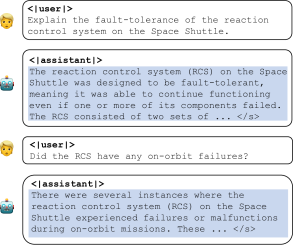
- Unify diverse instruction datasets into a common chatbot-style format to train decoder-only LMs with teacher-forcing and token-level loss masking.
- Train models across base LMs (LLaMa, LLaMa-2, OPT, Pythia) and sizes (6.7B–65B) on 12 instruction datasets spanning manual, synthetic, and distilled sources.
- Create two data mixtures (Human data, and Human+GPT data) to train Tülu models and compare mixtures.
- Evaluate models using a multi-faceted suite including MMLU, GSM, BBH, TyDiQA, Codex-Eval, AlpacaEval, ToxiGen, and TruthfulQA, plus model-based (GPT-4 annotator) and human evaluations.
- Analyze how dataset choice, base model quality, and data mixtures affect performance across tasks and evaluation modalities.
Experimental results
Research questions
- RQ1How do instruction-tuning datasets influence specific model skills (factual knowledge, reasoning, multilinguality, coding) and open-ended instruction following?
- RQ2Does combining diverse datasets yield overall best performance, or do task-specific datasets dominate in certain evaluations?
- RQ3How does base model quality (size and pretraining data) interact with instruction-tuning data to affect performance?
- RQ4How do model-based and human evaluations align with benchmark-based evaluations in reflecting model capabilities?
- RQ5What is the performance gap between open instruction-tuned models and proprietary models (ChatGPT, GPT-4) across evaluation settings?
Key findings
- Different instruction datasets boost different capabilities; no single dataset excels across all tasks.
- Larger base models generally perform better after instruction tuning, and base model quality is a dominant factor.
- A mixture of high-quality open datasets (Tülu) achieves the best average performance across benchmarks, but does not beat ChatGPT or GPT-4 on average in their setup.
- Even a 65B open model finetuned on diverse data falls short of proprietary models, highlighting remaining gaps.
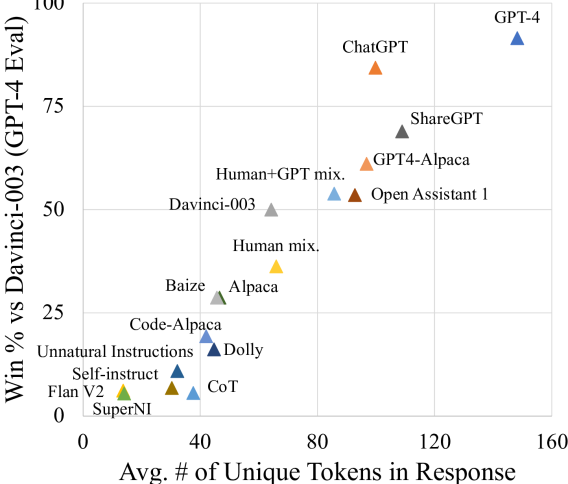
- Model-based preference signals correlate with generation length rather than true capability, suggesting biases in such evaluations.
Read this paper
Open the full text in the Nubint reader and ask about any passage as you read.
Read this paper on NubintThis review was generated by AI from the original paper. Please check the paper before citing it.