
[Paper Review] HuBERT-EE: Early Exiting HuBERT for Efficient Speech Recognition
HuBERT-EE proposes a dynamic early exit mechanism for efficient speech recognition by inserting multiple lightweight branches at intermediate layers of the HuBERT model, enabling early inference when prediction confidence is high. On LibriSpeech, it achieves up to 24% faster inference with under 3% WER degradation, balancing speed and accuracy without retraining.
Pre-training with self-supervised models, such as Hidden-unit BERT (HuBERT) and wav2vec 2.0, has brought significant improvements in automatic speech recognition (ASR). However, these models usually require an expensive computational cost to achieve outstanding performance, slowing down the inference speed. To improve the model efficiency, we introduce an early exit scheme for ASR, namely HuBERT-EE, that allows the model to stop the inference dynamically. In HuBERT-EE, multiple early exit branches are added at the intermediate layers. When the intermediate prediction of the early exit branch is confident, the model stops the inference, and the corresponding result can be returned early. We investigate the proper early exiting criterion and fine-tuning strategy to effectively perform early exiting. Experimental results on the LibriSpeech show that HuBERT-EE can accelerate the inference of the HuBERT while simultaneously balancing the trade-off between the performance and the latency.
Motivation & Objective
- Address the high inference latency of large-scale self-supervised speech models like HuBERT, which limits real-time deployment.
- Overcome the inefficiency of full-model inference in large architectures despite existing efficiency techniques like quantization or distillation.
- Design a novel early exit mechanism tailored for automatic speech recognition (ASR), particularly for CTC-based models, which differ from standard classification tasks.
- Enable dynamic, configurable trade-offs between inference speed and recognition accuracy without retraining the backbone model.
- Optimize the structure and placement of early exit branches to balance performance and computational efficiency in a frame-wise ASR setting.
Proposed method
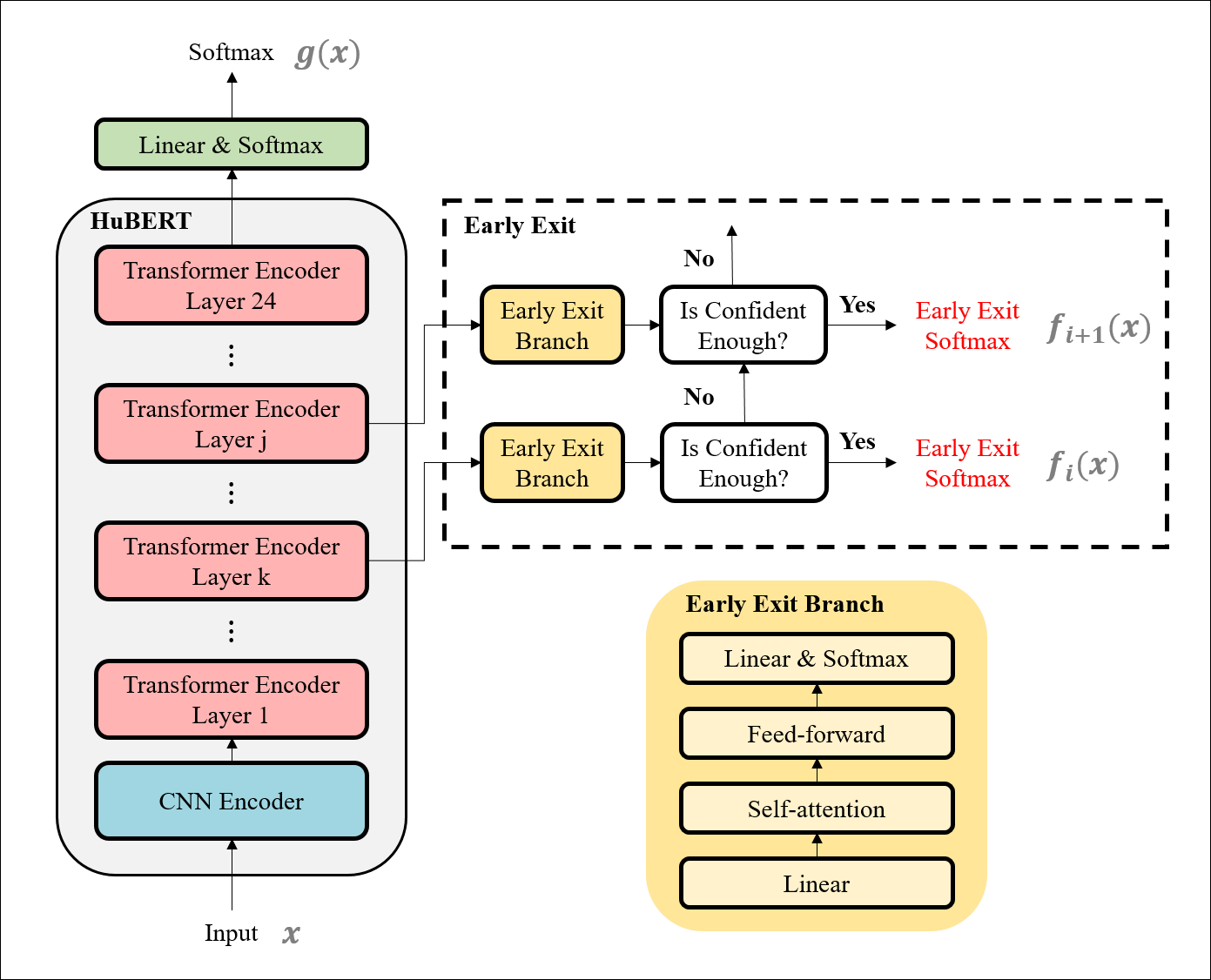
- Introduce multiple early exit branches at intermediate layers (5th, 10th, 15th, 20th) of the HuBERT-large model, each equipped with a self-attention mechanism and a linear projection for prediction.
- Use confidence score and entropy as early exit criteria: exit when confidence > 0.955 or entropy < 0.0035, enabling frame-wise decision-making.
- Train the early exit branches jointly with the backbone via end-to-end fine-tuning, maintaining alignment with the CTC objective for sequence-level ASR.
- Adjust the complexity of early exit branches by varying their self-attention dimension (D_EE = 512, 1024, 2048) to study performance-efficiency trade-offs.
- Apply early exit dynamically during inference: if a branch’s prediction meets the confidence or entropy threshold, the model returns the result early, skipping remaining layers.
- Use the dev-clean and test-clean sets to evaluate the quality-efficiency trade-off across different thresholds and branch configurations.
Experimental results
Research questions
- RQ1Can early exiting be effectively applied to CTC-based automatic speech recognition models, which differ from standard classification tasks?
- RQ2What is the optimal placement and complexity of early exit branches in a deep Transformer-based ASR model like HuBERT?
- RQ3How do confidence and entropy-based exit criteria compare in terms of inference speedup and WER performance on LibriSpeech?
- RQ4To what extent can HuBERT-EE accelerate inference while maintaining competitive WER compared to the full HuBERT-large model?
- RQ5Can the model dynamically adjust the speed-accuracy trade-off without retraining, based on configurable exit thresholds?
Key findings
- HuBERT-EE achieved up to 24% inference speedup on the dev-clean set with only 0.93% WER increase (from 2.02% to 2.95%), demonstrating strong efficiency gains.
- The entropy-based exit criterion (threshold < 0.0035) outperformed the confidence-based one (threshold > 0.955) in most cases, especially on dev-clean and test-clean, yielding faster inference with better WER.
- Early exit branches at deeper layers (e.g., 20th layer) achieved WER comparable to the full HuBERT model (2.02%), while shallower branches had significantly worse performance.
- A self-attention dimension of D_EE = 1024 in early exit branches provided the best quality-efficiency trade-off, while D_EE = 2048 led to worse performance (WER 2.97%) and even negative speedup (-0.24%), indicating diminishing returns.
- The model maintained competitive WER across all datasets, with less than 3% degradation on dev-clean and test-clean, and showed flexibility in adjusting speed and accuracy via threshold tuning.
- The method enables dynamic, runtime-configurable inference speed without retraining, making it suitable for real-world deployment under varying resource constraints.

Read this paper
Open the full text in the Nubint reader and ask about any passage as you read.
Read this paper on NubintThis review was generated by AI from the original paper. Please check the paper before citing it.