
[Paper Review] Hybrid DLT as a data layer for real-time, data-intensive applications
This paper proposes Hybrid DLT, a novel architecture combining private DLTs for real-time data processing with a public DLT-backed Notary for tamper-evident auditability. By storing only ledger digests and consistency proofs on a public blockchain, it ensures data integrity and compliance with GDPR while enabling low-latency, data-intensive collaboration without sacrificing privacy or performance.
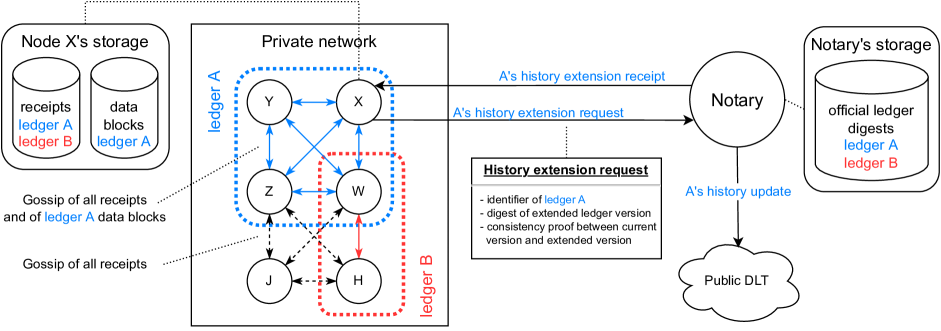
We propose a new approach, termed Hybrid DLT, to address a broad range of industrial use cases where certain properties of both private and public DLTs are valuable, while other properties may be unnecessary or detrimental. The Hybrid DLT approach involves a system where private ledgers, with limited data block dissemination, are collaboratively created by nodes within a private network. The Notary, a publicly auditable authoritative component, maintains a single, official, coherent history for each private ledger without requiring access to data blocks. This is achieved by leveraging a public DLT solution to render the ledger histories tamper-proof, consequently providing tamper-evidence for ledger data disclosed to external actors. We present Traent Hybrid Blockchain, a commercial implementation of the Hybrid DLT approach: a real-time, data-intensive collaboration system for organizations seeking immutable data while also needing to comply with the European General Data Protection Regulation (GDPR).
Motivation & Objective
- To address industrial use cases requiring both data immutability and privacy compliance, particularly under GDPR.
- To overcome limitations of public DLTs (low throughput, high cost) and private DLTs (lack of external auditability and trust)
- To design a system that maintains high performance and data privacy while enabling verifiable, tamper-evident data integrity for external parties.
- To provide a scalable, production-ready solution for real-time, data-intensive applications such as digital clinical trials and product passports.
Proposed method
- Private nodes within a closed network collaboratively maintain private ledgers with limited data dissemination.
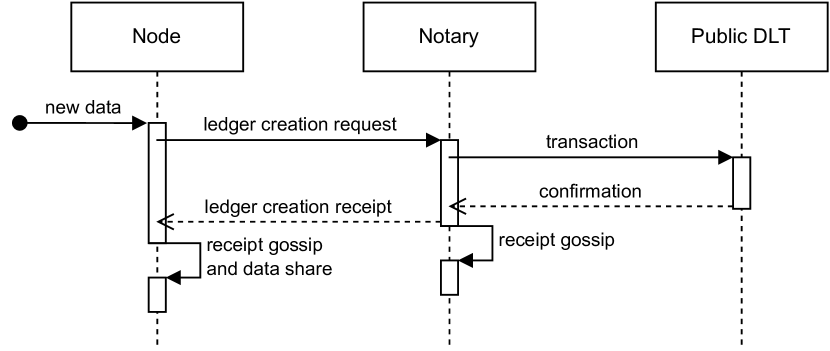
- A Notary component, external to the private network, records digests and consistency proofs of ledger states on a public DLT to ensure tamper-proof history.
- The Notary does not store or access raw ledger data, preserving privacy while enabling public auditability of ledger integrity.
- Consistency proofs are generated and verified to ensure that the official ledger history remains coherent and unaltered.
- The system supports real-time transaction processing by minimizing block delay and enabling immediate notarization of ledger extensions.
- A variation called Delayed Notarization reduces notarization overhead for frequently updated ledgers by batching proofs.
Experimental results
Research questions
- RQ1How can private DLTs be extended to provide external auditability without exposing sensitive data?
- RQ2Can a hybrid architecture balance high performance, data privacy, and verifiable integrity for industrial workloads?
- RQ3How can GDPR-compliant data erasure be achieved while maintaining tamper-evident data history?
- RQ4What is the impact of notarization frequency on system performance and trust in the Notary component?
- RQ5How can consistency proofs be efficiently generated and verified across multiple private ledgers using a single public DLT stream?
Key findings
- The Hybrid DLT architecture enables real-time, data-intensive applications with low-latency transaction processing by allowing immediate block creation for each transaction.
- By storing only digests and consistency proofs on a public DLT, the system achieves tamper-evidence for external parties without exposing raw data.
- The Notary component ensures a single, coherent, and publicly auditable history of each private ledger, even without access to the underlying data blocks.
- The approach supports GDPR compliance through native data erasure capabilities in private data collections, while preserving integrity via cryptographic proofs.
- The system’s design allows nodes to verify the Notary’s internal actions, enabling detection of misbehavior through verifiable proofs.
- A Delayed Notarization variant reduces notarization operations, improving performance for high-frequency update workloads.
Read this paper
Open the full text in the Nubint reader and ask about any passage as you read.
Read this paper on NubintThis review was generated by AI from the original paper. Please check the paper before citing it.