
[Paper Review] Hydrodynamical Evolution of Black-Hole Binaries Embedded in AGN Discs: III. The Effects of Viscosity
This study investigates the hydrodynamical evolution of equal-mass black-hole binaries in active galactic nucleus (AGN) discs, focusing on the effects of viscosity using 2D local shearing box simulations. Viscosity smooths flow structures, enhances accretion rates, and promotes binary hardening by increasing positive torques, especially in prograde configurations, while reducing dependence on accretor size when viscosity or an isothermal-like equation of state is present.
Stellar-mass binary black holes (BBHs) embedded in active galactic nucleus (AGN) discs offer a distinct dynamical channel to produce black hole mergers detected in gravitational waves by LIGO/Virgo. To understand their orbital evolution through interactions with the disc gas, we perform a suite of 2D high-resolution, local shearing box, viscous hydrodynamical simulations of equal-mass binaries. We find that viscosity not only smooths the flow structure around prograde circular binaries, but also greatly raises their accretion rates. The torque associated with accretion may be overwhelmingly positive and dominate over the gravitational torque at a high accretion rate. However, the accreted angular momentum per unit mass decreases with increasing viscosity, making it easier to shrink the binary orbit. In addition, retrograde binaries still experience rapid orbital decay, and prograde eccentric binaries still experience eccentricity damping. Our numerical experiments further show that prograde binaries are more likely to be hardened if the physical sizes of the accretors are sufficiently small such that the accretion rate is reduced. The dependency of the binary accretion rate on the accretor size can be weaken through boosted accretion either due to a high viscosity or a more isothermal-like equation of state (EOS). Our results widen the explored parameter space for the hydrodynamics of embedded BBHs and demonstrate that their orbital evolution in AGN discs is a complex, multifaceted problem.
Motivation & Objective
- To understand how viscosity influences the hydrodynamics and orbital evolution of black-hole binaries embedded in AGN discs.
- To examine whether viscosity reduces the dependency of accretion rates on the physical size of the accretors (sink radius).
- To investigate the role of viscosity in altering torque balance, particularly between gravitational and accretion-driven torques.
- To extend prior inviscid simulations by including viscous stress in a local shearing box framework to better model realistic AGN disc conditions.
- To assess the impact of viscosity on retrograde and eccentric binaries, comparing results with previous inviscid findings.
Proposed method
- Performs 2D high-resolution local shearing box hydrodynamical simulations of equal-mass black-hole binaries in viscous AGN discs.
- Implements a standard $α$-viscosity prescription to model turbulent viscosity in the disc gas.
- Uses absorbing sink particles with variable radii ($r_{\rm s} = 0.02a_{\rm b}, 0.04a_{\rm b}, 0.08a_{\rm b}$) to model accretion onto binary components.
- Resolves flow structures down to $\lesssim 1\%$ of the binary's Hill radius, with finest cells $\lesssim 0.1\%$ of the Hill radius.
- Varies the equation of state (EOS) via the adiabatic index $\gamma$, including nearly isothermal ($\gamma \approx 1$) and non-isothermal ($\gamma > 1$) cases.
- Measures time-averaged binary migration rates $\langle \dot{a}_{\rm b} \rangle / a_{\rm b}$, accretion rates, and torques to quantify orbital evolution.
Experimental results
Research questions
- RQ1How does viscosity alter the flow morphology and accretion structure around prograde, retrograde, and eccentric black-hole binaries in AGN discs?
- RQ2Does viscosity reduce the dependence of accretion rate on the sink radius (i.e., accretor size) of the black holes?
- RQ3What is the net effect of viscosity on the binary orbital evolution—does it promote hardening or expansion?
- RQ4How do accretion-driven torques compare to gravitational torques in viscous discs, and how does this change with viscosity and EOS?
- RQ5To what extent does viscosity influence the spin torque on binary components, particularly in the presence or absence of circum-single discs?
Key findings
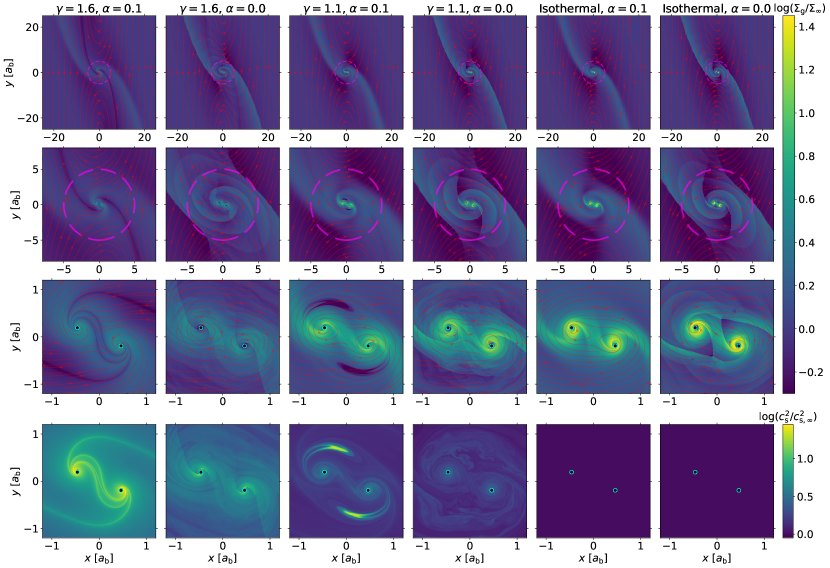
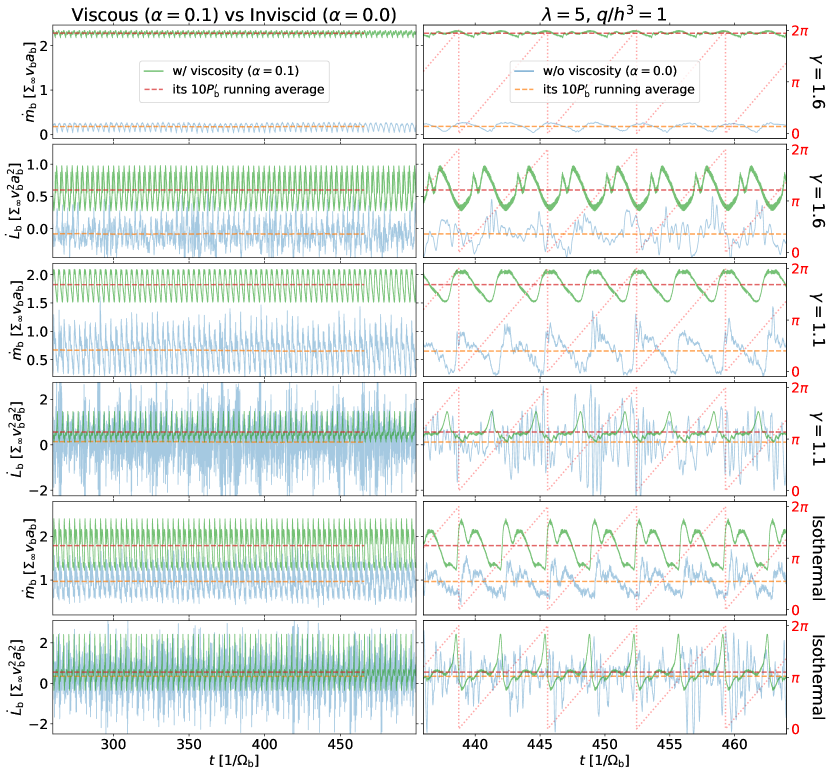
- Viscosity smooths shock structures and reduces the mass of circum-single discs (CSDs), leading to higher accretion rates and stronger total torques on the binary.
- Prograde binaries with non-isothermal equations of state (e.g., $\gamma > 1$) experience orbital decay at rates several times the mass doubling rate, with migration rates decreasing as $\gamma$ increases.
- In viscous discs, accretion-driven torques dominate over gravitational torques at high accretion rates, leading to net hardening for prograde binaries.
- The dependency of accretion rate on sink radius $r_{\rm s}$ is significantly weakened by high viscosity or an isothermal-like EOS, with viscosity-driven accretion being nearly independent of $r_{\rm s}$.
- Retrograde binaries still undergo rapid orbital decay due to strong accretion, despite the absence of CSDs and negligible spin torques.
- Eccentric prograde binaries experience strong eccentricity damping and enhanced accretion, leading to positive torques and orbital expansion, though viscosity reduces the accretion rate dependency on $r_{\rm s}$.
Read this paper
Open the full text in the Nubint reader and ask about any passage as you read.
Read this paper on NubintThis review was generated by AI from the original paper. Please check the paper before citing it.