
[Paper Review] Hyperbolic Contrastive Learning
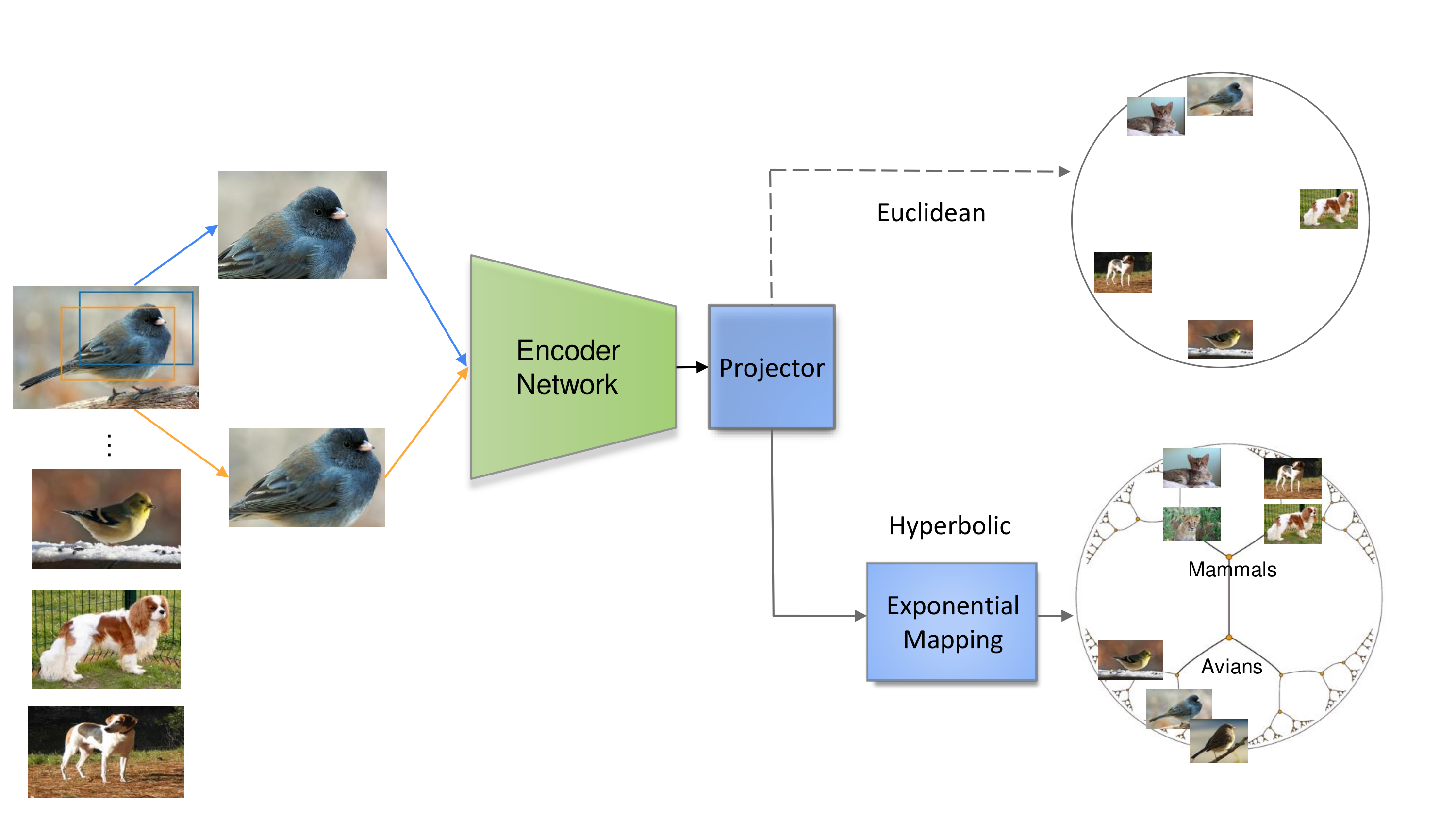
This paper proposes Hyperbolic Contrastive Learning (HCL), a novel self-supervised contrastive learning framework that projects image embeddings into hyperbolic space to better capture hierarchical data structures. By leveraging the Poincaré model for gradient-based optimization, HCL achieves improved downstream classification accuracy and enhanced adversarial robustness compared to Euclidean contrastive learning, with a 29.94% robust accuracy on CIFAR-10 under $υ_{\infty}$ attacks.
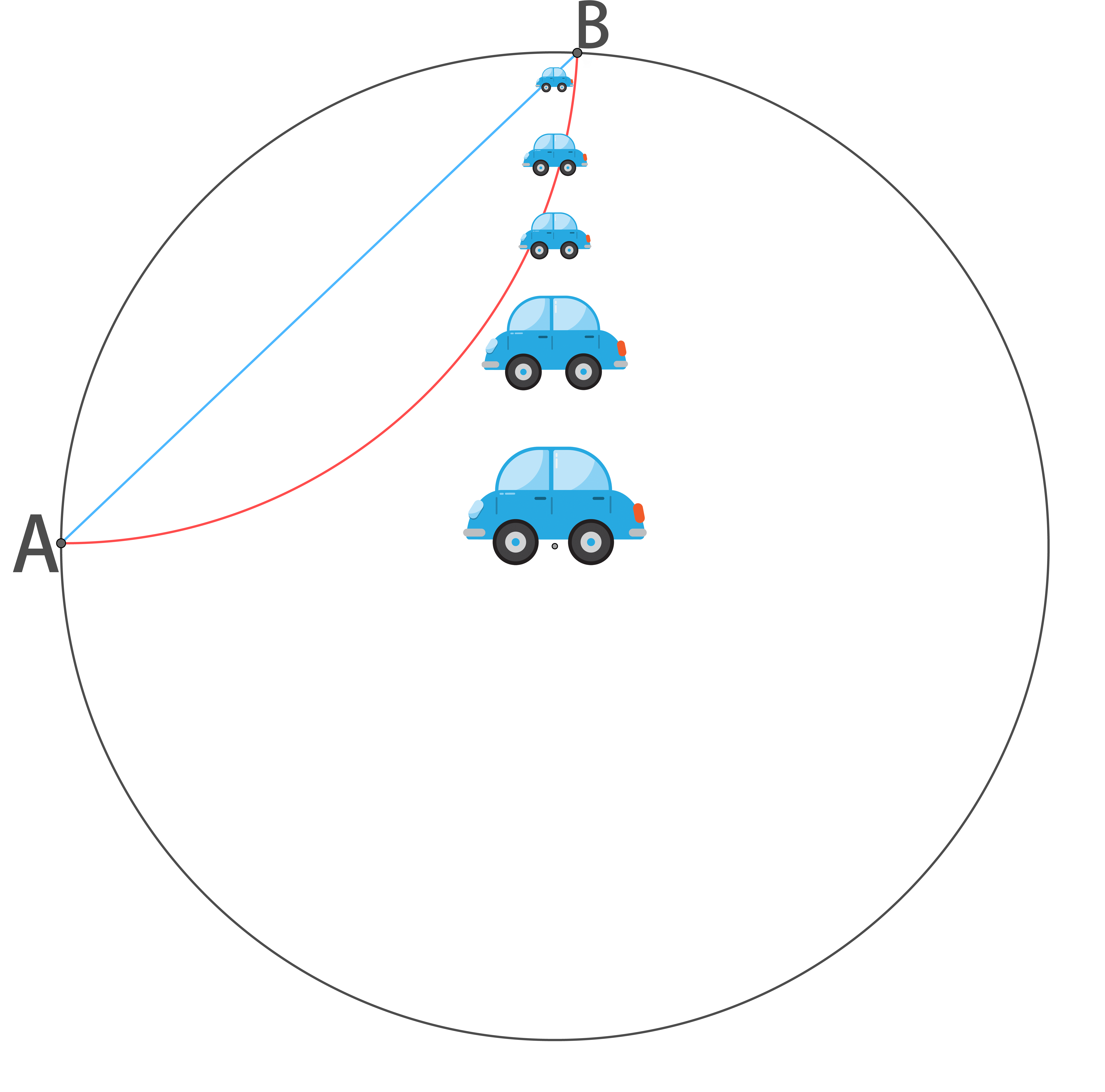
Learning good image representations that are beneficial to downstream tasks is a challenging task in computer vision. As such, a wide variety of self-supervised learning approaches have been proposed. Among them, contrastive learning has shown competitive performance on several benchmark datasets. The embeddings of contrastive learning are arranged on a hypersphere that results in using the inner (dot) product as a distance measurement in Euclidean space. However, the underlying structure of many scientific fields like social networks, brain imaging, and computer graphics data exhibit highly non-Euclidean latent geometry. We propose a novel contrastive learning framework to learn semantic relationships in the hyperbolic space. Hyperbolic space is a continuous version of trees that naturally owns the ability to model hierarchical structures and is thus beneficial for efficient contrastive representation learning. We also extend the proposed Hyperbolic Contrastive Learning (HCL) to the supervised domain and studied the adversarial robustness of HCL. The comprehensive experiments show that our proposed method achieves better results on self-supervised pretraining, supervised classification, and higher robust accuracy than baseline methods.
Motivation & Objective
- To address the limitation of Euclidean space in modeling hierarchical data structures common in vision, such as social networks and brain imaging.
- To explore whether hyperbolic space can enhance contrastive representation learning by exploiting its exponential volume growth and tree-like geometry.
- To develop a robust self-supervised pretraining method that generalizes well under adversarial attacks.
- To extend HCL to supervised and adversarial robustness settings, demonstrating its superiority in downstream tasks.
Proposed method
- Projects image embeddings into hyperbolic space using the Poincaré ball model, which supports efficient gradient-based optimization.
- Replaces the Euclidean dot product similarity with hyperbolic distance-based contrastive loss to better model hierarchical relationships.
- Introduces Supervised Hyperbolic Contrastive Learning (SHCL) by adapting the contrastive objective to supervised settings with class-level supervision.
- Proposes Robust Hyperbolic Contrastive Learning (RHCL) by combining HCL with adversarial training to improve robustness against $υ_{\infty}$ attacks.
- Employs curvature adjustment and normalization layers to stabilize training and improve representation quality in hyperbolic space.
- Uses standard data augmentations (e.g., crop, color jitter) and InfoNCE loss adapted to hyperbolic geometry for self-supervised pretraining.
Experimental results
Research questions
- RQ1Can hyperbolic space improve the representation learning of contrastive self-supervised models by capturing hierarchical data structures more effectively than Euclidean space?
- RQ2How does the curvature of hyperbolic space affect the performance of contrastive learning in image representation learning?
- RQ3Does hyperbolic contrastive learning generalize better to downstream classification tasks compared to standard Euclidean contrastive learning?
- RQ4Can hyperbolic contrastive learning be extended to supervised and adversarial robustness settings with improved performance?
- RQ5Is hyperbolic space more robust to adversarial attacks than Euclidean space in self-supervised representation learning?
Key findings
- HCL achieves 87.98% linear evaluation accuracy on CIFAR-10 with curvature $c = 0.6$, outperforming other curvature settings.
- Normalization before Poincaré projection is critical, as removing it reduces CIFAR-10 accuracy from 87.98% to 85.37%.
- RHCL achieves 29.94% robust accuracy on CIFAR-10 under $υ_{\infty}$ white-box attacks, surpassing SimCLR and RoCL.
- RHCL with adversarial fine-tuning (RHCL+AT) reaches 32.61% robust accuracy, demonstrating further improvement through joint self-supervision and adversarial training.
- SHCL achieves better performance than standard supervised contrastive learning on multiple benchmark datasets, indicating the benefit of hyperbolic geometry in supervised settings.
- The proposed HCL framework shows consistent gains in both self-supervised and supervised pretraining, confirming the superiority of hyperbolic space for hierarchical visual representation learning.
Read this paper
Open the full text in the Nubint reader and ask about any passage as you read.
Read this paper on NubintThis review was generated by AI from the original paper. Please check the paper before citing it.