
[Paper Review] I Spy a Metaphor: Large Language Models and Diffusion Models Co-Create Visual Metaphors
This paper proposes a collaborative framework where Large Language Models (LLMs) and diffusion models co-create visual metaphors by using Chain-of-Thought prompting to generate detailed visual elaborations of linguistic metaphors, which are then used as inputs to text-to-image diffusion models. The key contribution is a high-quality, human-verified dataset of 6,476 visual metaphors (HAIVMet), which enables a 23-point accuracy gain in visual entailment tasks when fine-tuning vision-language models.
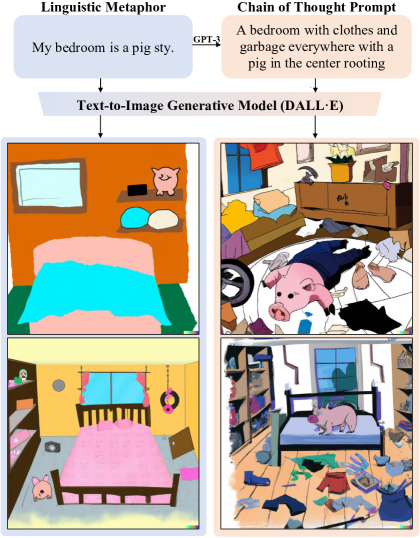
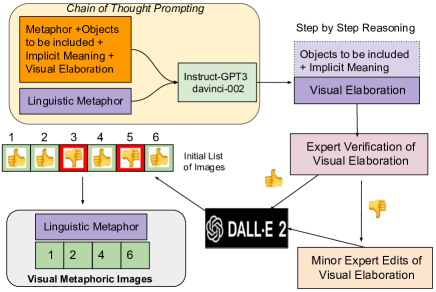
Visual metaphors are powerful rhetorical devices used to persuade or communicate creative ideas through images. Similar to linguistic metaphors, they convey meaning implicitly through symbolism and juxtaposition of the symbols. We propose a new task of generating visual metaphors from linguistic metaphors. This is a challenging task for diffusion-based text-to-image models, such as DALL$\cdot$E 2, since it requires the ability to model implicit meaning and compositionality. We propose to solve the task through the collaboration between Large Language Models (LLMs) and Diffusion Models: Instruct GPT-3 (davinci-002) with Chain-of-Thought prompting generates text that represents a visual elaboration of the linguistic metaphor containing the implicit meaning and relevant objects, which is then used as input to the diffusion-based text-to-image models.Using a human-AI collaboration framework, where humans interact both with the LLM and the top-performing diffusion model, we create a high-quality dataset containing 6,476 visual metaphors for 1,540 linguistic metaphors and their associated visual elaborations. Evaluation by professional illustrators shows the promise of LLM-Diffusion Model collaboration for this task . To evaluate the utility of our Human-AI collaboration framework and the quality of our dataset, we perform both an intrinsic human-based evaluation and an extrinsic evaluation using visual entailment as a downstream task.
Motivation & Objective
- To address the challenge of generating visual metaphors from linguistic metaphors, which requires modeling implicit meaning and compositional structure.
- To improve the performance of diffusion-based text-to-image models in generating figurative, metaphorical imagery beyond literal interpretations.
- To create a high-quality, human-verified dataset of visual metaphors to support future research in visual metaphor generation and vision-language understanding.
- To evaluate the effectiveness of LLM-diffusion collaboration and Human-AI co-creation in generating meaningful, compositionally accurate visual metaphors.
Proposed method
- Using Instruct GPT-3 (davinci-002) with Chain-of-Thought prompting to generate detailed visual elaborations that capture the implicit meaning and key objects of a linguistic metaphor.
- Using the LLM-generated visual elaboration as a prompt for diffusion-based text-to-image models such as DALL·E 2 or Stable Diffusion to generate the final visual metaphor.
- Implementing a Human-AI collaboration framework where human illustrators evaluate and refine outputs from the LLM-diffusion pipeline to ensure quality and accuracy.
- Creating the HAIVMet dataset of 6,476 visual metaphors derived from 1,540 linguistic metaphors, with associated human-verified visual elaborations.
- Evaluating the framework through intrinsic human evaluation by professional illustrators and extrinsic evaluation using a visual entailment downstream task.
- Fine-tuning a vision-language model (OFA-base) on the HAIVMet dataset and comparing performance to fine-tuning on SNLI-VE.
Experimental results
Research questions
- RQ1Can Chain-of-Thought prompting in LLMs significantly improve the quality of visual metaphors generated by diffusion models?
- RQ2How does Human-AI collaboration enhance the compositional accuracy and figurative fidelity of generated visual metaphors?
- RQ3To what extent does fine-tuning on the HAIVMet dataset improve performance on visual entailment tasks compared to standard benchmarks?
- RQ4What are the limitations of current diffusion models in capturing implicit, figurative meaning in visual metaphors?
Key findings
- The LLM-diffusion collaboration framework significantly improves visual metaphor generation quality, with professional illustrators preferring outputs generated from LLM-produced visual elaborations over direct linguistic metaphor prompts.
- DALL·E 2 outperforms Stable Diffusion v2.1 in generating accurate and conceptually coherent visual metaphors when prompted with LLM-generated elaborations.
- Fine-tuning a vision-language model on the HAIVMet dataset leads to a ~23-point improvement in visual entailment accuracy compared to fine-tuning on SNLI-VE alone.
- The HAIVMet dataset demonstrates strong compositional generalization, successfully capturing complex metaphors such as 'Love is a crocodile in the river of desire' through integrated visual elements.
- Human-AI collaboration is essential for maintaining high-quality outputs, as it addresses under-specification and attribute-object binding issues in text-to-image generation.
Read this paper
Open the full text in the Nubint reader and ask about any passage as you read.
Read this paper on NubintThis review was generated by AI from the original paper. Please check the paper before citing it.