
[Paper Review] Identifying the body force from partial observations of a 2D incompressible velocity field
This paper presents a rigorous algorithm that reconstructs a steady, divergence-free body force in 2D incompressible Navier-Stokes flows from partial, sparse velocity observations—using a continuous data assimilation framework with exponential error decay. The method achieves machine-precision convergence in turbulent flows with less than 10% of the full flow’s observational modes, proving convergence for state-independent, external forces.
Using limited observations of the velocity field of the two-dimensional Navier-Stokes equations, we successfully reconstruct the steady body force that drives the flow. The number of observed data points is less than 10\% of the number of modes that describes the full flow field, indicating that the method introduced here is capable of identifying complicated forcing mechanisms from a relatively small collection of observations. In addition to demonstrating the efficacy of this method on turbulent flow data generated by simulations of the two-dimensional Navier-Stokes equations, we also rigorously justify convergence of the derived algorithm. Beyond the practical applicability of such an algorithm, the reliance of this method on the dynamical evolution of the system yields physical insight into the turbulent cascade.
Motivation & Objective
- To address the inverse problem of identifying an unknown, steady, external body force from limited observations of a 2D incompressible flow.
- To develop a mathematically rigorous algorithm that ensures exponential convergence of state and model error to the true solution.
- To demonstrate the method’s efficacy in turbulent regimes using high-resolution numerical simulations of the 2D Navier-Stokes equations.
- To provide theoretical justification for the convergence of the algorithm under realistic observational conditions, including low observation density.
- To extend the applicability of continuous data assimilation beyond state estimation to force identification in fluid dynamics.
Proposed method
- Employs the Azouani-Olson-Titi (AOT) continuous data assimilation (CDA) framework, which combines a dynamic PDE model with partial observations via feedback control.
- Uses a feedback term proportional to the difference between observed and modeled velocity fields, localized via a projection operator $ I_h $, to enforce error decay.
- Applies Grönwall’s inequality to the state error $ extbf{w}^k = extbf{v}^k - extbf{u} $ to derive exponential decay bounds under specific conditions on the assimilation parameter $ u $, $ \mu $, and mesh size $ h $.
- Imposes constraints on $ \mu $ and $ h $ such that $ \mu h^2 \leq \overline{c}_0 $ and $ \mu \geq \underline{c}_0 \nu (\sigma_1 + G) G^2 $, ensuring stability and convergence.
- Relies on energy estimates and inequalities (Hölder, Ladyzhenskaya, Cauchy-Schwarz) to bound nonlinear and forcing terms in the error equation.
- Uses the fact that the true force is divergence-free and state-independent, allowing the algorithm to treat the force as a constant parameter to be recovered.
Experimental results
Research questions
- RQ1Can a steady, external body force in 2D incompressible Navier-Stokes flows be accurately reconstructed from partial, sparse velocity observations?
- RQ2Does the continuous data assimilation algorithm with feedback control achieve exponential convergence of the state and force estimates to the true values?
- RQ3How few observations are required to achieve machine-precision reconstruction of the forcing in turbulent flows?
- RQ4What theoretical conditions on the assimilation parameters $ \mu $, $ h $, and $ \nu $ ensure the convergence of the algorithm?
- RQ5Can the method provide physical insight into the turbulent energy cascade through its reliance on dynamical evolution and error decay?
Key findings
- The algorithm achieves exponential convergence of both state and model error to the true values when observations are made across all directly-forced scales.
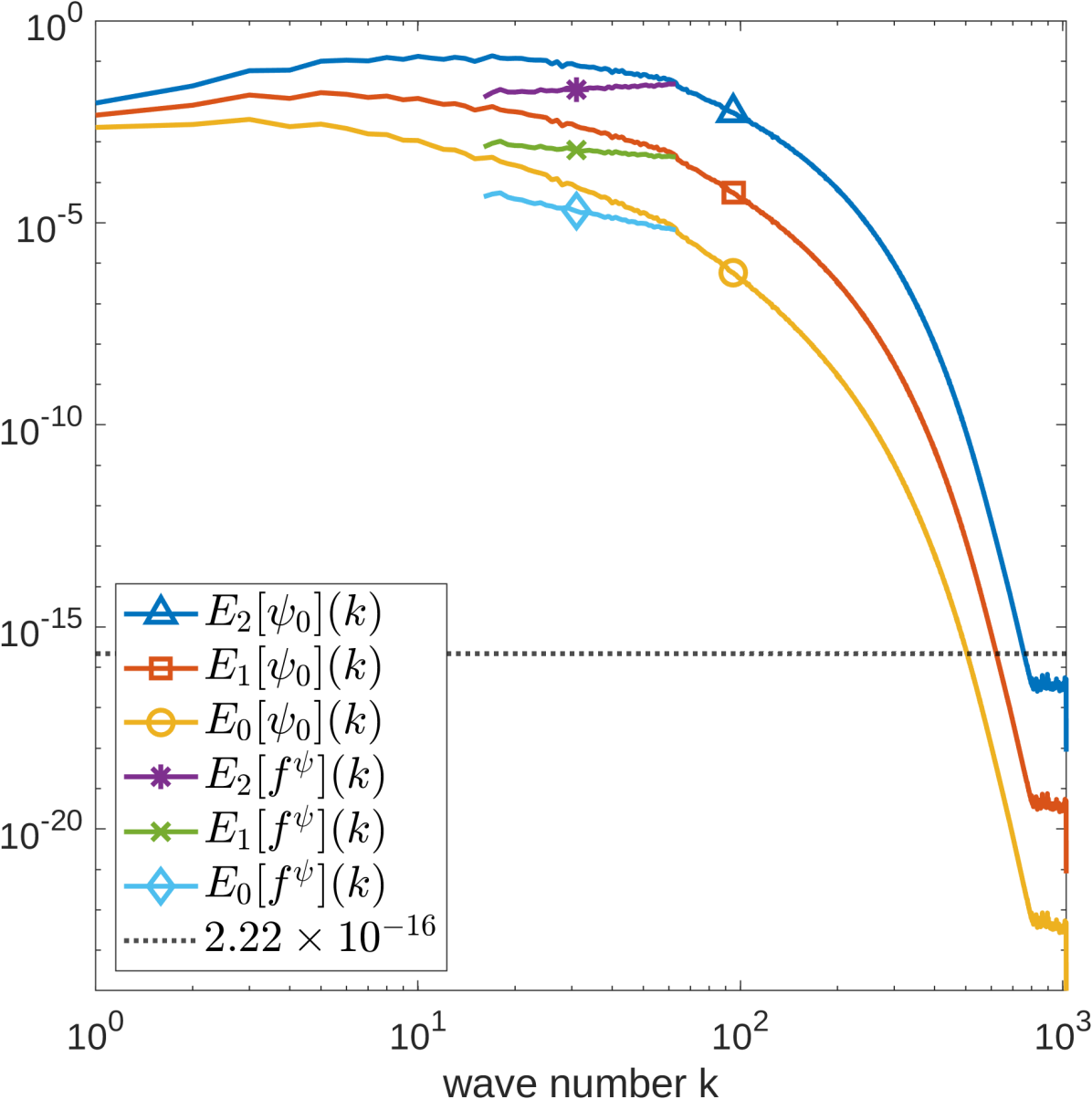
- Reconstruction is effective even with fewer than 10% of the total flow modes observed, demonstrating high efficiency in data-scarce settings.
- The method rigorously proves convergence for non-potential, state-independent body forces in the 2D Navier-Stokes equations with periodic boundary conditions.
- The state error $ \|\mathbf{w}^k\|_2 $ decays exponentially due to Grönwall’s inequality, under the condition $ \mu \geq \underline{c}_0 \nu (\sigma_1 + G) G^2 $ and $ \mu h^2 \leq \overline{c}_0 $.
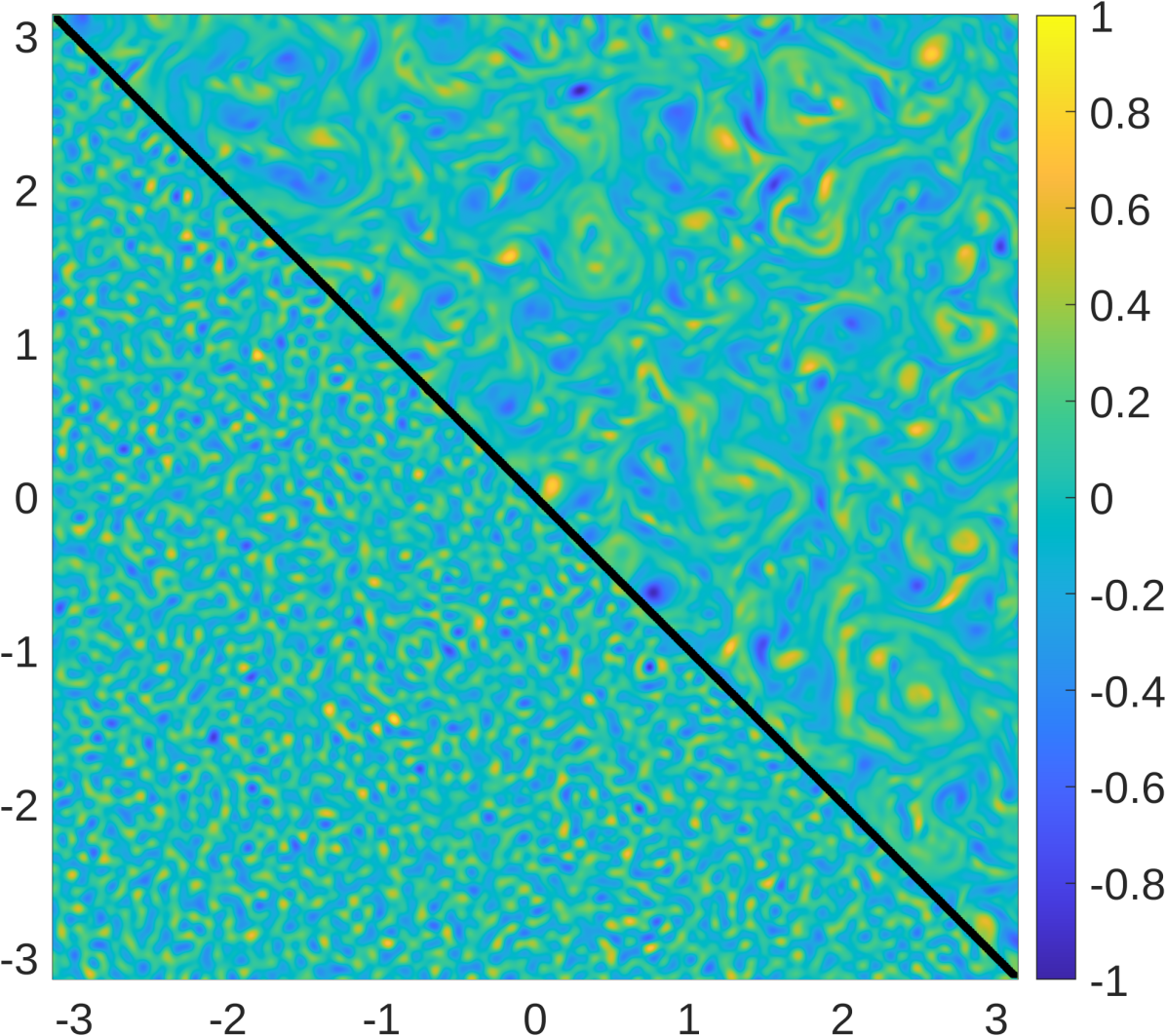
- Numerical simulations confirm that the method converges to the true forcing with machine precision in turbulent regimes, even when the forcing is unknown and randomized at low modes.
- The theoretical framework justifies the observed numerical behavior, linking error decay to the dynamical evolution and the structure of the forcing.
Read this paper
Open the full text in the Nubint reader and ask about any passage as you read.
Read this paper on NubintThis review was generated by AI from the original paper. Please check the paper before citing it.