
[Paper Review] Image Restoration for Under-Display Camera
This paper introduces the Under-Display Camera (UDC) as a novel image restoration problem caused by optical degradation from placing a camera beneath a display. It proposes a hybrid approach combining a model-based deconvolution pipeline (Wiener filter) and a learning-based method using synthetic data, achieving real-time, high-quality image restoration and demonstrating significant improvement in downstream tasks like face detection.
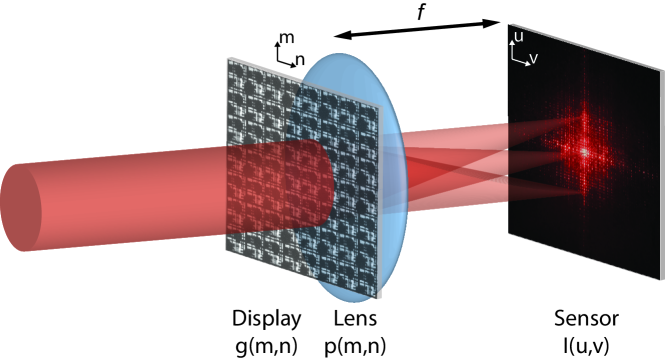
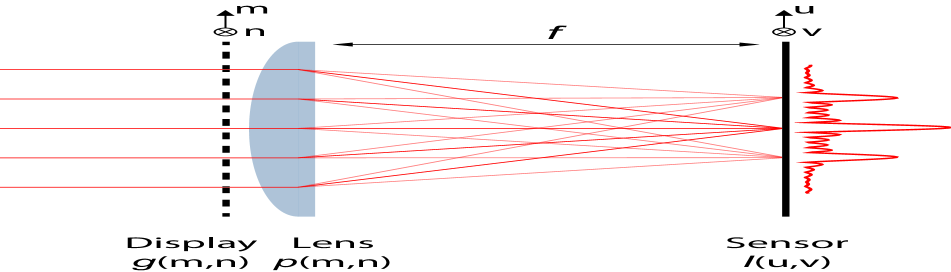
The new trend of full-screen devices encourages us to position a camera behind a screen. Removing the bezel and centralizing the camera under the screen brings larger display-to-body ratio and enhances eye contact in video chat, but also causes image degradation. In this paper, we focus on a newly-defined Under-Display Camera (UDC), as a novel real-world single image restoration problem. First, we take a 4k Transparent OLED (T-OLED) and a phone Pentile OLED (P-OLED) and analyze their optical systems to understand the degradation. Second, we design a Monitor-Camera Imaging System (MCIS) for easier real pair data acquisition, and a model-based data synthesizing pipeline to generate Point Spread Function (PSF) and UDC data only from display pattern and camera measurements. Finally, we resolve the complicated degradation using deconvolution-based pipeline and learning-based methods. Our model demonstrates a real-time high-quality restoration. The presented methods and results reveal the promising research values and directions of UDC.
Motivation & Objective
- To define and analyze the Under-Display Camera (UDC) system as a new real-world image restoration problem caused by optical degradation from display integration.
- To develop a Monitor-Camera Imaging System (MCIS) for acquiring real paired data and a model-based pipeline to synthesize realistic Point Spread Function (PSF) and UDC image data from display patterns and camera measurements.
- To address the complex, combined degradation in UDC images—such as blur, noise, and color shift—using both deconvolution-based and learning-based restoration methods.
- To evaluate the restoration performance on real-world tasks, including face detection, and release the first public UDC dataset for future research.
Proposed method
- Design and implement a Monitor-Camera Imaging System (MCIS) to capture real paired data of images captured under T-OLED and P-OLED displays.
- Develop a model-based data synthesizing pipeline that generates PSF and degraded UDC images using only display patterns and camera measurements, enabling large-scale synthetic data generation.
- Apply a deconvolution-based Wiener filter pipeline (DeP) to restore images by inverting the PSF, leveraging the system’s optical model.
- Train a U-Net-based deep learning model on the synthetic data to perform end-to-end image restoration, improving fidelity and visual quality.
- Use 16-bit raw sensor data for training and evaluation to preserve dynamic range and enable high-fidelity restoration.
- Address periodic banding artifacts in real data caused by imperfect display-lens alignment, acknowledging it as a minor gap in synthesis that may require future refinement.
Experimental results
Research questions
- RQ1How does the optical system of an Under-Display Camera (UDC) degrade image quality, and what are the dominant degradation factors such as blur, noise, and color shift?
- RQ2Can a model-based data synthesis pipeline accurately generate realistic PSFs and degraded UDC images from display patterns and camera measurements alone?
- RQ3How effective is a hybrid restoration approach combining deconvolution (Wiener filter) and deep learning on synthetic data for real-world UDC image restoration?
- RQ4To what extent does image restoration improve downstream vision tasks like face detection in UDC systems?
- RQ5What are the limitations of current data synthesis in replicating subtle real-world artifacts like periodic banding from display grating effects?
Key findings
- The Wiener filter-based deconvolution pipeline (DeP) achieves basic image restoration, demonstrating the feasibility of model-based approaches for UDC degradation.
- The learning-based model trained on synthetic data achieves high-quality restoration, indicating strong generalization capability despite the synthetic-train/real-test gap.
- Face detection recall rates improved significantly after restoration: from 8% (T-OLED) and 0% (P-OLED) to 56% and 39%, respectively, showing practical impact on downstream tasks.
- Synthetic data closely matches real data in visual characteristics, with perceptual similarity confirmed in qualitative comparisons.
- A minor but visible artifact—periodic bands from the T-OLED’s pixel structure—was observed in real data but not in synthetic data, highlighting a gap in current synthesis accuracy.
- The proposed MCIS system successfully enabled real paired data acquisition, and the first public UDC dataset is released to support future research.
Read this paper
Open the full text in the Nubint reader and ask about any passage as you read.
Read this paper on NubintThis review was generated by AI from the original paper. Please check the paper before citing it.