
[Paper Review] Implications of distance duality violation for the $H_0$ tension and evolving dark energy
The paper tests phenomenological violations of the distance duality relation (DDR) to address the H0 tension and the evidence for evolving dark energy. It finds two DDR-violating toy models can reconcile SNIa and BAO calibrations, with Bayesian evidence slightly favoring a redshift-dependent DDR plus phantom dark energy.
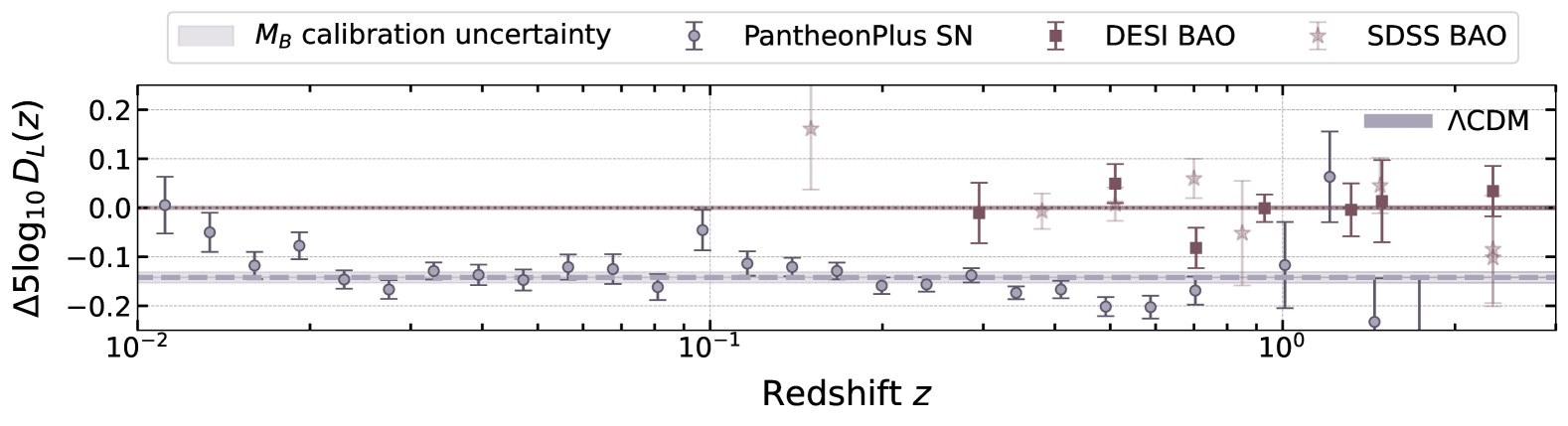
We investigate whether a violation of the distance duality relation (DDR), $D_L(z) = (1+z)^2 D_A(z)$, connecting the angular diameter and luminosity distances, can explain the Hubble tension and alter the evidence for dynamical dark energy in recent cosmological observations. We constrain five phenomenological parameterisations of DDR violation using Baryon Acoustic Oscillation measurements from the DESI survey calibrated with the sound horizon derived from extit{Planck} Cosmic Microwave Background data and the Pantheon+ Type Ia supernova (SNIa) catalogue calibrated with the supernova absolute magnitude from S$H_0$ES. We find that two toy models can resolve the tension: a constant offset in the DDR (equivalent to a shift in the calibration of the SNIa data), $D_L(z)/D_A(z)\simeq 0.925(1+z)^2$, which leaves the hint for evolving dark energy unaffected; or a change in the power-law redshift-dependence of the DDR, restricted to $z\lesssim 1$, $D_L(z)/D_A(z)\simeq(1+z)^{1.866}$, together with a {\it constant} phantom dark energy equation of state $w\sim -1.155$. The Bayesian evidence slightly favours the latter model. Our phenomenological approach motivates the investigation of physical models of DDR violation as a novel way to explain the Hubble tension.
Motivation & Objective
- Assess whether simple DDR violation parameterisations can reduce or remove the calibration tension between SNIa and BAO.
- Test whether DDR violation shows redshift evolution and is favored by data.
- Evaluate how DDR violation affects the evidence for dynamical dark energy vs. a cosmological constant.
- Compare multiple phenomenological DDR models and identify which are most supported by current data.
Proposed method
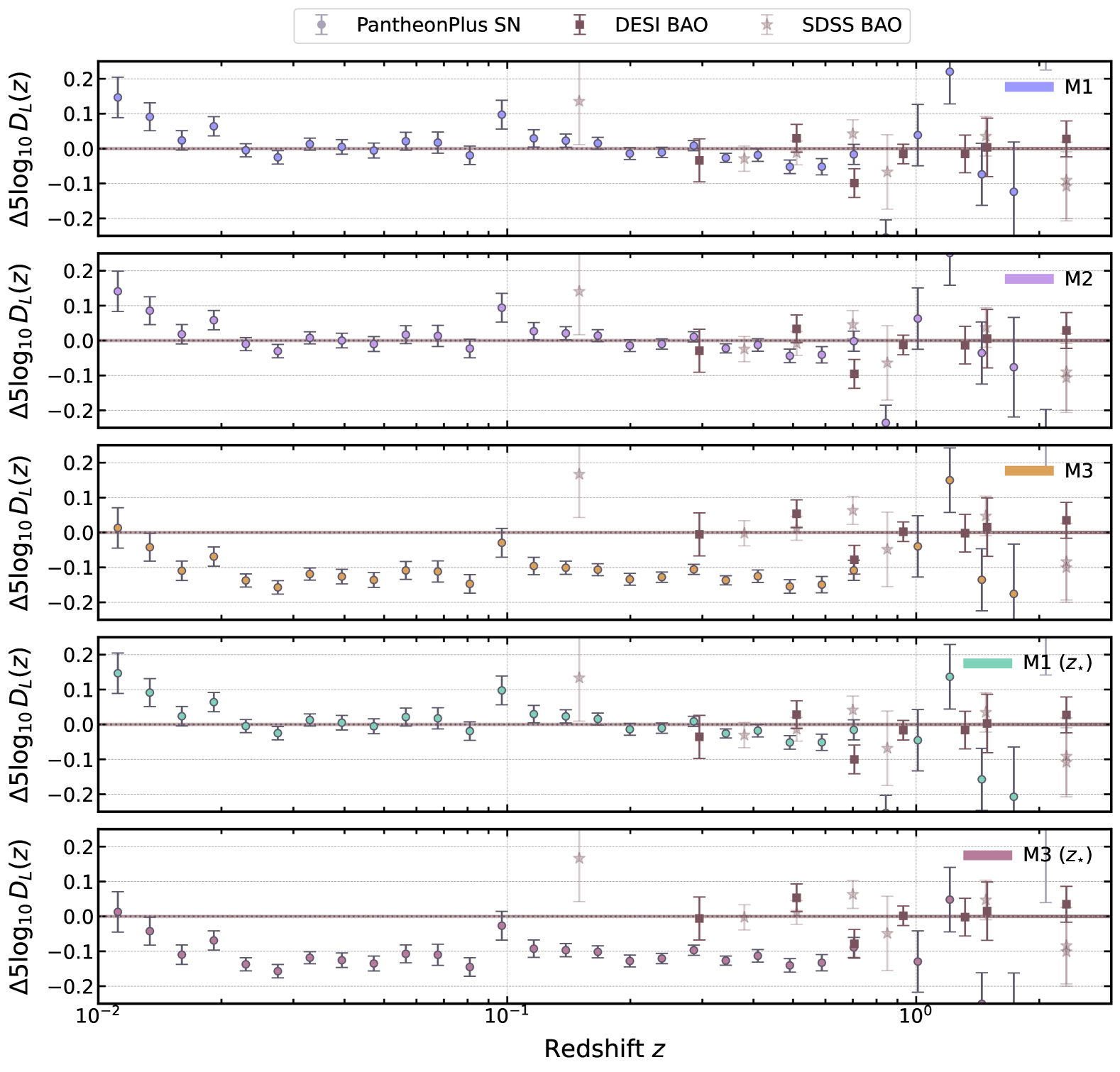
- Parameterise DDR violation with eta(z) functions M1, M2, M3 and redshift-dependent variants M1(z*) and M3(z*).
- Modify the luminosity distance in CLASS-DDR to include DDR parameters and compare to data via a DDR-specific likelihood.
- Use Bayesian inference with MontePython + MultiNest to obtain parameter posteriors and Bayesian evidences.
- Data: Planck 2018 CMB, DESI BAO, PantheonPlus SNIa, and SH0ES prior on M_B / H0.
- Consider both flat LCDM and w0-wa CPL dynamical dark energy backgrounds.
- Adopt flat priors on cosmological and DDR parameters as specified in the study.
Experimental results
Research questions
- RQ1Can simple phenomenological DDR violations reduce the calibration tension between SNIa and BAO?
- RQ2Is there evidence that DDR violation evolves with redshift?
- RQ3Does introducing DDR violation alter the preference for dynamical dark energy over a cosmological constant?
Key findings
- DDR-violating models can resolve the SNIa-BAO calibration tension. One option is a constant DDR offset (approximately D_L/D_A ≃ 0.925(1+z)^2).
- Another favored option is a redshift-dependent DDR with z* ≈ 0.9, D_L/D_A ≃ (1+z)^{1.866} for z ≲ 1, together with a phantom EoS w ≈ -1.155.
- Bayesian evidence prefers the evolving DDR scenario (M3(z*)) slightly over the constant offset model.
- Across models, the DDR parameter α0 is detected at roughly 3–5σ, with values around -0.05 to -0.075 depending on the model.
- When SH0ES prior is omitted, the DDR-violating models generally reduce or remove the H0-calibration tension; the level of residual tension varies by model.
- In the LCDM+η(z) analysis, some models still yield a compensated H0 and r_s consistent with Planck, while others align more with SH0ES calibrations.
Read this paper
Open the full text in the Nubint reader and ask about any passage as you read.
Read this paper on NubintThis review was generated by AI from the original paper. Please check the paper before citing it.