
[Paper Review] Improving End-to-End Speech Recognition with Policy Learning
This paper proposes a multi-objective training approach that combines maximum likelihood (CTC) with policy gradient learning via self-critical sequence training (SCST) to directly optimize for word error rate (WER) in end-to-end speech recognition. The method improves relative performance by 4% to 13% over CTC-only training, achieving 5.53% WER on Wall Street Journal and 5.42% on Librispeech test-clean.
Connectionist temporal classification (CTC) is widely used for maximum likelihood learning in end-to-end speech recognition models. However, there is usually a disparity between the negative maximum likelihood and the performance metric used in speech recognition, e.g., word error rate (WER). This results in a mismatch between the objective function and metric during training. We show that the above problem can be mitigated by jointly training with maximum likelihood and policy gradient. In particular, with policy learning we are able to directly optimize on the (otherwise non-differentiable) performance metric. We show that joint training improves relative performance by 4% to 13% for our end-to-end model as compared to the same model learned through maximum likelihood. The model achieves 5.53% WER on Wall Street Journal dataset, and 5.42% and 14.70% on Librispeech test-clean and test-other set, respectively.
Motivation & Objective
- Address the mismatch between the maximum likelihood objective (used in training) and the actual performance metric (WER) in end-to-end speech recognition.
- Overcome the challenge of optimizing non-differentiable metrics like WER by leveraging reinforcement learning techniques.
- Develop an efficient joint training strategy that combines CTC and policy gradient to improve final recognition accuracy.
- Demonstrate that direct optimization on WER through policy learning leads to consistent performance gains without requiring additional training data.
Proposed method
- Use connectionist temporal classification (CTC) as the primary maximum likelihood objective for sequence labeling in end-to-end ASR.
- Introduce a policy gradient objective based on self-critical sequence training (SCST), which estimates gradients using the expected reward difference between the model's own hypothesis and a greedy reference.
- Formulate a multi-objective loss combining CTC loss and the negative expected WER from SCST, enabling joint optimization.
- Apply the REINFORCE algorithm with a single sample approximation to estimate policy gradients efficiently, reducing computational cost.
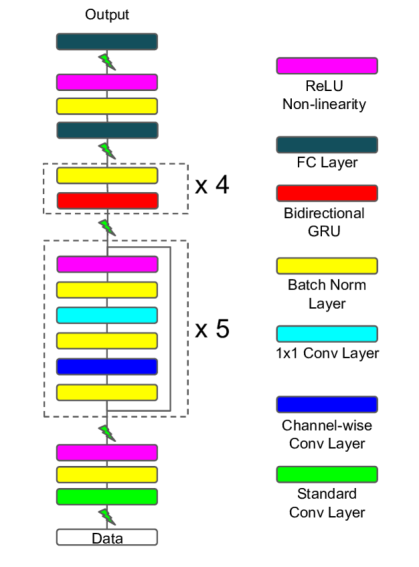
- Implement residual connections and depth-wise separable convolutions in the frontend for efficient feature extraction.
- Use scheduled sampling and curriculum learning, gradually increasing the policy learning weight (λ) from 0.1 to 1.0 as training progresses.
Experimental results
Research questions
- RQ1Can policy gradient learning effectively optimize non-differentiable metrics like WER in end-to-end speech recognition?
- RQ2Does joint training with CTC and policy gradient lead to measurable improvements in WER over standard CTC training?
- RQ3How efficient is the proposed method in terms of training cost, especially when using single-sample approximations for policy gradients?
- RQ4Can the model generalize better when trained on larger datasets, and does policy learning amplify this generalization?
Key findings
- Joint training with CTC and policy gradient via SCST reduced WER by 13.8% relative on the WSJ eval92 set compared to the CTC-only baseline.
- On Librispeech, the method achieved a 4% relative improvement in WER over the baseline, reaching 5.42% on test-clean and 14.70% on test-other.
- The model achieved 5.53% WER on the Wall Street Journal dataset, outperforming prior end-to-end models without additional data.
- The Librispeech model fine-tuned on WSJ outperformed the model trained directly on WSJ, indicating improved generalization due to policy learning.
- The method achieved competitive results with state-of-the-art models like Amodei et al. [6], even without using more training data.
- The use of single-sample approximation in policy gradient estimation proved effective and efficient, enabling practical joint training.
Read this paper
Open the full text in the Nubint reader and ask about any passage as you read.
Read this paper on NubintThis review was generated by AI from the original paper. Please check the paper before citing it.