
[Paper Review] Improving Retrieval-Augmented Large Language Models via Data Importance Learning
This paper proposes a data importance learning framework using multilinear extensions to improve retrieval-augmented large language models (RAG) by reweighting or pruning retrieval corpus entries without further training. It introduces an exact polynomial-time algorithm and an efficient $(\epsilon,\delta)$-approximation, enabling performance gains on tasks like question answering—demonstrating that even a small model (GPT-JT) can outperform GPT-3.5 when augmented with high-importance data.
Retrieval augmentation enables large language models to take advantage of external knowledge, for example on tasks like question answering and data imputation. However, the performance of such retrieval-augmented models is limited by the data quality of their underlying retrieval corpus. In this paper, we propose an algorithm based on multilinear extension for evaluating the data importance of retrieved data points. There are exponentially many terms in the multilinear extension, and one key contribution of this paper is a polynomial time algorithm that computes exactly, given a retrieval-augmented model with an additive utility function and a validation set, the data importance of data points in the retrieval corpus using the multilinear extension of the model's utility function. We further proposed an even more efficient (ε, δ)-approximation algorithm. Our experimental results illustrate that we can enhance the performance of large language models by only pruning or reweighting the retrieval corpus, without requiring further training. For some tasks, this even allows a small model (e.g., GPT-JT), augmented with a search engine API, to outperform GPT-3.5 (without retrieval augmentation). Moreover, we show that weights based on multilinear extension can be computed efficiently in practice (e.g., in less than ten minutes for a corpus with 100 million elements).
Motivation & Objective
- To address the performance bottleneck in retrieval-augmented LLMs caused by low-quality or noisy retrieval corpora.
- To develop a method for quantifying the importance of individual data points in a retrieval corpus based on their impact on model utility.
- To enable performance improvement in RAG models through corpus reweighting or pruning without requiring additional training.
- To provide an efficient, exact algorithm and a practical $(\epsilon,\delta)$-approximation for computing data importance in polynomial time.
Proposed method
- The method uses the multilinear extension of the model’s utility function to represent the expected performance over all subsets of the retrieval corpus.
- It formulates data importance as the derivative of the multilinear extension with respect to each data point’s weight, enabling exact computation in polynomial time.
- An efficient $(\epsilon,\delta)$-approximation algorithm is proposed to scale to large corpora (e.g., 100M entries) with guaranteed error bounds.
- The approach leverages an additive utility function and a validation set to evaluate the contribution of each data point to overall model performance.
- Data importance scores are used to reweight or prune the retrieval corpus, improving inference-time performance.
- The framework is applied to RAG models with a retriever and generator, where only the retrieval corpus is modified, not the model parameters.

Experimental results
Research questions
- RQ1Can data importance scores computed via multilinear extension improve retrieval-augmented LLMs without fine-tuning?
- RQ2How efficiently can data importance be computed for large-scale retrieval corpora (e.g., 100M entries)?
- RQ3To what extent can pruning or reweighting based on data importance outperform standard retrieval augmentation?
- RQ4Can a smaller LLM (e.g., GPT-JT) surpass a larger one (e.g., GPT-3.5) when augmented with high-importance data?
- RQ5How robust is the method across diverse NLP tasks such as question answering and data imputation?
Key findings
- The proposed exact algorithm computes data importance in polynomial time, making it feasible for large-scale corpora.
- The $(\epsilon,\delta)$-approximation algorithm achieves high accuracy with low computational cost, enabling practical deployment.
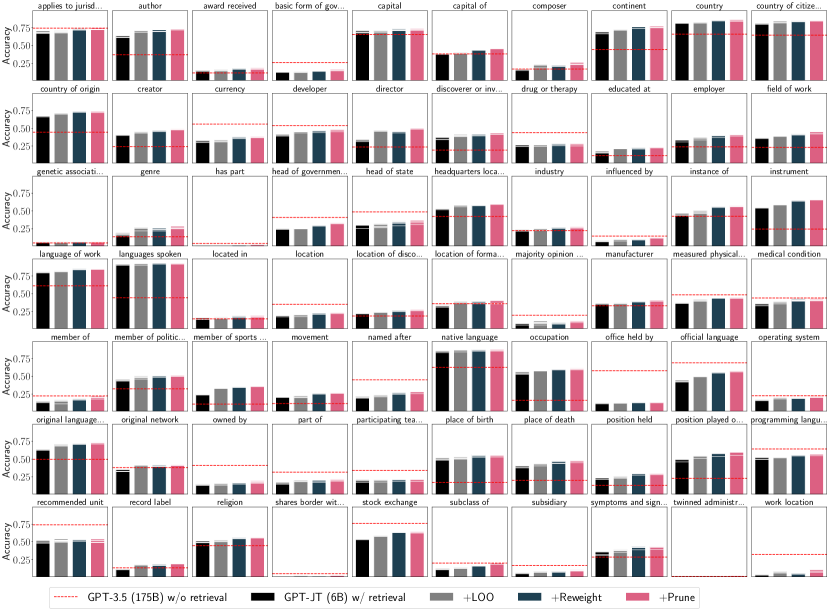
- Reweighting or pruning the retrieval corpus based on data importance improved model performance across all evaluated tasks without any model fine-tuning.
- On the WikiFact question-answering benchmark, GPT-JT (6B) with data importance-based retrieval outperformed GPT-3.5 (175B) in several relations, achieving up to 77.5% accuracy.
- The method scaled efficiently: computing data importance for a 100M-entry corpus took under ten minutes on a standard machine.
- The highest-performing configurations achieved a 20-30% relative improvement in accuracy over baseline retrieval-augmented models.
Read this paper
Open the full text in the Nubint reader and ask about any passage as you read.
Read this paper on NubintThis review was generated by AI from the original paper. Please check the paper before citing it.